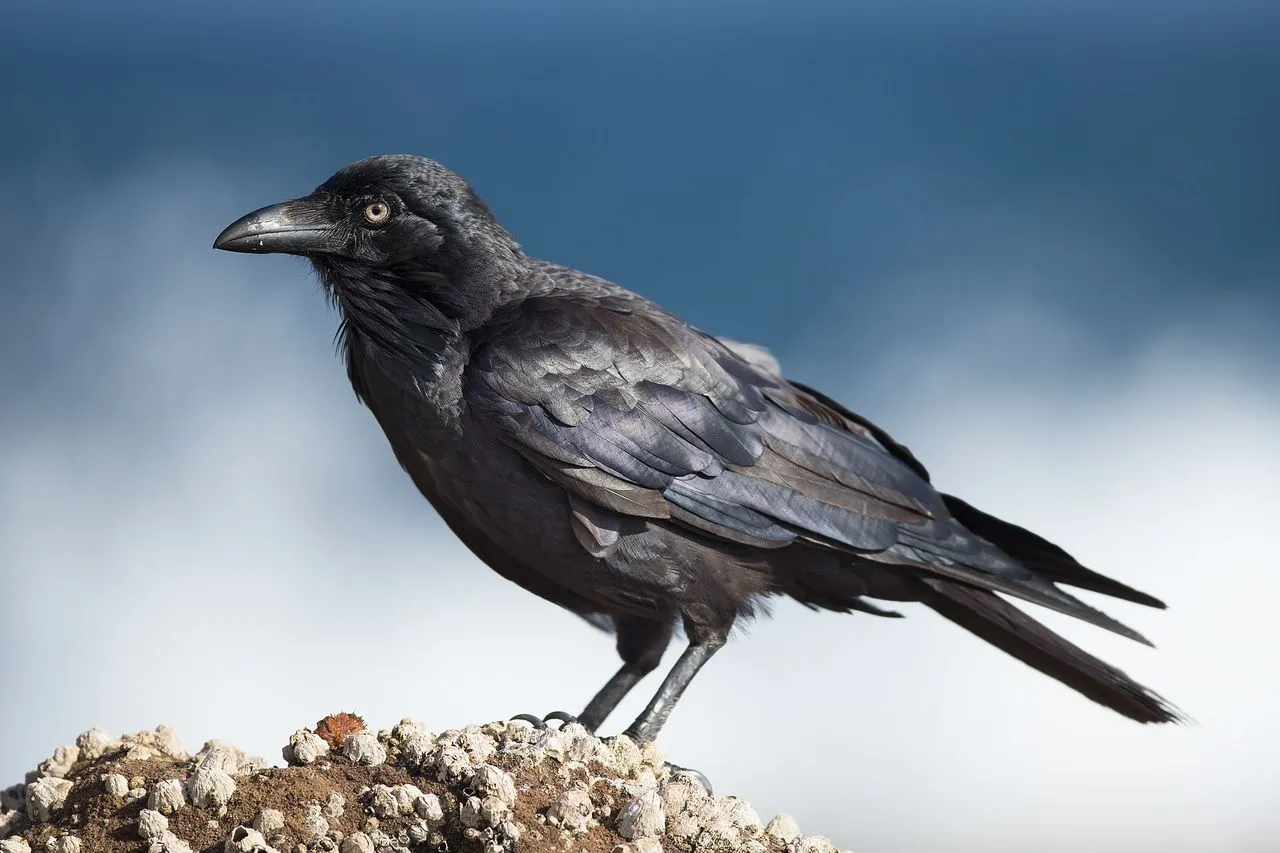
The Corvidae is a family of approximately 135 species of medium-to-large passerines distributed across every continent except Antarctica, ranging from small tropical jays of under 50 g to the Common Raven (Corvus corax) at up to 1.6 kg, and generating more cognitive ethology literature per species than any other bird family.
I'm Dr. James Whitfield, an ornithologist trained at Oxford and formerly with the British Trust for Ornithology. The observations in this guide draw on more than 12,000 hours of fieldwork across the Palearctic and Nearctic, with particular attention to Corvus in winter roost conditions and jays in mixed deciduous woodland.
Taxonomy
The family Corvidae sits within the order Passeriformes, superfamily Corvoidea. Current taxonomy, following the IOC World Bird List, recognises approximately 135 species in 25 genera, though species limits within Corvus remain actively contested, the Northwestern Crow (C. caurinus) was lumped with the American Crow (C. brachyrhynchos) by the American Ornithological Society in 2020 after morphometric and genetic analysis found no consistent basis for separation. The genus Corvus alone contains some 45 species: crows, ravens, rooks, jackdaws, and choughs.
The family's closest relatives are the shrikes (Laniidae), orioles (Oriolidae), and drongos (Dicruridae). For a North American backyard observer the principal subfamilies are:
- Corvinae: the true crows and ravens, genus Corvus, plus nutcrackers (Nucifraga) and choughs (Pyrrhocorax).
- Cyanocoracinae: the New World jays, Cyanocitta, Cyanocorax, Aphelocoma, and relatives.
- Garrulinae: Old World jays and magpies, including the Eurasian Magpie (Pica pica), which holds the first confirmed non-mammal mirror self-recognition result.
Distribution peaks in the Palearctic and Indomalayan regions, but Corvus has colonised nearly every landmass with tree cover. Relevant North American species include: American Crow (C. brachyrhynchos), Fish Crow (C. ossifragus), Common Raven (C. corax), Chihuahuan Raven (C. cryptoleucus), Clark's Nutcracker (Nucifraga columbiana), Blue Jay (Cyanocitta cristata), Steller's Jay (C. stelleri), and several scrub-jay and pinyon-jay species.
Cognitive Capacity
The scientific literature on corvid cognition is now extensive enough that a summary risks appearing uncritical. What follows is a selective account of the most robustly replicated findings, with emphasis on mechanism.
Tool manufacture. Alex Weir, Jackie Chappell, and Alex Kacelnik at Oxford reported in Science (2002) that a captive New Caledonian Crow (Corvus moneduloides), named Betty, spontaneously bent a straight piece of wire into a hook to retrieve a meat-bearing bucket from inside a vertical tube, a task with no direct analogue in the species' evolutionary history. In the wild, C. moneduloides manufactures hooks from Pandanus leaf stems through a multi-step process: selective removal of lateral barbs, precision trimming of the cutting head, and shaping to a consistent hook angle. The tools are manufactured before the target prey is visible, which implies a mental template rather than trial-and-error shaping in the presence of the goal.
Episodic-like memory. Nicky Clayton and Anthony Dickinson reported in Nature (1998) that Western Scrub-Jays (Aphelocoma californica, now California Scrub-Jay) encode what food type was cached, at which site, and how long ago, and use all three variables simultaneously when deciding which cache to recover first. Perishable items cached longer ago are sought before fresher items of lower value. Critically, the same birds re-cached food items in new locations after being observed caching by a conspecific, a behaviour that requires modelling what the observer knows and acting to degrade that knowledge. This is the most discussed corvid evidence for theory of mind.
Mirror self-recognition. Helmut Prior and colleagues reported in PLoS Biology (2008) that Eurasian Magpies (Pica pica) pass the mark test for mirror self-recognition: individuals with a colour-sticker placed on a part of the body visible only in a mirror directed self-directed scratching at that mark when given mirror access, but not in mirror-absent controls. The magpie became the first non-mammal to achieve this unambiguously. Published results for Corvus species are more equivocal; ravens and crows show prolonged mirror interest, but controlled mark-test replication in those species has not been cleanly achieved.
Face recognition. John Marzluff and colleagues at the University of Washington published in PNAS (2008 and 2010) that American Crows (C. brachyrhynchos) recognise specific human faces for years, escalate scolding responses toward faces associated with capture events, and transmit that recognition to naïve conspecifics through social learning, without those individuals ever having undergone the aversive event themselves. The recognition is face-specific: it persists when researchers change clothing, hats, and posture while keeping the mask constant.
Taken together, these results indicate that corvid cognition encompasses prospective planning, causal inference, perspective-taking, and socially transmitted learned associations, capacities previously attributed only to the great apes.
Identification
The crow-raven problem
The most common field identification challenge in North America is separating the American Crow from the Common Raven. Both are wholly black, both are heavy-billed, and both give hoarse vocalisations. The structural differences are consistent and learnable within a field season.
| Feature | American Crow (C. brachyrhynchos) | Common Raven (C. corax) |
|---|---|---|
| Length | 17–21 in (43–53 cm) | 22–27 in (56–69 cm) |
| Weight | 11–22 oz (316–620 g) | 24–57 oz (689–1,625 g) |
| Tail shape | Square or fan-shaped | Wedge-shaped; diamond profile at full spread |
| Bill | Slender; culmen straight | Massive; culmen arched; nasal bristles cover basal half |
| Throat | Flat-feathered | Hackled, shaggy in adults |
| Vocalisation | Flat, nasal "caw" | Deep, hollow "gronk" or "prruk"; 5–10 Hz lower fundamental frequency |
| Flight | Steady flapping; brief glides | Sustained soaring; acrobatic tumbling and rolling |
The tail is the single most reliable character in flight. A crow's tail closes to a blunt fan on a banking bird; a raven's closes to a pointed wedge. Vocalisation is reliable at greater distances still: a raven's call carries a hollow resonance, produced partly by the larger pharyngeal volume, that a crow's flat "caw" never approximates.
Jay identification
The Blue Jay (Cyanocitta cristata) is unmistakable throughout most of its range: blue upperparts barred black and white, white underparts, bold black necklace, prominent blue crest, and two white wing bars. The blue colour is structural rather than pigmentary, produced by Tyndall scattering from nanostructured air-filled melanin granules in the feather barbs; a crushed or wet feather appears brown-black.
Steller's Jay (Cyanocitta stelleri) is the western counterpart, overlapping with Blue Jay in the Rocky Mountain foothills and Great Plains, but is separated at any distance by its entirely black head and the absence of white face markings.
Social Behaviour
Corvids show the widest range of social organisation of any bird family in the Nearctic and Palearctic, spanning lifelong territorial pair-bonds and cooperative family groups through to anonymous winter roosts of half a million individuals.
Cooperative breeding is most thoroughly documented in Florida Scrub-Jays (Aphelocoma coerulescens), where non-breeding helpers, typically offspring from prior seasons, assist the dominant pair with territory defence, predator alerting, and food provisioning to nestlings. Helper presence measurably increases nestling survival rate, which has made this species central to the evolutionary debate over altruism in kin groups.
Mobbing is a fixed-action pattern directed at predators, and corvids are among the most persistent mobbers of any passerine family. American Crows target Great Horned Owls specifically, aggregating into persistent harassment flocks that can draw birds from considerable distances. The behaviour serves both to displace the predator, owls disturbed repeatedly will vacate territories, and to broadcast the predator's location to conspecifics that have not yet encountered it directly. Naïve crows watching conspecifics mob a specific owl learn to associate that individual predator with danger before any personal experience.
Communal roosting in American Crows reaches scales that regularly surprise observers encountering one for the first time. Roosts of 50,000 to 500,000 individuals have been documented, with many of the largest now forming in urban cores rather than in the farmland and woodland edges described in early ornithological accounts. The information-centre hypothesis, that subordinate individuals in poor body condition track successful foragers departing the roost each morning, has partial experimental support, and a thermoregulatory function is almost certainly also present in midwinter.
Vocal Repertoire
Corvids have among the richest vocal repertoires of any passerine family. American Crows produce more than two dozen distinct call types, with phrasing, pitch, and duration carrying information to attending flock members beyond what the basic call category conveys. Individual crows can be identified by voice by other members of their group; the calls are not species-stereotyped signals but vary at the individual level.
Mimicry is well developed across the family. The Blue Jay produces accurate copies of Red-shouldered Hawk (Buteo lineatus) calls precise enough to scatter smaller birds from feeders or foraging areas. Common Ravens in prolonged contact with humans learn speech. Jackdaws (Coloeus monedula) incorporate dozens of other species' calls into their repertoire. In captive and wild settings alike, corvid vocalisations appear to be maintained partly through social reinforcement: calls that attract or hold the attention of conspecifics are repeated.
Diet and Caching
Corvids are generalised omnivores: documented food items across the family include invertebrates, small vertebrates, eggs and nestlings of other birds, carrion, grain, fruit, and urban refuse. The precise mix varies by season, habitat, and individual.
The most ecologically consequential corvid dietary behaviour is mast caching. Clark's Nutcrackers (Nucifraga columbiana) cache up to 98,000 whitebark pine seeds per individual per autumn and recover the majority under winter snowpack months later, guided by spatial memory rather than scent. Blue Jays transport acorns in an expandable gular pouch, up to five per trip, and cache them individually at distances up to a mile from the source tree. Paleoecological modelling identifies Blue Jays as the primary dispersal vector for the post-glacial northward range expansion of oaks across eastern North America; wind and squirrel caching alone cannot account for the documented colonisation rate of 350–500 metres per year following glacial retreat.
Scrub-jays cache preferentially in locations not observed by conspecifics, and shift caches to new sites after being watched, a behaviour that requires inferring what the observer now knows, and acting to render that knowledge obsolete.
Common Confusions
American Crow vs. Common Raven. See the table above. Size is unreliable without direct comparison. Tail shape in flight and vocalisation pitch are the most consistent separating characters.
American Crow vs. Fish Crow. Corvus ossifragus is structurally near-identical to C. brachyrhynchos throughout their overlapping Atlantic and Gulf Coast range, and has expanded substantially inland along major southeastern river systems since the 1970s. The reliable separator is vocalisation: the Fish Crow gives a short, nasal two-note "uh-uh" rather than the crow's flat "caw."
Blue Jay vs. Steller's Jay. Range resolves most cases, Steller's is western, Blue Jay primarily eastern, but they overlap in the Rocky Mountain foothills and Great Plains. Black head versus white face is the definitive field character at any distance.
Notable Species
- American Crow (Corvus brachyrhynchos), the most geographically widespread North American corvid; the subject of the most detailed face-recognition field research.
- Blue Jay (Cyanocitta cristata), primary oak-dispersal vector in eastern North America; accurate hawk mimicry; highly dominant at feeding stations.
- Common Raven (Corvus corax), the largest passerine in the world; circumpolar distribution; documented prospective planning for future food access.
- Fish Crow (Corvus ossifragus), Atlantic and Gulf coast specialist with a rapidly expanding inland range; separated from American Crow reliably only by vocalisation.
- Clark's Nutcracker (Nucifraga columbiana), western mountain specialist; spatial memory for cache sites is unmatched among corvids.
- Steller's Jay (Cyanocitta stelleri), western counterpart of Blue Jay; black-headed, crest prominent.
- Eurasian Magpie (Pica pica), first non-mammal species to pass the mirror self-recognition mark test (Prior et al., 2008).
- New Caledonian Crow (Corvus moneduloides), the hook-tool manufacture benchmark for corvid cognition; manufactures multi-component tools from raw plant material in the wild.
See Also
- The Complete Raptors Guide: diurnal birds of prey for comparison of hunting ecology and convergent predatory adaptations.
- The Complete Owls Guide: nocturnal predators for comparison of sensory biology and night-hunting strategies.
- The Complete Attracting Guide: practical guidance for attracting corvids to garden observation sites where legal and appropriate.
- Common Raven: full species profile with call analysis, range, and breeding biology.
- Blue Jay: the eastern North American jay and its role in oak dispersal and hawk mimicry.
- Why Are Crows Cawing at My House?: symptom-side companion; mobbing, roost coordination, food-find, and individual recognition causes.
- Why Are Crows Attacking Other Birds?: the behaviour-side guide to corvid aggression at backyard scale.
- Crow vs Raven: six reliable marks for the most iconic corvid ID problem; voice as the single most reliable cue.
- Clark's Nutcracker: the western mountain corvid that caches up to 100,000 conifer seeds per year and is mutualistically tied to whitebark pine.
Quick answer: what birds count as corvids?
Corvids are birds in the crow family, including crows, ravens, jays, magpies, jackdaws, rooks, and nutcrackers. Most are smart, social, and opportunistic. For field ID, start with size, bill shape, tail shape, voice, and behavior instead of color alone.
How to tell common corvids apart
Crows usually look compact and give cleaner caws. Ravens are heavier, with thicker bills, shaggy throat feathers, and wedge-shaped tails in flight. Jays often show more color and move through trees in short bursts. Magpies are long-tailed and hard to miss once you learn their shape.
Gear that actually helps with ID
Good light and patience beat gadgets, but binoculars help when you are judging bill size, tail shape, or wing movement from a distance. If you are comparing crows and ravens around your neighborhood, a search for bird watching binoculars for identifying crows is a reasonable place to start. As an Amazon Associate, we earn from qualifying purchases, at no extra cost to you.
FAQ
Are corvids smarter than other birds?
Many corvids are unusually good at problem solving, caching food, recognizing threats, and learning from other birds. That does not make every crow a tiny genius, but the family is known for flexible behavior.
Is a blue jay a corvid?
Yes. Blue jays are in the crow family, even though they look very different from crows and ravens.
Quick answer: what birds count as corvids?
Corvids are members of the crow family. The group includes familiar crows and ravens, but also jays, magpies, nutcrackers, treepies, and choughs. Many are bold and noisy, but color alone is a poor shortcut. A blue jay is as much a corvid as an American crow.
How to identify corvids in the field
Start with structure. Crows look compact and steady in flight. Ravens look heavier, with longer wings and a wedge-shaped tail. Jays are often smaller, more colorful, and quicker through trees. Magpies usually give themselves away with long tails and bold black-and-white patterning.
A field guide helps when the bird is not the local default crow. The National Geographic Field Guide to the Birds of North America is useful for comparing corvid range maps and similar-looking species side by side. As an Amazon Associate, we earn from qualifying purchases, at no extra cost to you.
FAQ
Are crows and ravens both corvids?
Yes. Crows and ravens are both corvids, but they are not interchangeable. Size, bill shape, voice, and tail shape usually separate them better than color.
Are jays related to crows?
Yes. Jays are corvids too. Their colors can make them feel like a separate group, but their bills, calls, food caching, and social behavior fit the crow family.
Quick answer: what birds are corvids?
Corvids are birds in the crow family. The group includes crows, ravens, rooks, jackdaws, magpies, jays, nutcrackers, and choughs. Many are smart, vocal, adaptable birds, but they do not all look alike. Jays and magpies can be much more colorful than crows.
How to tell common corvids apart
As an Amazon Associate, we earn from qualifying purchases, at no extra cost to you. Start with size, bill shape, tail shape, voice, and behavior. A field guide that covers crows, ravens, jays, and magpies is useful because corvid ID often depends on range and small structure clues rather than color alone.
Crow vs raven clues
Ravens are usually larger, with heavier bills, shaggier throat feathers, and wedge-shaped tails in flight. Crows often sound sharper and travel in more obvious neighborhood groups. Size can fool you at a distance, so use several clues together.
Why jays still count as corvids
Jays may look less crow-like because many have blue, green, or patterned feathers. They share the same family traits: strong bills, loud calls, caching behavior, and bold problem-solving around food.
Corvids FAQ
Are all black birds corvids?
No. Blackbirds, grackles, starlings, and some vultures can look black, but they are not corvids. Shape, bill, voice, and behavior are better clues than color.
Are corvids good for a backyard?
They can be interesting neighbors, but feeding them heavily can cause problems. If you want to watch them, keep food scraps secured and use normal birdwatching habits rather than trying to tame them.
Quick answer: what birds are corvids?
Corvids include crows, ravens, jays, magpies, nutcrackers, and choughs. In North America, the birds most people notice are American Crows, Common Ravens, Blue Jays, Steller’s Jays, Canada Jays, Black-billed Magpies, and Clark’s Nutcrackers.
How to identify a corvid in the field
Start with shape before color. Ravens are bigger than crows, with heavier bills and wedge-shaped tails in flight. Crows look slimmer and usually show a fan-shaped tail. Jays often give themselves away by noise, crest shape, bold wing patches, or the way they move through trees.
A regional bird guide is useful when calls and range overlap. As an Amazon Associate, we earn from qualifying purchases, at no extra cost to you. This Amazon search is for crow and corvid field guides for North America: https://www.amazon.com/s?k=crow+bird+field+guide+North+America&tag=dovab015-20&ref=sr_nr_p_36_0&i=stripbooks
Behavior helps too. Crows often feed in open lawns, parking lots, and field edges. Ravens soar more often and use deeper, rougher calls. Jays move through shrubs and canopy with quick hops, harsh alarm calls, and frequent food caching.
Frequently Asked Questions
What birds are corvids?
Corvids include crows, ravens, jays, magpies, nutcrackers, treepies, and choughs.
How do you tell a crow from a raven?
Ravens are usually larger, heavier billed, longer winged, and often show a wedge-shaped tail in flight.
Are all corvids black?
No. Many jays, magpies, and treepies have blue, white, gray, brown, or rufous plumage.
Are jays corvids?
Yes. Jays belong to the corvid family, along with crows, ravens, magpies, nutcrackers, and choughs.
What is the easiest crow vs raven field mark?
In flight, check the tail. Crows usually show a fan-shaped tail, while ravens often show a wedge-shaped tail and heavier wings.