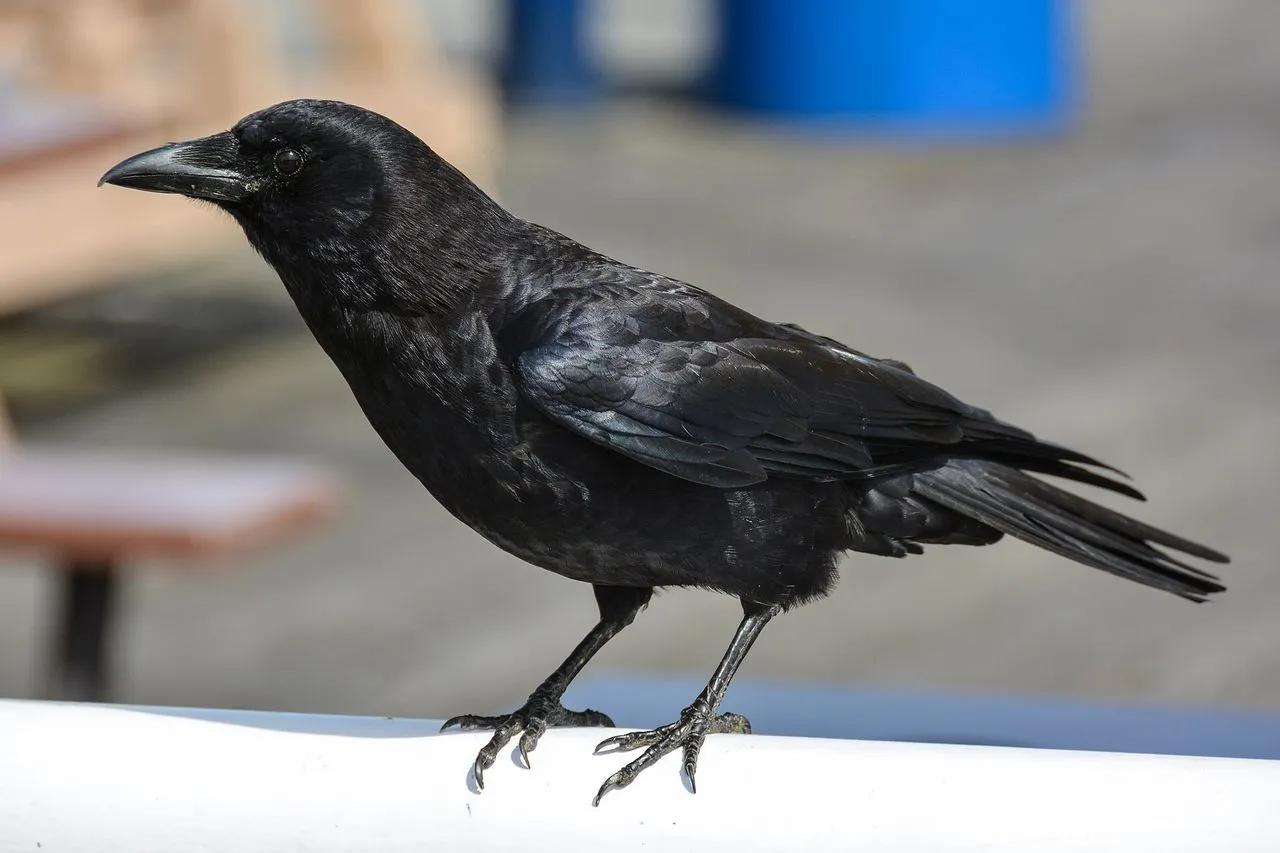
Crow attacks on other birds fall into four categories: mobbing raptors and owls to drive them from nesting territory, taking eggs and nestlings as opportunistic food, defending territory against rival corvids and jays, and displacing smaller birds at food sources. All four are normal corvid ecology. If a small bird is making repeated dive passes at a crow, the crow has approached its nest and the small bird is the defender, not the victim.
Crow attacks on other birds fall into four distinct categories, and which one applies changes everything about how to interpret the interaction. Some of what observers describe as attacks are not attacks at all: the crow is the one being driven off.
Part of the Complete Corvids Guide.
Quick answer: Crows attack other birds for four reasons: mobbing raptors and owls from nesting territory, taking eggs and nestlings as food, defending territory against rival corvids, and displacing smaller birds at food sources. None of these is aberrant behaviour.
Best first step: Identify the target. A crow group making repeated passes at a large owl or hawk is mobbing a predator. Crows visiting dense shrubs in May or June while smaller birds alarm-call nearby suggests nest predation. A small bird making repeated diving passes at a crow means the crow has approached that bird's nest.
Avoid: Taking any action against the crow. The American Crow is protected under the Migratory Bird Treaty Act. Lethal control outside a legal hunting season is a federal offence without a depredation permit.
What You Are Likely Watching: A Diagnostic
| Behaviour observed | Most likely explanation | Recommended action |
|---|---|---|
| Crow group dive-bombing a large owl or hawk, loud persistent calling | Mobbing: predator displacement from nesting territory | Nothing; normal corvid behaviour |
| Crows at dense shrubs in May to July, small birds alarm-calling nearby | Nest predation attempt | Dense native cover reduces nest accessibility |
| One crow chasing another crow or jay along a territory boundary | Inter-corvid territorial dispute | Nothing; seasonal and self-limiting |
| Crows displacing small birds at carrion or compost in winter | Food competition | Remove food scraps if crow recruitment is a concern |
| A small bird (robin, kingbird, blackbird) repeatedly diving at a crow | The crow is being mobbed near a nest | Nothing; the small bird is the defender |
Mobbing: Driving Predators from Nesting Territory
Mobbing is the most conspicuous crow behaviour directed at other birds, and it is defensive rather than predatory. A crow or crow group locates a roosting or perched predator and harasses it persistently through dive passes, loud calling, and close approach until it moves on.
The Great Horned Owl (Bubo virginianus) is the primary target. It is the most significant natural predator of American Crows across most of the species' range, hunting from roosts at night and taking prey that cannot detect it in darkness. Cornell Lab documents crows gathering from considerable distances and harassing Great Horned Owls for hours at a time. An active Great Horned Owl roost site near crow nesting territory will almost always draw this response during the breeding season.
Other consistent mobbing targets include Barred Owls, Red-tailed Hawks, and Cooper's Hawks. Marzluff et al. (2015) found that American Crows showed higher mobbing intensity toward Red-tailed Hawks than toward Ospreys, suggesting that mobbing effort scales with the predatory threat the target species represents to the crow rather than being a uniform response to any large bird.
Mobbing is primarily a display: shallow dive passes, loud calls, and sustained presence near the target. Physical contact with a mobbed owl does occasionally occur during high-intensity bouts, but the objective is displacement rather than injury. The owl is the predator; the crows are the defenders.
The behaviour serves two functions simultaneously. Direct predator displacement is the immediate goal: a Great Horned Owl harassed persistently at a roost site may reduce its use of that location, though whether this produces permanent territory displacement is context-dependent and lacks controlled quantification. The second function is information broadcasting: crows that observe conspecifics mob a specific predator learn to associate that individual with danger before any direct personal encounter, a social-learning mechanism documented in Marzluff's face-recognition research (discussed in the American Crow profile).
Blue Jays also mob raptors, but rely more heavily on vocal alarm and hawk-call mimicry than on the sustained physical dive-harassment that American Crows direct at roosting owls. The two species' predation ecologies are distinct enough that their mobbing strategies differ accordingly.
Nest Predation: Eggs and Nestlings as Food
Between May and July, American Crows take eggs and nestlings from accessible nests. This is the aspect of crow behaviour that generates the most concern from garden observers, and it requires ecological framing to assess accurately.
Crows are dietary generalists. Documented food items include invertebrates, small vertebrates, carrion, grain, fruit, and urban refuse. Eggs and nestlings are seasonally available, energy-dense, and effectively defenceless. Taking them is the same foraging opportunism that leads a crow to exploit road kill or an accessible compost heap. American Robins, open-cup passerines, and colonially nesting waterfowl with exposed nests are common targets. Crows do not specialise in nest predation; they exploit what is accessible during a period when many other food sources are also available.
The ecological significance of corvid nest predation is consistently smaller than popular accounts suggest. Madden, Arroyo & Amar (2015) reviewed 42 studies comprising 326 evaluations of corvid impacts on prey-bird abundance and productivity. Eighty-one percent of evaluations showed no negative influence on either metric. Where corvid removal did improve nesting success, removing the broader predator guild was more effective than removing corvids alone.
The predator community taking eggs and nestlings in a typical suburban landscape includes raccoons, weasels, rat snakes, domestic cats, and squirrels alongside crows. Chalfoun et al. (2002) found that nest-predator impacts are taxon-specific and context-dependent; there is no fixed hierarchy with corvids as the dominant component. Schmidt & Whelan (1999) identified nest predation probabilities above 0.65, characteristic of fragmented suburban landscapes, as the dominant fecundity constraint on songbirds, but their analysis attributes this to the total predator guild operating within a fragmented habitat, not to any single species within that guild. Habitat loss, which simultaneously reduces nesting cover and increases the density and diversity of the predator guild as a whole, is consistently identified as the principal limiting factor for declining songbird populations.
Territorial Defence Against Other Corvids
During the breeding season, American Crows defend territories against neighbouring pairs and unpaired floaters. Where American Crows and Common Ravens overlap in range, the size differential runs against the crow: ravens are substantially heavier, and crows are typically subordinate in direct confrontations. Crow-jay interactions reverse that dynamic: crows are the larger bird, and Blue Jays are displaced from territories during active crow breeding.
These are boundary disputes rather than predatory interactions. Both species have a defined stake in the outcome, and the behaviour is most intense from March through June before diminishing markedly as the nesting period ends.
Food Competition in Winter
Outside the breeding season, food competition replaces territorial and predatory motivations. Crows are dominant over nearly all smaller passerines at carrion, exposed food, and compost. Displacement is usually passive: a crow lands, smaller birds leave. Physical chasing occurs but is less common outside the breeding season.
The practical consequence for garden observers is that crows are recruited by accessible food, compost, food scraps, and platform feeders with scattered seed on the ground. A garden offering these at higher density than the surrounding area will sustain higher crow activity and, through it, higher incidental disturbance to smaller species. Reducing these attractants during May to July lowers crow visitation frequency without any direct action against the birds.
When the Crow Is the One Being Attacked
A significant share of reported crow-on-bird incidents are the inverse. American Robins, Eastern Kingbirds, Red-winged Blackbirds, and Barn Swallows all mob crows that approach active nests. In those interactions the crow is the predator; the smaller bird is the defender.
McLean (1986) documented that robin mobbing calls attracted the American Crow complex to nest sites, and that exposed nests elicited direct physical contact from the defending robin, including swoops and hits. Kingbirds are particularly aggressive: Cornell Lab documents Eastern Kingbirds striking crows, hawks, and squirrels directly when defending nest contents. Physical contact during these reverse-mob interactions is not unusual.
The identification cue is straightforward: if the smaller bird is making the repeated close-approach passes and the crow is continuing to move or attempting to leave the area, the crow is the target.
Legal Protections and What Not to Do
The American Crow is protected under the Migratory Bird Treaty Act (50 CFR 10.13). Outside of state-prescribed hunting seasons, which may not exceed 124 days per year and must avoid peak nesting periods (50 CFR 20.133), harassing, trapping, or killing crows is a federal offence. A federal depredation order under 50 CFR 21.150 covers specific situations involving agricultural damage by crow flocks, with nonlethal methods required first; it does not extend to garden nest-protection.
The only legal and ecologically effective response to crow nest predation near a garden is passive habitat management:
- Dense native shrub cover. Nests in structurally complex, dense vegetation are substantially harder for crows to locate and access than nests in open, low-canopy settings. Native shrub species support the cavity-nesting and dense-shrub-nesting species that are least vulnerable to crow predation.
- Multiple nesting layers. A garden with ground cover, mid-shrub, and canopy nesting opportunities supports a more diverse nesting community with varying vulnerability profiles.
- Reduce food attractants. Compost bins, food scraps, and exposed feeders that scatter seed onto the ground all recruit crows at above-ambient density. Reducing these during May to July lowers crow visitation frequency in the immediate area without affecting the wider crow population.
For full guidance on feeding-station management and corvid interactions, see The Complete Attracting Guide.
See Also
- American Crow: full species profile, including diet, cooperative breeding, and face-recognition research.
- The Complete Corvids Guide: corvid taxonomy, cognition, social behaviour, and identification across the family.
- Blue Jay: how the Blue Jay's predation ecology and feeder dominance differ from those of the American Crow.
- Great Horned Owl: the primary corvid predator, the most frequent mobbing target, and roost-site ecology.
- Red-tailed Hawk: a consistent corvid mobbing target during the breeding season, and a documented nest predator of smaller passerines.
- The Complete Attracting Guide: feeding-station management, including reducing food attractants that recruit corvids to a garden.
Frequently Asked Questions
Are crows dangerous to songbirds at my feeder?
Crows visiting a feeding station are unlikely to take adult songbirds. The risk is indirect: a crow foraging nearby may cause smaller birds to scatter temporarily. During May through July, crows foraging near dense shrubs may be searching for accessible nests. Removing food scraps that recruit crows to a garden reduces that exposure without any direct action against the crow population.
Do crows hurt the birds they mob?
When crows mob, the target is a predator, typically a Great Horned Owl or Red-tailed Hawk. Mobbing consists of persistent dive passes, loud calling, and close approach. Physical contact with the target does occasionally occur during high-intensity bouts with owls, but the objective is displacement rather than injury. The owl is the target; the crows are the defenders.
Can crows drive a Great Horned Owl out of its territory?
Sustained mobbing by a crow flock can pressure a Great Horned Owl to vacate a roost site or reduce its use of an area during daylight hours. Cornell Lab documents crows gathering from considerable distances and harassing owls for hours at a time. Whether this produces permanent territory displacement is context-dependent and has not been quantified in controlled studies.
Is it legal to stop crows from taking nests near my house?
The American Crow is protected under the Migratory Bird Treaty Act (50 CFR 10.13). Outside of state-prescribed hunting seasons (maximum 124 days per year, not during peak nesting), harassing, trapping, or killing crows is a federal offence. A depredation permit under 50 CFR 21.150 covers specific agricultural damage situations. Passive habitat modification, dense native cover and no food scraps attracting crows, is legal and the most effective long-term approach.
Why do small birds attack crows?
American Robins, Eastern Kingbirds, Red-winged Blackbirds, and Barn Swallows all mob crows that approach active nests. The crow is the predator in those interactions; the smaller bird is the defender. McLean (1986) documented that robin mobbing calls attracted the American Crow complex to exposed nests, and that the defending robin made direct physical contact, including swoops and hits. Kingbirds are documented striking crows, hawks, and squirrels directly when defending nest contents.
Sources & References
- Cornell Lab of Ornithology, Birds of the World: American Crow (<em>Corvus brachyrhynchos</em>)
- Cornell Lab of Ornithology, All About Birds: American Crow
- Madden, C.F., Arroyo, B. & Amar, A. (2015). 'A review of the impacts of corvids on bird productivity and abundance.' Ibis 157(1):1–16. Forty-two studies, 326 evaluations: 81% showed no negative corvid influence; corvid-only removals were less effective than multi-predator removals.
- Schmidt, K.A. & Whelan, C.J. (1999). 'The Relative Impacts of Nest Predation and Brood Parasitism on Seasonal Fecundity in Songbirds.' Conservation Biology 13(1):46–57. Nest predation dominates fecundity constraints across most parameterisations; impact is amplified in fragmented landscapes.
- Chalfoun, A.D., Thompson, F.R. III & Ratnaswamy, M.J. (2002). 'Nest Predators and Fragmentation: a Review and Meta-Analysis.' Conservation Biology 16(2):306–318. Predator impacts are taxon-specific and context-dependent; corvids operate within a diverse guild that includes mammalian predators.
- Marzluff, J.M., DeLap, J.H. & Haycock, K. (2015). 'Population Variation in Mobbing Ospreys by American Crows.' Wilson Journal of Ornithology 127(2):266–270. Mobbing intensity was higher toward Red-tailed Hawks and Bald Eagles than toward Ospreys, suggesting intensity scales with predatory threat to crows.
- McLean, I.G. (1986). 'Mobbing Behaviour, Nest Exposure, and Breeding Success in the American Robin.' Behaviour 96:171–186. Robin mobbing calls attracted the American Crow complex to nest sites; exposed nests elicited direct physical contact from the defending robin.
- U.S. Fish & Wildlife Service. 50 CFR 10.13, 20.133, 21.150: Migratory Bird Treaty Act protections, crow hunting season regulations, and depredation orders.