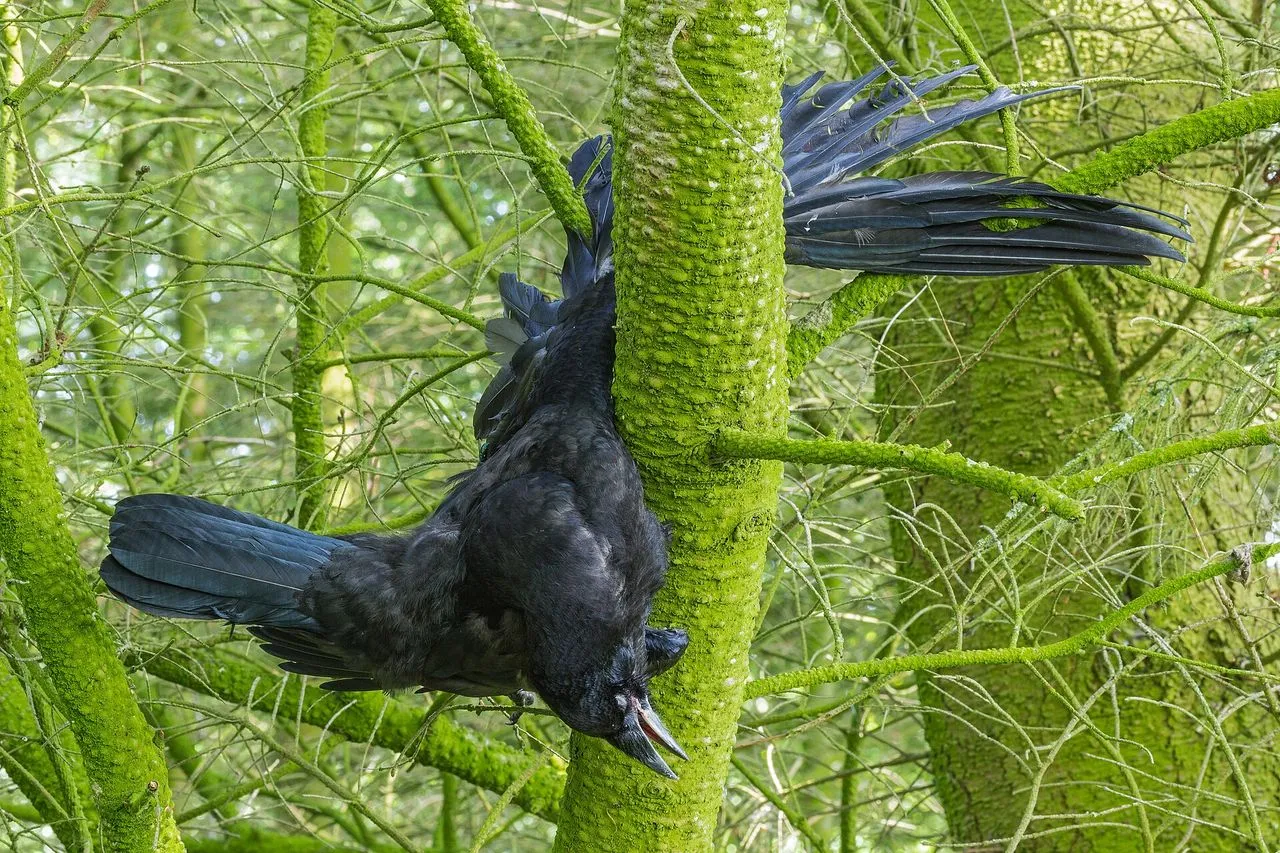
Corvus frugilegus Linnaeus, 1758, the Rook, is the colonial farmland crow of Europe and western Asia, named from Latin roots meaning crop-gathering, and adult birds are separated from Carrion Crows by the bare grey-white skin at the base of the bill.
Part of the Complete Corvids Guide.
Identification
Visual
Adult Rook is black with purplish gloss, peaked crown, long pointed bill, shaggy feathering around the thighs, and a bare pale face at the bill base. This bare facial skin develops with age through feather wear and is absent in juveniles. The body is similar in length to Carrion Crow but often looks slimmer, longer-winged, and more angular.
Carrion Crow has a fully feathered black face, heavier-looking bill, flatter crown, and more solitary or paired territorial behaviour. Juvenile Rooks are the main confusion: they lack the bare face and can appear crow-like. Look for slimmer bill, peaked head, looser flock association, and presence near a rookery or feeding flock.
| Feature | Rook (Corvus frugilegus) | Carrion Crow (C. corone) | Eurasian Jackdaw (Coloeus monedula) |
|---|---|---|---|
| Length | 17-18 in (44-46 cm) | 18-19 in (45-47 cm) | 13-15 in (34-39 cm) |
| Adult face | Bare grey-white skin at bill base | Fully feathered black face | Dark face with pale iris |
| Bill and head | Long pointed bill; peaked crown | Heavier bill; flatter crown | Short compact bill; grey nape |
| Social setting | Colonial rookeries; feeding flocks | Territorial pairs and family groups | Paired birds inside flocks; cavities |
| Voice | Nasal, drawn-out caw | Harsher measured caw | Sharp metallic "chak" |
Jackdaw often feeds with Rooks but is much smaller, grey-naped, pale-eyed, and short-billed. Raven is larger, wedge-tailed, and usually not part of lowland rookery flocks.
Audio
Rook voice is a nasal, drawn-out caw, often higher and more conversational than Carrion Crow. Colonies produce continuous background calling: begging, pair contact, disputes, alarm, and display calls. In flight, flock members call repeatedly, creating the familiar soundscape of British and European farmland.
Voice alone can be difficult for beginners because individual crows vary. Social context helps. A crowd of black corvids circling tall trees in March while giving nasal caws is almost certainly a rookery, not a gathering of Carrion Crows.
Distribution
Rook breeds across much of Europe and western to central Asia, with introduced populations in New Zealand. It is common in Britain and Ireland, though local declines have occurred where agricultural change reduced invertebrate food or rookery trees.
Northern and eastern populations may migrate or move substantially in winter, while many western birds are resident. Winter flocks can be large and mixed with Jackdaws, Carrion Crows, and gulls, especially on pasture, stubble, and around livestock operations.
Habitat
Rooks are birds of open agricultural landscapes with tall trees for colonial nesting. Pasture, arable fields, parkland, floodplain meadows, villages, shelterbelts, and estate trees are typical. They avoid extensive closed forest for feeding but need mature trees for rookeries.
Rookeries are often traditional, occupying the same grove, churchyard, avenue, or estate planting for decades. Nest numbers fluctuate with disturbance, tree loss, shooting, food supply, and weather. A single rookery may contain a handful of nests or several hundred.
Diet and Foraging
Diet includes earthworms, leatherjackets, beetle larvae, wireworms, grain, seeds, potatoes, fruit, carrion, and refuse. Rooks probe soil with the long bill, especially in damp pasture. They follow ploughs, feed among livestock, inspect dung, and work stubble after harvest.
The agricultural reputation is mixed because the bird eats both crop pests and crops. In spring, rooks can pull seedlings or take grain; in pasture they remove large numbers of leatherjackets and other larvae. The net effect depends on crop, season, and local abundance, which is why historical campaigns alternated between protection and persecution.
Social foraging is central. Rooks feed in flocks with local information transfer: birds arriving at productive fields attract others, and unsuccessful individuals shift with the group. They are less territorial in feeding areas than Carrion Crows and more tolerant at close range.
Breeding Biology
Rooks nest colonially in tall trees. Nests are stick platforms lined with grass, moss, wool, hair, and soil, usually near the crown. Pairs refurbish old nests or build new ones in late winter and early spring. Stick theft within the rookery is common; a bird leaving its nest unattended may return to find material removed by neighbours.
Clutch size is usually 3-5 eggs. Incubation lasts about 16-18 days, mainly by the female, with the male feeding her. Young fledge after about 30-36 days. The colony remains noisy through the nestling period, then disperses into family and feeding flocks.
Pair bonds are strong, and social rank affects access to nest positions and food. Central nest sites may be safer from some predators, while edge nests can be more exposed. Predators include Carrion Crows, raptors, martens, and humans.
Notes
Rooks have been used in laboratory cognition studies, including work on tool use and causal reasoning in captive birds, because they are social corvids even though wild Rooks do not normally manufacture tools. The distinction matters: a captive problem-solving result shows capacity under conditions, not a claim that wild birds routinely behave like New Caledonian Crows.
For field observers, the quickest separation from Carrion Crow is not just the bare face; it is the whole social system. Carrion Crow is the territorial pair in the field corner. Rook is the colony overhead, the flock behind the plough, and the nasal chorus from tall elms or sycamores in March.
Rookery counts should be made before leaf-out where deciduous trees are used. Counting apparently active nests later in spring can undercount hidden cups or overcount abandoned structures, so repeated visits and evidence of attending adults give better breeding estimates.
The best counts therefore record date, tree species, and nest activity separately.
See Also
Frequently Asked Questions
How do I distinguish a Rook from a Carrion Crow?
Adult Rooks show a bare grey-white face at the bill base, peaked crown, long pointed bill, and shaggy thigh feathering, and feed socially in flocks at colonial rookeries. Carrion Crow has a fully feathered black face, flatter crown, heavier-looking bill, and is usually in pairs holding a territory. Juvenile Rooks lack the bare face but show a slimmer bill, peaked head, and association with rookery flocks.
Why do Rooks nest in colonies?
Colonial nesting allows social information transfer about food, mass mobbing of predators, and concentrated defence of nest sites. Rookeries are often traditional, occupying the same grove or churchyard for decades. Stick theft within the colony is common, a bird leaving its nest unattended may return to find material removed by neighbours, a recurring feature of rookery social life.
Are Rooks agricultural pests?
The reputation is mixed because Rooks eat both crop pests and crops. In spring they may pull seedlings or take grain; in pasture they remove large numbers of leatherjackets, wireworms, and other larvae. The net effect depends on crop, season, and local abundance, which is why historical campaigns alternated between protection and persecution.
Do wild Rooks use tools?
Wild Rooks do not normally manufacture tools. Captive Rooks have been used in laboratory cognition studies on tool use and causal reasoning because they are highly social and tractable, but those results show capacity under experimental conditions, not a claim that wild birds behave like New Caledonian Crows. The distinction matters when interpreting popular reports of corvid intelligence.
Sources & References
- Svensson, L., Mullarney, K. & Zetterström, D. (2010). Collins Bird Guide (2nd ed.). HarperCollins.
- British Trust for Ornithology. (2024). BirdFacts: Rook. bto.org
- Cramp, S. & Perrins, C.M. (1994). Handbook of the Birds of Europe, the Middle East and North Africa, Vol. VIII. Oxford University Press.
- Madge, S. & Burn, H. (1994). Crows and Jays: A Guide to the Crows, Jays and Magpies of the World. Helm.