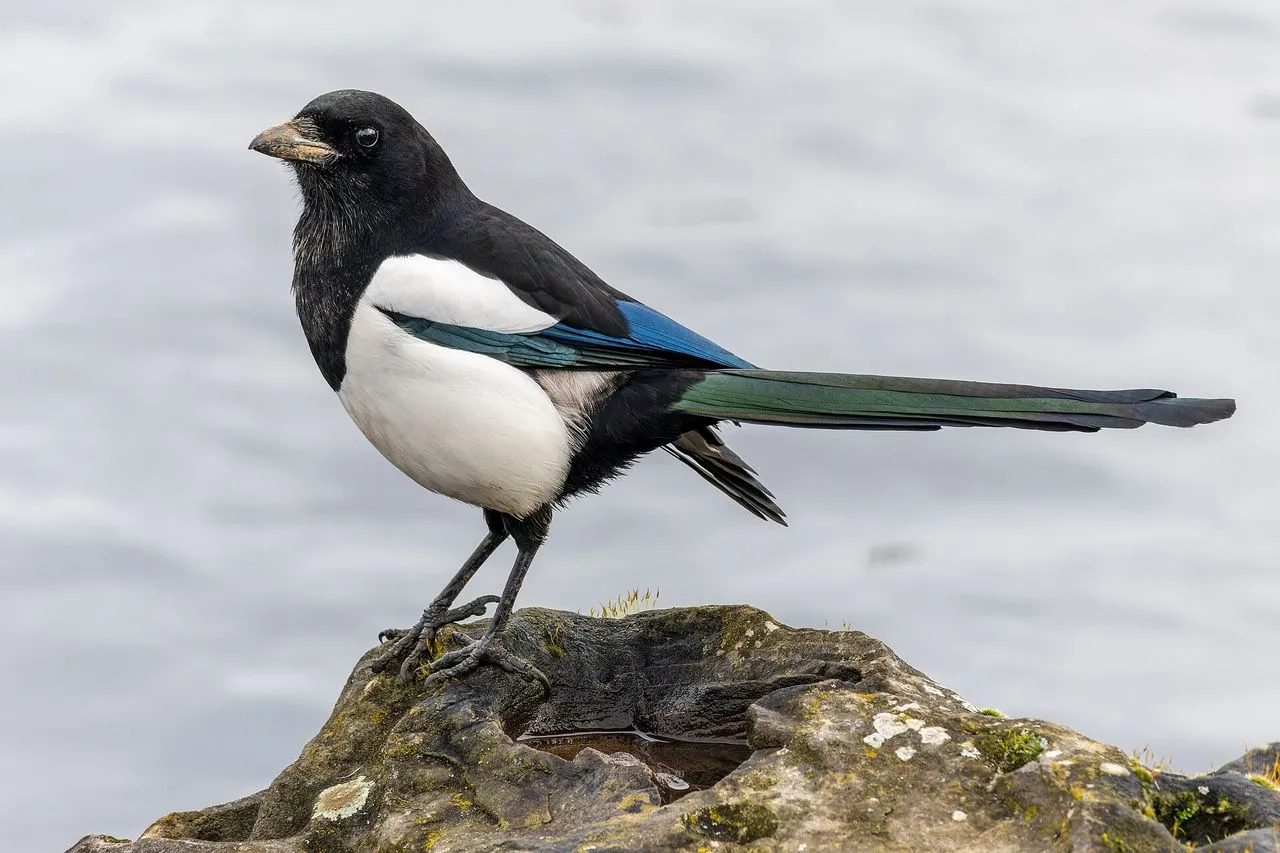
Pica pica (Linnaeus, 1758), the Eurasian Magpie, is the pied long-tailed corvid of Europe and temperate Asia, and in Prior, Schwarz, and Gunturkun's 2008 PLoS Biology experiment it became the first non-mammal reported to pass the mirror mark test.
Part of the Complete Corvids Guide.
Identification
Visual
Eurasian Magpie is black and white with a long graduated tail glossed green, blue, and bronze. The belly, scapulars, and inner wing patches are white; head, breast, back, and bill are black. In flight the white primaries and scapulars produce a flashing pied pattern. Length is roughly 44-46 cm in many European birds, with tail accounting for much of the measurement.
No European crow or jackdaw shares this structure. Great Spotted Woodpecker is pied but smaller, tree-clinging, red-marked, and not long-tailed. Black-billed Magpie of North America is similar but geographically separate and differs in details of voice, genetics, and measurements.
| Feature | Eurasian Magpie (Pica pica) | Black-billed Magpie (P. hudsonia) | Carrion Crow (Corvus corone) |
|---|---|---|---|
| Length | 17-18 in (44-46 cm) | 17-24 in (45-60 cm) | 18-19 in (45-47 cm) |
| Plumage | Pied black-and-white; iridescent tail | Pied black-and-white; very long tail | Wholly black |
| Range | Europe and temperate Asia | Western North America | Western Europe |
| Tail | Long, graduated, glossy | Longer on average; green-bronze gloss | Shorter, square-ended |
| Voice | Hard rapid chatter | Rough western chatter | Harsh measured caw |
The bird's appearance changes with light because the black areas are iridescent, not flat. A bird on wet grass under cloud can appear almost black-and-white; the same bird in sun shows green tail and blue wing gloss.
Audio
The common call is a hard, rapid chatter, often a dry "chak-ak-ak-ak." Alarm calling is loud and prolonged, especially when cats, foxes, owls, or Carrion Crows approach nests. Pairs also use quieter contact calls and subdued conversational notes.
Voice is useful for detecting birds hidden in hedgerows. In suburban Britain, a magpie's scolding often identifies a cat or perched raptor before the observer sees it. The call is harsher and more rattling than Jackdaw, less deep than Carrion Crow, and more mechanical than Eurasian Jay.
Distribution
The Eurasian Magpie occupies most of Europe and broad parts of temperate Asia, with taxonomic limits varying by authority across the wider Pica complex. It is common in Britain, Ireland, western and central Europe, much of Scandinavia outside the highest Arctic areas, and eastward across suitable open woodland and farmland.
It is mostly resident. Local dispersal occurs after breeding, and winter groups may form around feeding sites, but long-distance migration is not typical. Urban and suburban expansion has benefited the species in many regions by providing trees, lawns, roads, and refuse.
Habitat
Preferred habitat is open country with trees: farmland hedgerows, pasture, orchards, parks, gardens, railway edges, scrub, riparian woodland, and urban green space. Dense closed forest holds fewer birds; treeless intensively farmed landscapes need hedges, copses, or pylons for nesting.
In Britain and western Europe, magpies are now among the most visible suburban corvids. Their success reflects structural habitat: short grass for foraging, shrubs for cover, tall trees for nests, road-kill, and food waste. It does not require wilderness.
Diet and Foraging
Diet includes beetles, worms, leatherjackets, caterpillars, grain, fruit, carrion, eggs, nestlings, small mammals, and refuse. The species walks over lawns and pasture, probes soil and dung, raids nests, and scavenges road-kill. Seasonal diet shifts are strong: invertebrates in spring and summer, mast, carrion, and refuse in winter.
Magpies cache food, especially surplus meat or household scraps, but caching is less central than in nutcrackers or Canada Jays. They are also known for inspecting novel objects; the popular idea that magpies compulsively steal shiny items is overstated. Experimental work has not supported a simple attraction to gloss independent of context.
Predation on songbird nests is real but frequently exaggerated in public debate. Local nest losses can be substantial, yet broad songbird declines in Britain are better explained by habitat change, agricultural intensification, pesticide history, and food availability than by magpie abundance alone.
Breeding Biology
The nest is a large domed stick structure with a side entrance, often placed high in thorn, hawthorn, poplar, willow, or urban trees. The cup includes mud and a lining of fine roots, grass, hair, and fibres. Some pairs build multiple partial structures before completing one nest.
Clutch size is usually 5-8 eggs. Incubation lasts about 17-18 days, mostly by the female. Young fledge around 24-30 days after hatching. Pairs are territorial and conspicuous in defence, but non-breeding birds may form loose flocks, especially in winter or where territories are saturated.
The domed nest reduces some predation but does not make the contents safe. Carrion Crows, raptors, mammals, and other magpies can take eggs or young. Old nests provide platforms for other birds, including Long-eared Owls and kestrels.
Notes
The mirror test result deserves precision. Prior et al. placed coloured marks on magpies' throat feathers where they could be seen only in a mirror. Marked birds showed self-directed scratching when the mirror was present and did not show the same response to sham marks or mirror absence. The experiment does not mean a magpie has human self-concept; it shows that at least some individuals used mirror information to inspect their own body.
That result remains important because it broke a mammal-centred assumption in comparative cognition. The bird in a European garden is also the bird in a controlled cognition paper; field familiarity should not make the species seem scientifically ordinary.
Long-term urban counts should also separate breeding pairs from non-breeding flocks. Magpie abundance can look high where unmated birds gather, even when the number of defended nesting territories changes little.
See Also
Frequently Asked Questions
Did Eurasian Magpies pass the mirror self-recognition test?
Yes. Prior, Schwarz, and Gunturkun (2008, PLoS Biology) placed coloured marks on magpies' throat feathers visible only in a mirror. Marked birds showed self-directed scratching when the mirror was present but not in response to sham marks or mirror absence. The result doesn't imply human-like self-concept, but it broke a mammal-centred assumption in comparative cognition.
Are magpies really attracted to shiny objects?
The popular idea is overstated. Magpies inspect novel objects, but experimental work has not supported a simple attraction to gloss independent of context. Caching behaviour involves food and useful items; the 'thieving magpie' folklore exaggerates a more general curiosity that applies to many novel items, not specifically shiny ones.
How destructive are magpies to songbirds?
Local nest losses to magpies can be substantial, but broad songbird declines in Britain are better explained by habitat change, agricultural intensification, pesticide history, and food availability than by magpie abundance alone. Predation on eggs and nestlings is real and visible, which has produced strong public reactions out of proportion to the population-level impact.
Why are magpie nests domed?
Eurasian Magpie nests are large stick domes with a side entrance, mud cup, and lining of fine roots, grass, and hair, placed high in thorn, hawthorn, or urban trees. The roof reduces some aerial predation, though Carrion Crows, raptors, mammals, and other magpies can still take eggs or young. Old nests provide platforms for Long-eared Owls and kestrels.
Sources & References
- Prior, H., Schwarz, A. & Güntürkün, O. (2008). Mirror-induced behavior in the magpie (Pica pica): Evidence of self-recognition. PLoS Biology, 6(8), e202.
- Svensson, L., Mullarney, K. & Zetterström, D. (2010). Collins Bird Guide (2nd ed.). HarperCollins.
- British Trust for Ornithology. (2024). BirdFacts: Magpie. bto.org
- Madge, S. & Burn, H. (1994). Crows and Jays: A Guide to the Crows, Jays and Magpies of the World. Helm.