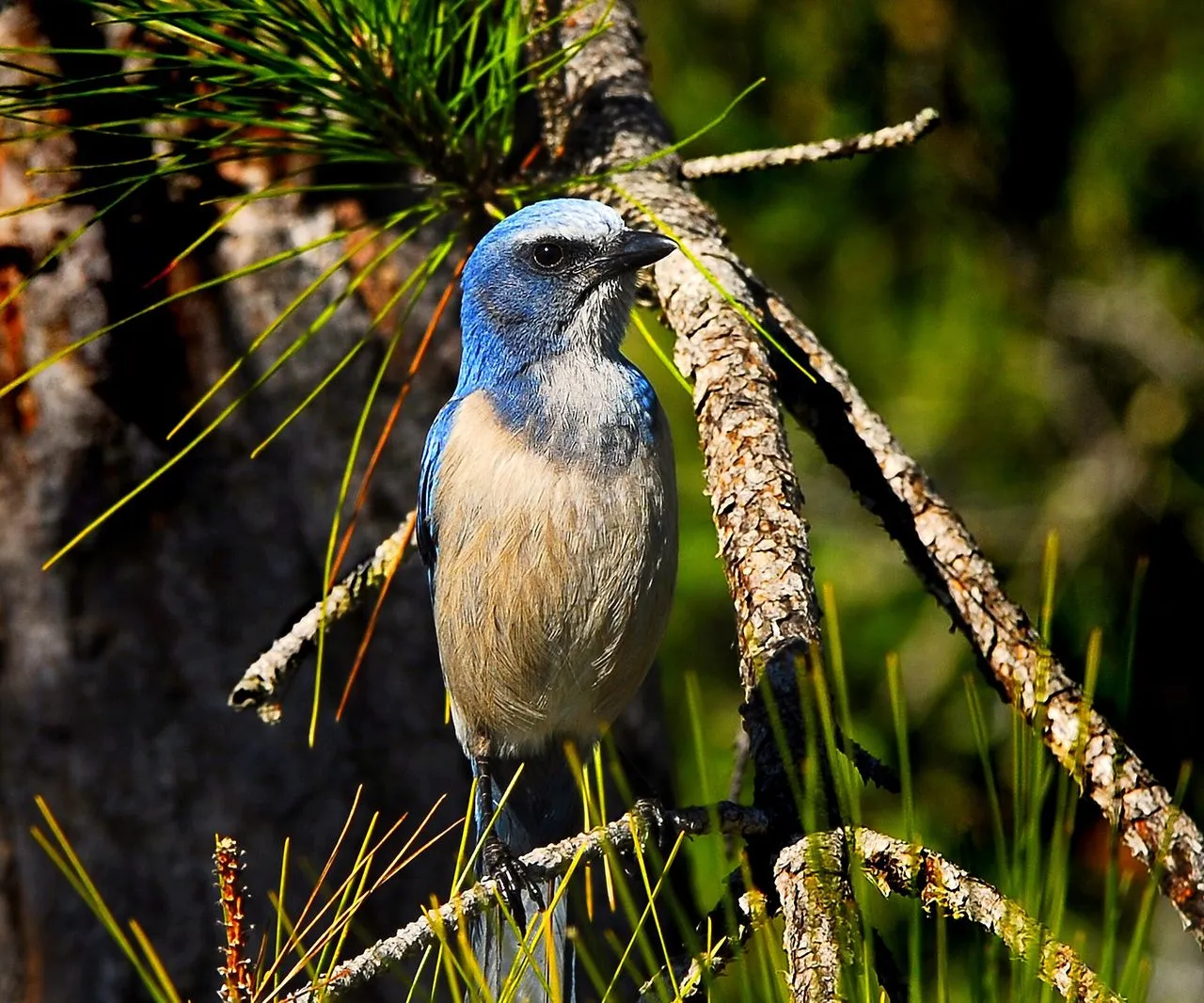
Aphelocoma coerulescens (Bosc, 1795), the Florida Scrub-Jay, is the only bird species endemic to Florida, with a global population often estimated near 7,000-8,000 individuals and a breeding system in which retained offspring serve as helpers on family territories.
Part of the Complete Corvids Guide.
Identification
Visual
Florida Scrub-Jay is a crestless blue-and-grey jay, smaller and plainer than Blue Jay. Adults show blue head, wings, and tail; pale grey back and underparts; whitish forehead and throat; and no black necklace. The tail is long, the posture upright, and the bird often moves low through scrub oaks or stands on exposed sandy tracks.
California Scrub-Jay and Woodhouse's Scrub-Jay are geographically separate. Blue Jay overlaps in Florida but has a crest, white wing bars, black necklace, and stronger facial pattern. In poor light, a Florida Scrub-Jay may look washed-out rather than bright; the absence of crest and the open scrub setting are important.
| Feature | Florida Scrub-Jay (Aphelocoma coerulescens) | Blue Jay (Cyanocitta cristata) | California Scrub-Jay (A. californica) |
|---|---|---|---|
| Length | About 11 in (28 cm) | 10-12 in (25-30 cm) | 11-12 in (28-30 cm) |
| Crest | Absent | Prominent blue crest | Absent |
| Head pattern | Blue head; whitish forehead and throat | White face; black necklace | Blue head; pale eyebrow; blue necklace |
| Range | Peninsular Florida scrub only | Eastern North America, including Florida | Pacific slope and coastal West |
| Habitat | Low fire-maintained oak scrub | Woodland, suburbs, parks | Oak woodland, chaparral, suburban scrub |
Juveniles have a brownish head and duller blue wings and tail. Family groups can therefore show mixed head colours in summer. Because the species is range-restricted and protected, observers should avoid playback and should not approach nests or feed birds for photographs.
Audio
Calls are harsh, nasal, and rasping, including scolds, contact notes, and sentinel alarms. Groups communicate constantly when moving through scrub. Alarm calling is linked to cooperative defence: helpers and breeders respond to snakes, accipiters, and mammalian predators.
The vocalisations are less varied to the casual ear than Blue Jay, but their social use is precise. A perched sentinel giving repeated alarm notes can freeze an entire family group and reveal a predator's direction.
Distribution
Florida Scrub-Jay is confined to peninsular Florida, with strongholds on the Lake Wales Ridge, Merritt Island, Ocala National Forest, and scattered protected scrub fragments. Its range has contracted severely because ancient scrub ridges were converted to citrus, housing, roads, and fire-suppressed woodland.
It is listed as Threatened under the U.S. Endangered Species Act. Population estimates vary by survey year and method, but the order of magnitude is small: several thousand birds, not tens of thousands. Fragmentation is as important as absolute habitat loss because family groups need territories, dispersal routes, and unoccupied openings for young breeders.
Habitat
The required habitat is fire-maintained oak scrub on well-drained sandy soils, especially low, open stands of scrub oak with patches of bare sand and scattered pines. Optimal vegetation is often 1-2 m tall, low enough for predator detection and movement, open enough for foraging, and dense enough for nesting cover.
Fire suppression makes habitat unsuitable. Scrub oaks grow too tall, canopy closes, bare sand disappears, and jays decline. Mechanical cutting can imitate some fire effects but does not fully replace the ecological reset. Management therefore uses prescribed fire, cutting, and careful timing to maintain a shifting mosaic.
Diet and Foraging
Diet includes acorns, insects, spiders, lizards, frogs, small snakes, berries, seeds, and occasional eggs or nestlings. Acorns are cached and recovered, making scrub oaks both food source and structural habitat. Jays forage on ground and low vegetation, often dropping from a perch to seize prey in bare sand.
Cooperative group foraging is common in the sense that family members remain within contact and benefit from alarms, not because they hunt as a coordinated pack. Helpers may feed nestlings and fledglings, watch for predators, and assist territorial defence. Long-term studies at Archbold Biological Station made this species central to research on kin selection, delayed dispersal, and habitat saturation.
Breeding Biology
Florida Scrub-Jays are cooperative breeders. A breeding pair holds a territory with one or more helpers, usually offspring from previous years. Helpers do not normally breed while remaining subordinate, but they increase group vigilance, help feed young, and improve territory defence. Their delayed dispersal is favoured when suitable vacant territories are scarce.
Nests are placed in scrub oaks or other low shrubs, generally 1-2 m above ground. Clutch size is usually 3-4 eggs. Breeding begins from March into June, with timing affected by rainfall, food, and habitat condition. Incubation is by the female; the male and helpers provision her and later the nestlings.
Young fledge after about 17-19 days and remain dependent. Family territories are stable and mapped in long-term research by colour-banding individuals. Those banding programmes have shown survival, inheritance of territories, breeder replacement, and the demographic cost of habitat fragmentation with unusual precision.
Notes
The conservation problem is not solved by protecting any green space in Florida. The bird needs a particular fire-maintained scrub structure on ancient sandy ridges. A site can contain oaks and still be useless if the vegetation is too tall and closed.
Florida Scrub-Jay is also a case where public affection can harm. Hand-feeding habituates birds to roads and people, increases collision risk, and can disrupt natural foraging. The correct field behaviour is distance, quiet observation, and support for prescribed fire even when smoke and blackened scrub are politically unpopular.
Survey work should record group size, helper number, colour bands when present, and scrub height class. Those details matter because a single calling bird may represent a failing territory, while a five-bird family group in low oak scrub indicates breeding structure and management condition.
See Also
Frequently Asked Questions
How do I identify a Florida Scrub-Jay?
Look for a crestless blue-and-grey jay smaller and plainer than Blue Jay. Adults have blue head, wings, and tail, pale grey back and underparts, whitish forehead and throat, and no black necklace. Juveniles have brownish head and duller blue wings. In poor light may look washed out. No crest and open scrub setting are important clues.
Why is the Florida Scrub-Jay endangered?
Listed as Threatened under the U.S. Endangered Species Act with only 7,000-8,000 birds. Range has contracted severely because ancient scrub ridges were converted to citrus, housing, and roads. Fire suppression makes scrub too tall and closed. Fragmentation is as important as habitat loss, family groups need territories, dispersal routes, and unoccupied openings.
What is cooperative breeding in Florida Scrub-Jays?
A breeding pair holds a territory with one or more helpers, usually offspring from previous years. Helpers do not breed while subordinate but increase group vigilance, help feed young, and improve territory defence. Their delayed dispersal is favoured when suitable vacant territories are scarce. Long-term studies at Archbold Biological Station made this species central to kin selection research.
What habitat do Florida Scrub-Jays need?
Fire-maintained oak scrub on well-drained sandy soils, especially low (1-2 m tall), open stands of scrub oak with patches of bare sand and scattered pines. Optimal vegetation is low enough for predator detection and movement, open enough for foraging, dense enough for nesting. Fire suppression makes habitat unsuitable; prescribed fire is essential for management.
Sources & References
- Ehrlich, P.R., Dobkin, D.S. & Wheye, D. (1988). The Birders Handbook. Simon & Schuster.
- Cornell Lab of Ornithology. (2024). All About Birds: Florida Scrub-Jay. birds.cornell.edu
- Sibley, D.A. (2014). The Sibley Guide to Birds (2nd ed.). Knopf.
- Woolfenden, G.E. & Fitzpatrick, J.W. (1996). 'Florida Scrub-Jay.' The Birds of North America, No. 228.