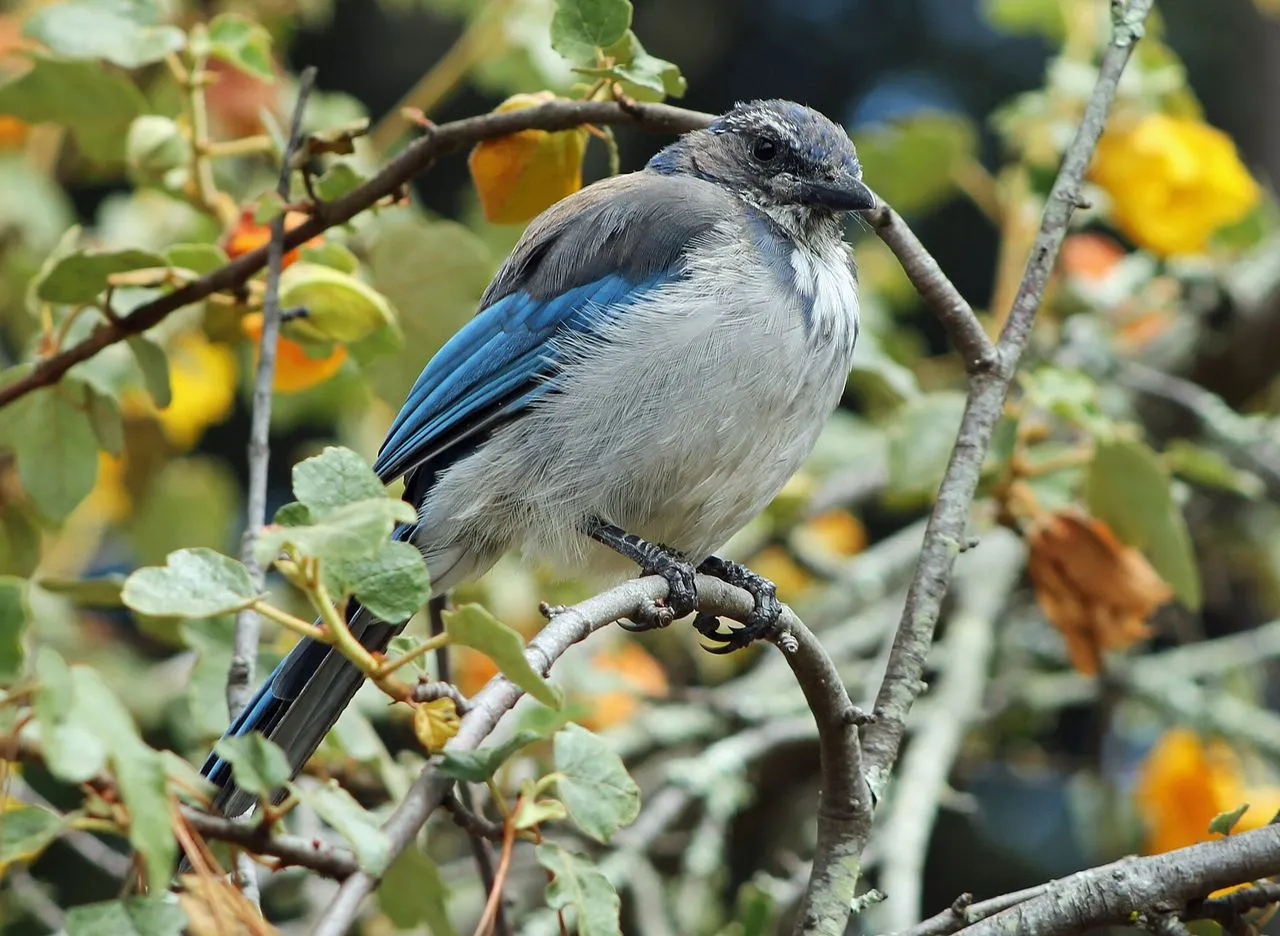
Aphelocoma californica (Vigors, 1839), the California Scrub-Jay, is the crestless blue-and-grey jay of Pacific oak woodland and chaparral, and its former inclusion in Western Scrub-Jay supplied the birds used in Clayton and Dickinson's 1998 episodic-like memory experiments on what-where-when cache recovery.
Part of the Complete Corvids Guide.
Identification
Visual
California Scrub-Jay is a long-tailed, crestless jay, about 11-12 in (28-30 cm) long. It has a blue head, wings, and tail; grey-brown back; pale grey underparts; whitish throat bordered by a blue necklace; and a distinct pale eyebrow. The posture is upright, often with tail cocked downward and head held high from a shrub or fence.
Woodhouse's Scrub-Jay, formerly grouped with it, is duller and greyer, with less contrast and a different interior range. Island Scrub-Jay on Santa Cruz Island is larger, deeper blue, and geographically isolated. Steller's Jay has a crest and dark head. Blue Jay has white wing bars, a crest, and a black necklace.
| Feature | California Scrub-Jay (Aphelocoma californica) | Woodhouse's Scrub-Jay (A. woodhouseii) | Florida Scrub-Jay (A. coerulescens) |
|---|---|---|---|
| Length | 11-12 in (28-30 cm) | About 11-12 in (28-30 cm) | About 11 in (28 cm) |
| Crest | Absent | Absent | Absent |
| Back tone | Grey-brown saddle; richer blue contrast | Duller grey-brown; less contrast | Pale grey back and underparts |
| Throat | Whitish with blue necklace | Whitish, usually duller border | Whitish; no black necklace |
| Range | Pacific slope and coastal West | Interior Great Basin and Rockies | Peninsular Florida only |
Variation within California Scrub-Jay is visible: coastal birds can look richer blue and darker-backed than interior birds. None of this obscures the basic pattern: no crest, blue upperparts, grey-brown saddle, pale throat, and loud behaviour in oak or suburban scrub.
Audio
The common call is a harsh, rising "shreep" or "shrenk," often repeated from exposed perches. Alarm calls are rasping and persistent. Pairs and family members use softer contact notes while moving through trees and shrubs. The vocal repertoire is less musical than a Blue Jay's but locally informative; a calling scrub-jay often reveals a cat, snake, accipiter, or human disturbance before the observer sees it.
Mimicry occurs but is not the field hallmark. The important point is that vocalisations are socially responsive. Calls differ with predator type and intensity, and neighbourhood birds attend to each other's scolding.
Distribution
The species occupies the Pacific slope from Washington and Oregon through California into Baja California, with inland presence in suitable oak, pinyon-juniper, riparian, and suburban habitats. The split from Woodhouse's Scrub-Jay clarified a coastal-western species rather than the older broad Western Scrub-Jay concept.
It is resident across most of its range. Local movements follow food, drought, and breeding dispersal rather than long-distance migration. In urban California it is one of the most familiar corvids wherever mature oaks, ornamental trees, and shrub cover persist.
Habitat
Core habitat is oak woodland, oak savanna, chaparral edge, riparian woodland, pinyon-juniper in parts of the range, orchards, parks, and residential areas with trees and shrubs. It avoids extensive closed conifer forest, where Steller's Jay predominates, and open treeless grassland except for foraging excursions.
Oaks are central. Coast live oak, valley oak, blue oak, and other mast-producing trees provide autumn food and cache material. Suburban plantings can support high densities if acorns, insects, and nesting shrubs are available.
Diet and Foraging
California Scrub-Jay eats acorns, insects, spiders, lizards, small snakes, eggs, nestlings, fruit, seeds, suet, peanuts, and human food. It forages on ground, in shrubs, and in trees, often watching from a perch before dropping to seize prey or collect nuts.
Acorn caching is extensive. Birds hammer acorns loose, test them, carry them in the bill or throat, and bury them singly in soil or leaf litter. They often choose open ground or sparse vegetation where retrieval landmarks are visible. Some acorns are recovered within weeks; others remain through winter; unrecovered seeds germinate and contribute to oak dispersal.
The cognitive literature attached to this species comes from the former Western Scrub-Jay. Clayton and Dickinson showed that scrub-jays remembered food type, cache location, and elapsed time, retrieving perishable waxworms before peanuts when fresh but shifting strategy after worms had degraded. Later work showed re-caching after being observed by potential pilferers.
Breeding Biology
Pairs defend territories and may remain together for multiple years. The nest is a cup of twigs, roots, plant fibres, and animal hair, placed in shrubs, small trees, oaks, or ornamental vegetation, usually concealed but not necessarily high. Clutch size is commonly 3-6 eggs.
Breeding begins from March onward in much of California, earlier in mild regions and later in cooler or drought-affected sites. Incubation lasts about 16 days, primarily by the female. Young fledge after about 18-19 days and remain with adults for several weeks.
Adults are conspicuous nest defenders. They scold cats, snakes, accipiters, owls, and humans, often drawing in neighbouring jays. They also prey on nests of smaller birds. Both facts belong in the same account; corvids are not moral categories.
Notes
The old Western Scrub-Jay split matters for field records and for reading older studies. Many pre-split papers using "Western Scrub-Jay" from California populations refer to what is now California Scrub-Jay. Interior Great Basin and Rocky Mountain birds are Woodhouse's Scrub-Jay.
In California oak landscapes, the bird is both seed predator and seed disperser. It destroys many acorns, caches many more, and forgets or abandons enough to plant trees. That mixed role is typical of corvid ecology: the effect depends on season, abundance, and the fraction of stored food never recovered.
Banding studies also show strong site fidelity in established adults. A pair in a productive oak-suburban territory may be easier to relocate by its daily route than by any plumage mark, because neighbours, cache sites, and predator perches structure the territory year after year.
See Also
Frequently Asked Questions
How do I identify a California Scrub-Jay?
Look for a crestless blue jay with blue head, wings, and tail, grey-brown back, pale grey-white underparts, and white throat with a blue necklace. Has a distinct pale eyebrow. Posture is upright with tail often cocked downward. Less contrasty and more grey than the沿海 populations.
What's the difference between California and Woodhouse's Scrub-Jay?
California Scrub-Jay is a coastal-western species; Woodhouse's Scrub-Jay occupies the interior Great Basin and Rocky Mountains. California is richer blue with more contrast; Woodhouse's is duller and greyer. They were split as separate species in 2016 from the older 'Western Scrub-Jay' concept.
Do California Scrub-Jays cache acorns like Blue Jays?
Yes, extensively. They hammer acorns loose, test them, and bury them singly in soil or leaf litter, often choosing open ground with visible retrieval landmarks. Some acorns are recovered within weeks; others remain through winter. Unrecovered seeds germinate, contributing to oak dispersal, the same ecological role as Blue Jays in the East.
What did the scrub-jay memory experiments show?
Clayton and Dickinson's 1998 experiments (on birds then called Western Scrub-Jay) showed jays remember what food was cached, where, and how long ago, demonstrating 'episodic-like' memory. Later work showed they re-cache food after being observed by potential pilferers, indicating awareness of being watched.
Sources & References
- Ehrlich, P.R., Dobkin, D.S. & Wheye, D. (1988). The Birders Handbook. Simon & Schuster.
- Cornell Lab of Ornithology. (2024). All About Birds: California Scrub-Jay. birds.cornell.edu
- Sibley, D.A. (2014). The Sibley Guide to Birds (2nd ed.). Knopf.
- Clayton, N.S. & Dickinson, A. (1998). 'Episodic-like memory during cache recovery by scrub jays.' Nature, 395(6699): 272-274.