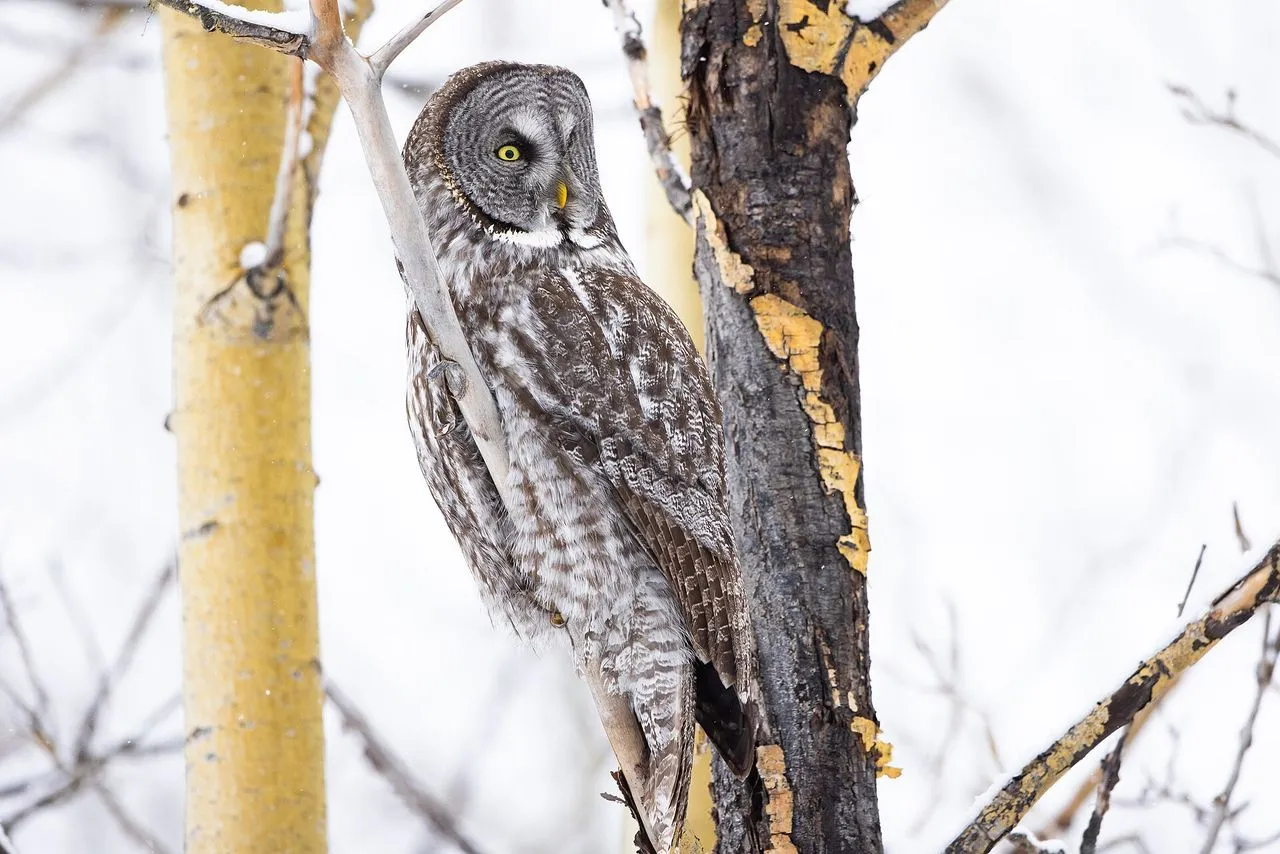
Owls (Strigiformes, 240 species) are divided into Tytonidae (barn owls, heart-shaped face) and Strigidae (typical owls, round face). They have asymmetrical ears for locating prey in darkness, specialized feathers for silent flight, and forward-facing eyes. Most hunt at night; some like Snowy Owl are diurnal. Listen for calls at dusk, Great Horned, Barred, and Eastern Screech-Owl are the most widespread North American species.
Strigiformes is an order of around 240 species of mostly nocturnal predators distributed across every continent except Antarctica, ranging in size from the 31-gram Elf Owl (Micrathene whitneyi) to the 4.2-kilogram Blakiston's Fish Owl (Ketupa blakistoni).
I'm Dr. James Whitfield, an ornithologist trained at Oxford and formerly a survey coordinator with the British Trust for Ornithology, with around 12,000 hours of fieldwork behind me across garden, farmland, and upland sites, a significant portion of it conducted after dark. What follows is a working reference covering taxonomy, the biology behind the key adaptations, and practical guidance on finding owls without disturbing them.
Taxonomy
Two families sit under Strigiformes.
Tytonidae, the barn owls. Around 20 species, characterised by a heart-shaped facial disc formed from a continuous ruff of stiff feathers, a divided sternum, a distinctive comb-like serration on the middle claw, and relatively long legs. The most widespread member, the Barn Owl (Tyto alba), holds the record for the most widely distributed land bird in the world, occurring across six continents.
Strigidae, the typical owls. Around 220 species taking in everything from the diminutive Pygmy Owls (Glaucidium spp.) through the large eagle-owls (Bubo spp.) to the streaked eared owls (Asio spp.). Facial discs in this family are generally round rather than heart-shaped, and skull anatomy differs from Tytonidae in several structural details, including the configuration of the temporal bone.
Species diversity peaks in the tropics and subtropics. Temperate Europe and North America each hold around 10 to 20 resident species, with a handful of winter visitors from Arctic and boreal zones augmenting that total in irruptive years.
Owls Are Not Raptors
The popular grouping of owls with hawks, eagles, and falcons under the label "raptors" is a functional description, not a phylogenetic one. Molecular studies from the 1990s onward, most decisively the large-scale analyses published by Hackett et al. in Science (2008) and confirmed by subsequent whole-genome sequencing work, placed Strigiformes not within Accipitriformes or Falconiformes but in a completely separate clade, more closely related to kingfishers, rollers, and woodpeckers than to any diurnal bird of prey.
The shared features, talons designed for gripping prey, a hooked bill for tearing flesh, forward-facing eyes, and broad carnivorous diet, are the result of convergent evolution. Owls and diurnal raptors arrived at similar solutions to similar ecological problems independently, from different starting points in the vertebrate tree. This matters practically: the behavioural ecology and sensory biology of owls cannot be assumed to follow the hawk template. Owls are a separate evolutionary experiment, and treating them as nocturnal hawks will consistently produce the wrong predictions.
Silhouette Identification
The owl silhouette is distinctive enough that family-level identification rarely requires much disambiguation, even in poor light. The key characters:
- Round or heart-shaped head with no visible neck. Owls have fourteen cervical vertebrae (humans have seven), which allows the near-270 degree head rotation familiar from wildlife footage, but the feathering compresses the neck to near-invisibility, giving a large-headed, neckless outline shared by no other bird group.
- Large facial disc. Even in silhouette, the disc gives the face a flat, forward-facing aspect that is unlike any diurnal raptor. Barn Owls in car headlights appear as a pale disc on wings, nothing more.
- Upright posture. Owls perch upright on a horizontal branch, not canted as woodpeckers do, and not hunched like nightjars.
- Ear tufts, where present, project above the crown and are often the first feature visible at rest. These are feather tufts with no acoustic function whatsoever. The actual ear openings are hidden beneath facial feathers, asymmetrically placed in many species.
Wing shape varies by foraging strategy. Barn Owls and Short-eared Owls (Asio flammeus) have long, buoyant wings suited to quartering flight over open ground. Tawny Owls (Strix aluco) have shorter, broader wings for manoeuvring through woodland. Long-eared Owls (Asio otus) sit between the two, with wings intermediate in both length and aspect ratio.
The Facial Disc: An Acoustic Collecting Structure
The facial disc is not primarily a visual feature. The stiff feathers forming the ruff act as a parabolic collector, focusing incoming sound waves toward the ear openings in the same way a satellite dish focuses radio waves. The mechanism was quantified most clearly for Tyto alba by Roger Payne in his 1971 paper in Living Bird, demonstrating that Barn Owls can locate and strike prey in total darkness (0 lux) by sound alone, with accuracy of approximately 1 degree in both azimuth and elevation.
The vertical precision depends on anatomical asymmetry. In Tyto alba, the left ear opening sits approximately 1.5 cm higher on the skull than the right, and the left half of the facial disc is correspondingly enlarged. Sound arriving from below reaches the right ear fractionally before the left; sound from above does the reverse. The brain computes three-dimensional source position from the timing and intensity differences between the two channels simultaneously.
The degree of asymmetry varies across species and correlates with hunting strategy. Aegolius funereus (Tengmalm's Owl) and the Boreal Owl have similarly asymmetric skulls and regularly strike prey through snow. The Burrowing Owl (Athene cunicularia), which hunts visually in open daylight, has relatively symmetrical ears and a reduced facial disc by owl standards. The Tytonidae, as a family, carry the most extreme asymmetry of any bird group yet measured.
Calls Before Sight
For the nocturnal majority of species, call identification is the primary field skill. Visual confirmation typically follows a heard bird rather than preceding it. Positioning yourself downwind from a likely site 20 to 30 minutes after sunset, on a still night, is the most productive listening strategy available without specialist equipment.
| Species | Call | Season | Notes |
|---|---|---|---|
| Barn Owl (Tyto alba) | Long, harsh screech, 2-3 seconds | Year-round, dusk/night | Not a hoot; often described as a scream |
| Tawny Owl (Strix aluco) | Quavering hoooooo and sharp ke-wick contact call | Autumn to spring | The classic "twit-twoo" is a duet between these two call types |
| Long-eared Owl (Asio otus) | Low, moaning hoo repeated 20 or more times | February to April | Easy to overlook; carries poorly in wind |
| Short-eared Owl (Asio flammeus) | Hoarse barks in flight; wing-clapping display | Breeding season | More visual than vocal; hunts in daylight |
| Little Owl (Athene noctua) | Plaintive, upward-inflected keeoo | Year-round, often at dusk | Surprisingly loud for a 170 g bird |
| Great Horned Owl (Bubo virginianus) | Deep, rhythmic hu-hu-hoo-hoo-hoo | December to March especially | Carries 1 to 2 km in still air |
Wind above Beaufort scale 3 renders most owl listening futile. A calm, cold night with clear skies is consistently the most productive condition.
Owl Pellets and What They Tell You
Owls cannot fully digest bone, fur, feathers, or the chitinous exoskeletons of beetles. These materials are compressed in the gizzard and ejected as a compact, roughly cylindrical pellet, typically 2 to 8 hours after a meal. Pellets accumulate below regular roost sites and are among the most reliable signs of consistent owl presence at a location.
Pellet composition is diagnostic at the family level. Barn Owl pellets are dark, glossy when fresh, and contain whole, undamaged small-mammal skulls, because the Barn Owl's stomach acid is comparatively weak and preserves bone. Pellets from most Strigidae show more acid etching; skulls are present but often fragmented, and teeth are partially dissolved.
Dissecting a pellet reveals diet with unusual precision. Barn Owl pellets from farmland-edge habitat typically yield Field Voles (Microtus agrestis), Wood Mice (Apodemus sylvaticus), Common Shrews (Sorex araneus), and occasionally Water Voles or small birds, in proportions that shift with local prey availability. Long-term pellet series from fixed roosts have been used to track vole population cycles across decades, because the owl is in effect running a continuous small-mammal census at any site where it roosts regularly.
If you locate a pellet accumulation, do not approach the roost itself to collect them. The pellets on the ground are accessible without disturbing the bird above.
Hunting Behaviour
Three broad strategies cover most temperate species.
Acoustic quartering. The Barn Owl and Short-eared Owl fly slowly and low over open ground, typically between 1.5 and 4 metres, listening for prey movement in grass. The Barn Owl uses its asymmetric hearing to triangulate source position before committing to a strike. The leading edge of the primary feathers carries a comb-like fringe that breaks up airflow turbulence; the trailing edge is soft-fringed rather than stiff-edged. The result is wing noise well below the owl's own hearing sensitivity, allowing continuous acoustic monitoring through the final approach.
Perch-and-pounce. The Tawny Owl, Great Grey Owl (Strix nebulosa), and most Bubo eagle-owls sit motionless on an elevated perch, sometimes for hours, before dropping onto prey detected by sight or sound from below. This is energetically cheaper than quartering and is the dominant strategy in woodland, where long-range acoustic hunting is impractical.
Active pursuit. Small owls including the Pygmy Owls (Glaucidium spp.) and the Hawk Owl (Surnia ulula) hunt diurnally or crepuscularly, taking small birds in short aerial pursuits. These are exceptions; the wing morphology and sensory biology of most owls are not configured for sustained chase.
Where to Find Owls
Barn Owl. Road edges through improved and rough grassland at dusk, particularly where long tussock grass borders the verge. Barn Owls quarter these corridors predictably, and a slow drive along a known route at dusk with a passenger watching is one of the most reliable viewing methods available. In North America the same behaviour occurs along road margins through farmland and coastal marsh. See the full Barn Owl profile for site-selection detail.
Tawny Owl. Mature deciduous woodland, parks, and large gardens with old trees. Listen from the garden from September onward. Tawnies establish territories vocally from October and are among the more frequently heard garden owls in suburban Britain.
Long-eared Owl. Winter communal roosts in dense conifer plantations, hawthorn thickets, or ivy-covered hedgerows offer the best access point. Groups of 2 to 20 birds roost together from November through February; local wildlife trusts frequently know active roost sites. The birds are cryptically still by day but reveal themselves through pellet accumulations and whitewash beneath the roost.
Short-eared Owl. Open moorland, rough grassland, and coastal marshes. Unusually for an owl, it hunts in good light, often from mid-afternoon onward. A moor with an active vole cycle in autumn can hold impressive numbers of quartering birds simultaneously.
Great Horned Owl. Common across North America in woodland edge, suburban parks, and urban areas with mature trees. Territorial calling from December onward is the best locator. See the Great Horned Owl profile for behaviour and breeding timing.
Common Confusions
Long-eared Owl vs. Short-eared Owl. Both are medium-sized, streaked, and occur in open habitats in winter. The Long-eared has prominent, widely spaced ear tufts and a vivid orange-yellow iris; the Short-eared has very short tufts, often invisible at any distance, and a yellow iris in a notably flatter face. The decisive separator: Short-eared hunts in daylight, Long-eared is primarily nocturnal.
Barn Owl vs. Little Owl at distance. Barn Owls appear entirely white in car headlights. Little Owls are spotted brown above with white streaking below and are much smaller, roughly starling-sized at 170 g. Flight style also separates them: Barn Owl has buoyant, wavering, slow wingbeats; Little Owl is direct and bounding.
Tawny Owl juveniles vs. unknown calling birds. Newly fledged Tawny Owls in May and June produce a persistent, high-pitched whistle that many observers mistake for a distressed mammal. These birds are not lost; adults continue to feed them for weeks after fledging and will find them by that call. Interference is counterproductive.
Notable Species
The order contains far more species than a single guide can cover. Full profiles for the two most commonly encountered in garden and farmland contexts across Britain and North America:
- Barn Owl (Tyto alba): the acoustic precision hunter, with nest-box specifications.
- Great Horned Owl (Bubo virginianus): the most widespread large owl in the Americas; diet, calls, and breeding phenology.
Others worth knowing: the Snowy Owl (Bubo scandiacus), an irruptive visitor to northern latitudes; the Little Owl (Athene noctua), introduced to Britain in the 1870s and now a familiar farmland resident; the Burrowing Owl (Athene cunicularia), the only regularly diurnal owl of North American open country; and the Tawny Owl (Strix aluco), the species most British garden birders will hear before they see any other owl in their lives.
Photographing Owls Without Disturbing Them
The most important rule is also the most frequently ignored: do not use audio playback to attract owls. Playback provokes territorial responses, drains energy that breeding birds cannot spare, and can cause nest abandonment when used near active nests. In the UK it is illegal under Schedule 1 of the Wildlife and Countryside Act 1981 to intentionally disturb nesting Schedule 1 species, which includes Barn Owls and several others.
For Barn Owls: position at a known quartering route 30 minutes before dusk, remain stationary, and wait. Car-based observation is less disturbing than standing in the open; many Barn Owls have habituated to slow-moving vehicles and will quarter within 30 metres of a stationary car. A 400mm or longer prime lens from a car window with a beanbag mount is the standard practical setup.
For roosting Long-eared Owls: locate the roost from pellets and whitewash on the ground without approaching close enough to flush the birds. The birds are stationary, so 300mm with adequate light is usually sufficient.
Do not approach active nest sites. Barn Owl nest-box cameras, operated remotely, produce better footage than any close approach and generate no disturbance at all.
See Also
- The Complete Raptors Guide: diurnal birds of prey for comparison of convergent predatory adaptations and hunting ecology.
- The Complete Corvids Guide: intelligent omnivores for comparison of social behaviour and vocal complexity.
- The Complete Attracting Guide: practical guidance for nest boxes and feeding stations that support owl prey species.
- Barn Owl: the acoustic precision hunter with full nest-box specifications and habitat guidance.
- Great Horned Owl: the most widespread large owl in the Americas with call analysis and breeding phenology.
- Why Is an Owl Calling at Night?: species-by-species call diagnostic for the 8 most likely temperate-zone owls, with season and time-of-night tables.
- Why Is an Owl in My Yard?: the daytime sighting companion; diurnal species, roost identification, and when to call a rehabilitator.
- Great Horned Owl vs Barred Owl: the canonical large-owl ID problem with a 12-row side-by-side.
- Eastern vs Western Screech-Owl: bill colour as the diagnostic; voice and range fill in the rest.
Frequently Asked Questions
How do owls hunt in the dark?
Owls have highly asymmetric ears (one higher than the other) that detect the precise location of tiny sounds. Their facial disc funnels sound to the ears. They also have specialized feathers that make flight nearly silent, allowing them to hear prey while approaching undetected.
What do owl pellets tell you?
Owl pellets are regurgitated undigested parts (bones, fur, feathers). Dissecting pellets reveals exactly what the owl ate, small mammals, birds, insects. Pellet analysis is a non-invasive way to study owl diet. Great Horned Owl pellets contain mostly mammal remains; Barn Owl pellets often show the highest diversity.
Why do some owls have 'ear' tufts?
Those 'ears' (horned Owls, Great Horned) are feather tufts called plumicorns, not ears. They help with camouflage by breaking up the owl's outline against tree bark. They may also communicate mood or territorial presence. Great Horned Owls use these tufts to appear larger when threatened.
Do owls actually turn their heads 360 degrees?
No. Owls can rotate their heads about 270 degrees, three-quarters of a full circle. This is possible because owls have 14 neck vertebrae (twice as many as humans) and special blood vessels that prevent blood flow from being cut off during extreme rotation.