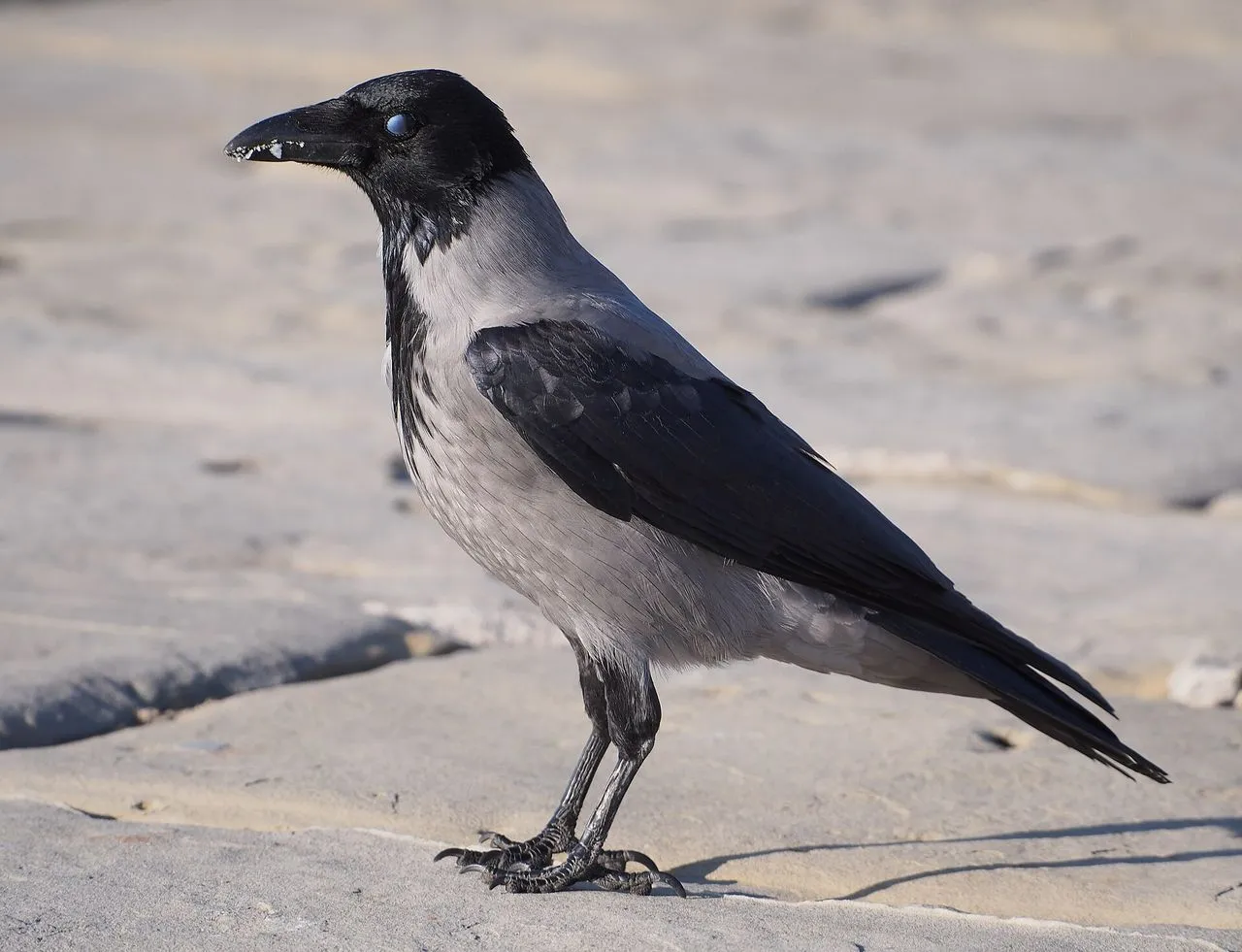
Corvus cornix Linnaeus, 1758, the Hooded Crow, is the grey-bodied counterpart of the Carrion Crow, black-headed, black-winged, and black-tailed, with a narrow European hybrid zone that has become a standard example of plumage divergence despite ongoing gene flow.
Part of the Complete Corvids Guide.
Identification
Visual
Hooded Crow is immediately recognisable in clean adult plumage: black head, throat, wings, tail, and thighs, with ash-grey mantle, back, breast, belly, and flanks. The bill is black and crow-like, the tail squared, and the body size similar to Carrion Crow. The contrast is strongest in fresh plumage and good light; worn or dirty birds can look browner or sootier.
Carrion Crow differs by being all black. Hybrid birds may show grey patches on otherwise black plumage, black mottling in grey areas, or intermediate hood patterns. Rook has a bare pale face as an adult and different structure. Jackdaw is smaller, pale-eyed, and grey-naped rather than grey-bodied. Raven is larger with wedge tail and heavier bill.
| Feature | Hooded Crow (Corvus cornix) | Carrion Crow (C. corone) | Rook (C. frugilegus) |
|---|---|---|---|
| Length | About 18-19 in (45-47 cm) | 18-19 in (45-47 cm) | 17-18 in (44-46 cm) |
| Body pattern | Ash-grey body; black head, wings, tail | Wholly black | Wholly black; bare pale face in adults |
| Tail | Squared | Squared | Squared, often with longer-winged look |
| Voice | Carrion-like harsh caw | Harsh caw | More nasal social cawing |
| Best field clue | Grey-black plumage and range | All-black plumage and western range | Bare face, peaked head, flock or rookery context |
Juveniles are duller and can show less crisp contrast, but the hooded pattern is generally apparent. In regions where Carrion and Hooded Crows meet, careful notes on the amount and placement of grey are more useful than forcing every bird into a pure category.
Audio
Voice is much like Carrion Crow: harsh caws, scolds, and contact calls. Claims of reliable vocal separation are weak. Local dialect and individual variation exist, but plumage and geography do the main identification work.
In mixed zones, a crow's call rarely settles ancestry. A grey-black bird giving a Carrion-like caw is still expected; the two are close relatives and often interbreed where they meet.
Distribution
Hooded Crow occurs across northern, eastern, and southeastern Europe and into western Asia, including Ireland, northern and western Scotland, Scandinavia, Italy, the Balkans, eastern Europe, and parts of the Middle East depending on taxonomy. It replaces Carrion Crow across much of the north and east.
The hybrid zone with Carrion Crow runs through parts of Scotland, central Europe, northern Italy, and other contact regions. The zone is narrow relative to the broad ranges, suggesting selection against some mixed phenotypes or strong mate preference, even though hybrids can be viable and fertile.
Habitat
Habitats match Carrion Crow broadly: farmland, pasture, coastal shore, river valleys, towns, woodland edge, moorland edge, islands, and refuse sites. In Ireland and Scotland it is a familiar bird of sheep pasture, seaweed-covered shorelines, village edges, and open country with scattered trees.
The species is especially conspicuous along coasts, where it works wrack lines, mussel beds, fish waste, stranded animals, and seabird colonies. Inland birds feed on fields, roadsides, dumps, and around livestock.
Diet and Foraging
Hooded Crow is omnivorous: carrion, insects, worms, grain, berries, eggs, nestlings, shellfish, fish scraps, small mammals, and refuse. Coastal birds drop shellfish onto rocks or roads, probe seaweed, and patrol tide lines. Inland birds follow ploughs, inspect dung, and scavenge road-kill.
As with Carrion Crow, livestock conflict requires care. Hooded Crows scavenge lamb carcasses and may attack weak neonates or exposed tissue, but many observations of feeding on lambs occur after death. Management decisions should be based on direct evidence, not the visual shock of black-and-grey crows at a carcass.
Caching is common with surplus food. Meat, bread, eggs, and shellfish pieces may be hidden in grass, moss, soil, or roof structures. Theft by other crows encourages quick feeding or re-hiding.
Breeding Biology
Pairs are territorial. Nests are stick platforms lined with wool, hair, grass, and softer material, usually in trees, cliffs, pylons, or buildings. In treeless island landscapes, cliffs and human structures become more important. Clutch size is commonly 3-6 eggs.
Breeding begins in spring, with local timing shaped by latitude and weather. The female incubates while the male provisions her; both parents feed young. Fledglings remain dependent for weeks and may stay near the territory into autumn.
Nest defence is vigorous. Hooded Crows mob eagles, buzzards, gulls, owls, foxes, cats, and humans. On islands with ground-nesting seabirds or waders, they can be significant egg and chick predators, particularly where human food subsidies raise crow density above natural levels.
Notes
The Carrion-Hooded Crow system is more than a field-identification curiosity. Genomic studies have found that large parts of the genome are weakly differentiated while regions associated with pigmentation and mate choice show stronger divergence. In plain terms, the birds can exchange genes, but plumage and social preference help maintain recognisable forms.
That makes the hybrid zone worth watching carefully. A mottled crow in Scotland or northern Italy is not a nuisance record; it is a data point in an active speciation process. Photographs should show back, breast, wings, tail, and head, not merely a distant black-and-grey impression.
Island populations deserve separate attention. On Hebridean and Irish coasts, Hooded Crows move between pasture, strandline, cliffs, and villages within a small daily circuit, so apparent habitat breadth may belong to one pair rather than to many independent birds. Repeated observations of direction of travel, tide state, and food item give better evidence than a single coastal checklist.
The species also illustrates how plumage can dominate human perception. A Hooded Crow looks less like a Carrion Crow than its genome suggests, and that mismatch is precisely why the pair remains useful for teaching speciation.
See Also
Frequently Asked Questions
How do I distinguish a Hooded Crow from a Carrion Crow?
Plumage is decisive in clean adults: Hooded Crow has black head, wings, and tail with an ash-grey body, while Carrion Crow is wholly black. Voice and structure are essentially identical, so plumage and geography do the identification work. In contact zones, hybrid birds may show grey patches on otherwise black plumage, or black mottling in grey areas, record placement of grey rather than forcing a category.
Where does the Hooded Crow occur in Britain and Ireland?
Hooded Crow replaces Carrion Crow across Ireland, northern and western Scotland, and some islands. The hybrid zone with Carrion Crow runs through parts of Scotland, where mottled intermediates occur. In Hebridean and Irish coasts the species moves between pasture, strandline, cliffs, and villages within compact daily circuits.
Are Hooded Crow and Carrion Crow separate species?
Current European treatments commonly recognise both as full species, though they were long treated as subspecies. Genomic studies find large parts of the genome weakly differentiated while regions linked to pigmentation and mate choice show stronger divergence, meaning the birds exchange genes but plumage and social preference maintain recognisable forms.
What do Hooded Crows eat on coasts?
Coastal Hooded Crows work wrack lines, mussel beds, fish waste, stranded animals, and seabird colonies. They drop shellfish onto rocks or roads to break them open, probe seaweed, and patrol tide lines. Inland birds feed on fields, roadsides, dumps, and around livestock, diet is omnivorous and closely tracks local food availability.
Sources & References
- Svensson, L., Mullarney, K. & Zetterström, D. (2010). Collins Bird Guide (2nd ed.). HarperCollins.
- British Trust for Ornithology. (2024). BirdFacts: Hooded Crow. bto.org
- Poelstra, J.W. et al. (2014). The genomic landscape underlying phenotypic integrity in the face of gene flow in crows. Science, 344(6190), 1410-1414.
- Madge, S. & Burn, H. (1994). Crows and Jays: A Guide to the Crows, Jays and Magpies of the World. Helm.