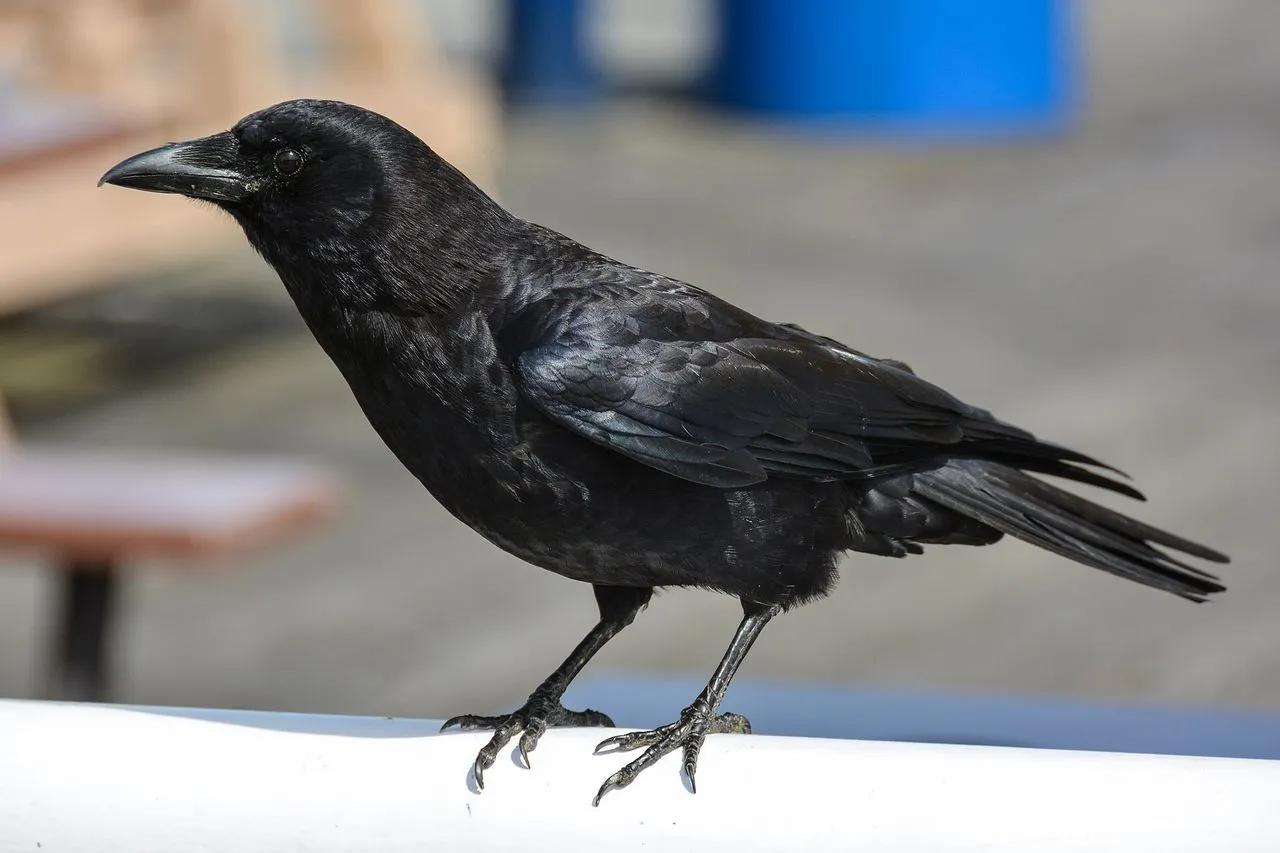
Corvus brachyrhynchos Brehm, 1822, the American Crow, breeds across North America from the Pacific to the Atlantic and from southern Canada to central Mexico, wintering across virtually the entire contiguous United States. It occupies a wider range of habitat types than any other North American corvid, from old-growth forest edge to city centre, and its winter communal roosts have in recent decades shifted progressively into urban cores.
Part of the Complete Corvids Guide.
Identification
Crow vs. Raven
The most common field error in this species is confusion with the Common Raven (Corvus corax). Both are wholly black passerines with heavy bills and hoarse vocalisations; range is not a reliable separator in the mountainous west and across Canada. The structural differences are consistent and learnable within a field season.
| Feature | American Crow (C. brachyrhynchos) | Common Raven (C. corax) |
|---|---|---|
| Length | 17–21 in (43–53 cm) | 22–27 in (56–69 cm) |
| Weight | 11–22 oz (316–620 g) | 24–57 oz (689–1,625 g) |
| Tail shape | Square; fan-shaped in flight | Wedge-shaped; diamond profile at full spread |
| Bill | Slender; culmen straight | Massive; culmen strongly arched; nasal bristles cover basal half |
| Throat feathers | Flat | Hackled, shaggy in adults |
| Vocalisation | Flat, nasal "caw" | Deep, hollow "gronk" or "prruk"; 5–10 Hz lower fundamental frequency |
| Flight | Steady flapping; brief glides | Sustained soaring; acrobatic rolling and tumbling |
Tail shape in flight is the most reliable single character. On a banking crow the tail closes to a blunt fan; on a raven it closes to a pointed wedge. This distinction holds across all plumage ages and is visible at 200 m with adequate light. Vocalisation is reliable at greater distances: a raven's call carries a hollow resonance, produced in part by its substantially larger pharyngeal volume, that a crow's flat "caw" never approximates.
Fish Crow
Corvus ossifragus, the Fish Crow, is structurally near-identical to C. brachyrhynchos throughout their overlapping Atlantic and Gulf coast range. The reliable separator is vocalisation: the Fish Crow gives a short, nasal two-note "uh-uh", the second syllable the same pitch or lower, rather than the crow's flat "caw." C. ossifragus has expanded substantially inland along major southeastern river systems since the 1970s; any crow at a large interior southeastern reservoir should have its call checked.
Winter Roost Behaviour
American Crow communal winter roosts reach scales that regularly surprise those who have not encountered one. Roosts of 50,000 to 500,000 individuals have been documented, and many of the largest now form within cities, Sacramento, California; Auburn, New York; Lancaster, Pennsylvania; Danville, Indiana, rather than in the agricultural fields and woodland edges that early ornithological accounts described.
The aggregation begins in autumn as local breeding-season pairs and their offspring join progressively larger pre-roost flocks. By midwinter a large roost draws crows from a foraging radius of 50 miles or more. Birds stream in each evening from multiple directions, typically staging in smaller assemblies on power lines or bare trees before moving to the final roost site at or just after last light. Favoured sites, large trees with overhead cover, proximity to urban food, freedom from persistent disturbance, are returned to across multiple winters. The information-centre hypothesis holds that subordinate individuals track successful foragers departing the roost each morning, gaining access to food patches they could not locate independently; a thermoregulatory function in midwinter is likely also present.
Face Recognition
John Marzluff's research group at the University of Washington conducted the most rigorous experimental investigation of face recognition in this species, with results published in PNAS in 2008 and 2010.
The 2008 paper established that crows captured by researchers wearing a specific rubber "dangerous" mask subsequently scolded individuals wearing that mask, not control masks, not people in different clothing, for years after the original capture event, across sites where those particular scolding birds had never been disturbed. The response intensified over time and spread beyond the immediate capture site.
The 2010 follow-up addressed social transmission. Naïve crows that had never experienced capture or direct interaction with the masked researcher nevertheless scolded the dangerous mask after observing conspecifics doing so, without any personal aversive experience. The face-specific recognition persisted when researchers changed hats, clothing, and posture while keeping the mask constant, confirming that the recognition target is facial structure rather than associated clothing or general human category.
Diet and Nesting
American Crows are dietary generalists: invertebrates, small vertebrates, eggs and nestlings of other species, carrion, grain, fruit, and urban refuse, with refuse prominent in winter urban habitats.
Nests are placed in the crotch or outer branches of large trees, typically 10–70 feet above ground, with a clutch of 3–6 eggs and one brood per season across most of the range. Offspring from the prior season frequently remain in the parental territory as non-breeding helpers, assisting with territory defence and occasionally with food provisioning to nestlings, making the American Crow a cooperatively breeding species across a significant portion of its range.
See Also
- Fish Crow
- Northwestern Crow
- Common Raven
- Great Horned Owl
- The Complete Corvids Guide
- Why Are Crows Cawing at My House?: call-cadence diagnostic for mobbing vs territorial vs family-group calling, with a duration table.
- Why Are Crows Attacking Other Birds?: mobbing, nest predation, and territorial defense, with an action table and ecological framing.
- Crow vs Raven: the six reliable marks (size, tail, voice, hackles, bill, flight) with audio cue priority.
- Why Corvids Are Intelligent: the cognitive research that explains crow face recognition and social learning.
How to identify an American crow quickly
Start with shape and voice. American crows look blocky and clean edged in flight, with a fan-shaped or squared tail and steady wingbeats. Their call is the familiar caw-caw, usually sharper and less croaky than a raven.
What do people confuse them with?
The two common traps are Common Raven and Fish Crow. Ravens are heavier, longer winged, wedge tailed, and deeper voiced. Fish Crows can look very similar, so voice and range matter more than a quick photo.
If you are sorting crows, ravens, and other blackbirds in the field, a compact guide such as The Sibley Guide to Birds, 2nd Edition helps because the comparison plates keep shape differences side by side. As an Amazon Associate, we earn from qualifying purchases, at no extra cost to you.
How big is an American crow?
American crows are roughly 16-21 inches long, with a wingspan often around 33-39 inches. Size changes with posture and distance, so use it as a clue, not the whole ID.
Frequently Asked Questions
How do I distinguish an American Crow from a Common Raven?
Look at tail shape in flight: ravens have a wedge-shaped (pointed) tail while crows have a square tail. Ravens also have shaggy throat hackles, a massive arched bill with nasal bristles covering half the upper mandible, and a deeper, hollow-sounding call. Ravens are also larger (56-69 cm vs 43-53 cm).
Why do American Crows gather in such large winter roosts?
Winter roosts serve multiple functions: thermal benefits from communal clustering, information exchange about food sources (the information-centre hypothesis), and predator avoidance. Roosts can contain tens of thousands to hundreds of thousands of birds and have increasingly shifted into urban cores over recent decades.
Do American Crows really recognize human faces?
Yes. Research by John Marzluff's group at the University of Washington showed crows remember specific human faces for years after negative encounters, scolding individuals wearing 'dangerous' masks but not control masks. This recognition spreads socially, even crows without direct experience learned to scold the dangerous mask by watching others.
What do American Crows eat?
Crows are dietary generalists: invertebrates, small vertebrates, eggs and nestlings, carrion, grain, fruit, and urban refuse. In urban areas, refuse becomes prominent in winter. They also cache food and may cooperatively breed when offspring from the prior season remain as helpers.
Sources & References
- Ehrlich, P.R., Dobkin, D.S. & Wheye, D. (1988). The Birders Handbook. Simon & Schuster.
- Cornell Lab of Ornithology. (2024). All About Birds: American Crow. birds.cornell.edu
- Sibley, D.A. (2014). The Sibley Guide to Birds (2nd ed.). Knopf.
- Marzluff, J.M. & Angell, T. (2005). In the Company of Crows and Ravens. Yale University Press.