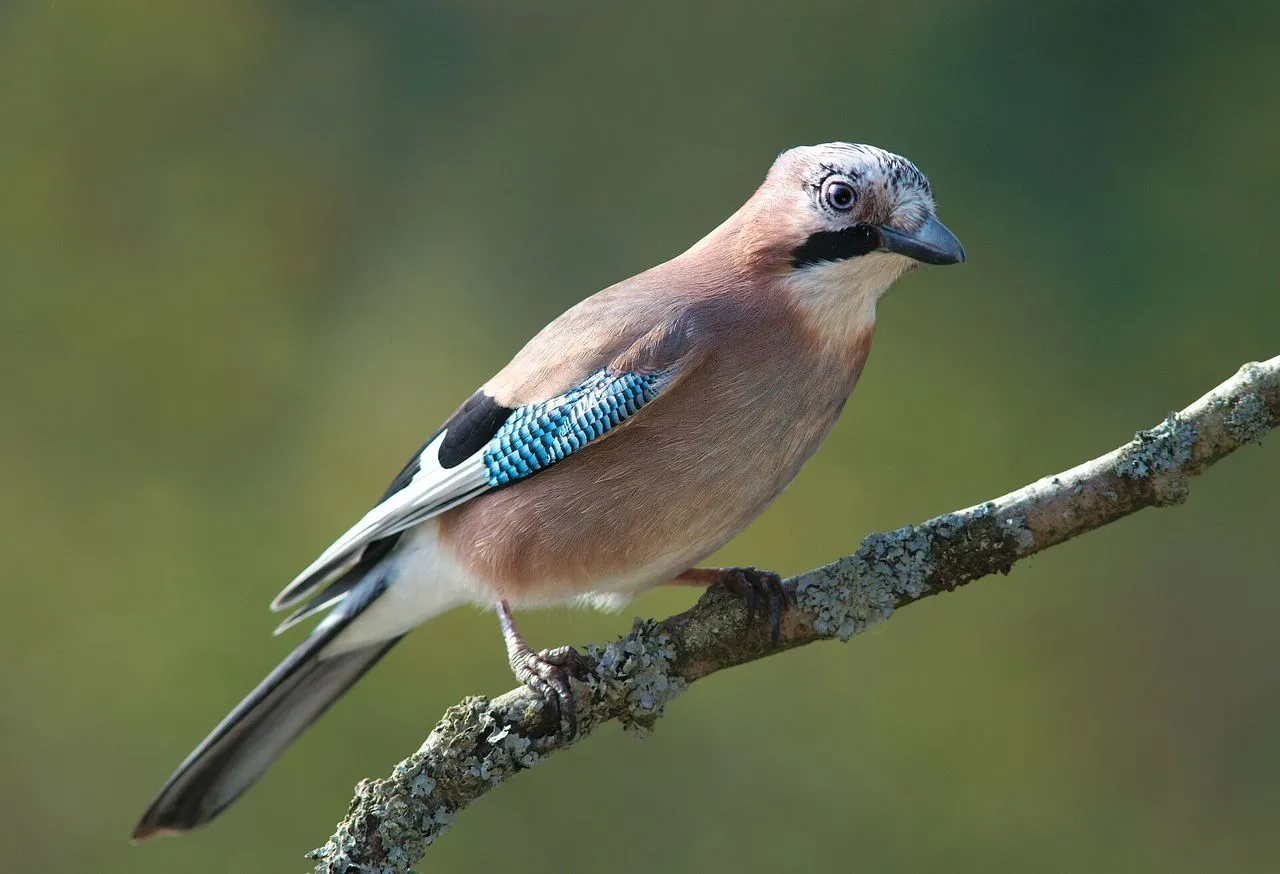
Garrulus glandarius (Linnaeus, 1758), the Eurasian Jay, is the pink-brown woodland corvid with barred blue wing coverts, and its scientific name points directly to acorns: glandarius is from Latin glans, an acorn or mast fruit.
Part of the Complete Corvids Guide.
Identification
Visual
Eurasian Jay is a medium-sized corvid, about 32-35 cm long, with warm pinkish-brown body, black moustachial stripe, pale throat, black-and-white wing pattern, white rump, black tail, and a small panel of electric blue-and-black barred coverts. The crown is streaked in many western European birds and can be raised slightly, though it is not a Blue Jay-like crest.
In flight, the white rump flashes conspicuously as the bird slips between trees. The flight is broad-winged and somewhat floppy, usually short-distance from cover to cover. No other common European woodland bird combines the pink-brown body, black moustache, blue wing panel, and white rump.
| Feature | Eurasian Jay (Garrulus glandarius) | Blue Jay (Cyanocitta cristata) | Eurasian Magpie (Pica pica) |
|---|---|---|---|
| Length | 13-14 in (32-35 cm) | 10-12 in (25-30 cm) | 17-18 in (44-46 cm) |
| Main colour | Pink-brown body; blue wing panel | Blue, white, and black; crested | Black-and-white; very long tail |
| Rump in flight | White rump flash | Blue tail with white corners | White wing and body flashes; long tail |
| Habitat | European woodland, parks, mature gardens | Eastern North American woodland | Open country with trees; towns and hedges |
| Voice | Harsh tearing scream; mimicry | Loud "jay-jay" and hawk mimicry | Dry mechanical chatter |
Juveniles resemble adults but are duller and looser-plumaged. Geographic variation across Eurasia is extensive, with differences in crown pattern, body tone, and wing markings among subspecies. In Britain and western Europe the standard field pattern is stable.
Audio
The typical call is a harsh, tearing scream, often the first sign of a jay in woodland. It is used as alarm and contact and carries well through trees. Eurasian Jays also produce soft whistles, clicks, and quiet song-like sequences in spring.
Mimicry is well developed. Buzzard calls are frequently imitated, as are Tawny Owl, goshawk, cats, and other sounds. The mimicry can be accurate enough to mislead an observer for a moment, but context helps: a buzzard-like call from inside dense oak understorey may be a jay.
Distribution
Eurasian Jay occurs across most of Europe, North Africa in parts, and a broad belt of temperate Asia to Japan and Southeast Asia, with many regional forms. It is widespread in Britain and Ireland where woodland, parks, and mature gardens provide tree cover.
Most populations are resident or locally dispersive. Irruptive movements occur in some years, especially from northern and eastern populations when acorn crops fail. Western European observers may notice autumn influxes along coasts or through urban parks.
Habitat
Primary habitat is deciduous and mixed woodland, especially oak, beech, and hornbeam, with understorey and edge. It also uses conifer plantations, orchards, hedgerow networks, wooded parks, cemeteries, and large gardens. Dense treeless farmland and open moor hold few birds except in passage.
The species is shy in heavily hunted rural areas and bolder in suburban parks where persecution is low. In closed woodland it can be common but under-recorded because it moves quietly except when alarmed.
Diet and Foraging
Diet includes acorns, beechnuts, hazelnuts, insects, caterpillars, beetles, fruit, eggs, nestlings, small rodents, and occasional carrion. Acorns dominate autumn behaviour. Jays collect acorns, carry them in the bill and throat, and bury them in soil, leaf litter, moss, grass, and woodland edges.
A single Eurasian Jay can cache several thousand acorns in a season. Recovery depends on spatial memory and landmarks; not all stores are recovered. The unrecovered fraction contributes to oak regeneration, particularly away from parent trees where seedling survival is higher. In European forestry and rewilding discussions, jay-mediated acorn dispersal is an underused natural process.
Foraging is often secretive. Jays glean canopy insects, raid nests, descend to lawns for acorns, and visit feeders for peanuts. At feeders they load several items and leave, consistent with caching rather than prolonged feeding.
Breeding Biology
Pairs form territories in woodland and begin nesting in spring. The nest is a cup of twigs, roots, stems, and fine lining, placed in shrubs or trees, often 2-5 m high but variable. It is smaller and less conspicuous than crow or magpie nests.
Clutch size is usually 4-6 eggs. Incubation lasts about 16-17 days, mainly by the female. Young fledge after roughly 19-23 days. Both parents feed nestlings and fledglings. Adults are quiet around the nest compared with their loud autumn behaviour, a useful reminder that detectability changes by season.
Nest predation includes squirrels, crows, magpies, martens, and raptors. Jays themselves take eggs and nestlings of smaller birds. As with other corvids, this role is locally visible but should not be inflated into a universal driver of songbird populations.
Notes
The Eurasian Jay is one of Europe's important oak dispersers. Rodents move acorns short distances and often cache under cover; jays move them farther, across gaps, into hedgerows, and into early-successional habitats. That matters for woodland expansion under changing land use.
The bird's secretive spring and noisy autumn produce two public images: hidden nester and screaming acorn thief. Both are incomplete. The species is best understood as a woodland corvid whose annual cycle is organised around mast, cover, and memory.
Mast failure changes detectability. In poor acorn years, birds move farther, visit gardens more readily, and appear in coastal migration counts that would otherwise record few jays. A sudden autumn presence in a city park may therefore reflect regional food shortage rather than local population growth.
For woodland surveys, record oak crop as well as jay numbers. Without the food context, annual variation in calling birds can be misread as demographic change.
See Also
Frequently Asked Questions
How do I identify a Eurasian Jay?
Look for a medium-sized corvid (32-35 cm) with warm pinkish-brown body, black moustachial stripe, pale throat, black-and-white wing pattern, white rump, black tail, and a small panel of electric blue-and-black barred coverts. In flight, the white rump flashes conspicuously as the bird moves between trees. No other common European woodland bird combines these features.
Why do Eurasian Jays cache so many acorns?
Acorns are a high-energy autumn food, and a single jay can bury several thousand in a season in soil, leaf litter, moss, or grass. Recovery depends on spatial memory and landmarks, but not all stores are recovered. The unrecovered fraction contributes to oak regeneration, especially across gaps and into early-successional habitats where seedling survival is higher than under parent trees.
Can Eurasian Jays really mimic other birds?
Yes, mimicry is well developed. Buzzard calls are frequently imitated, as are Tawny Owl, goshawk, cats, and other ambient sounds. The mimicry can be accurate enough to mislead an observer momentarily, but context helps, a buzzard-like call from inside dense oak understorey is more likely a jay than the raptor itself.
Are Eurasian Jays migratory?
Most populations are resident or locally dispersive, but irruptive movements occur in some years when acorn crops fail, especially from northern and eastern populations. Western European observers may notice autumn influxes along coasts or through urban parks. A sudden park presence often reflects regional food shortage rather than local population change.
Sources & References
- Svensson, L., Mullarney, K. & Zetterström, D. (2010). Collins Bird Guide (2nd ed.). HarperCollins.
- British Trust for Ornithology. (2024). BirdFacts: Jay. bto.org
- Cramp, S. & Perrins, C.M. (1994). Handbook of the Birds of Europe, the Middle East and North Africa, Vol. VIII. Oxford University Press.
- Madge, S. & Burn, H. (1994). Crows and Jays: A Guide to the Crows, Jays and Magpies of the World. Helm.