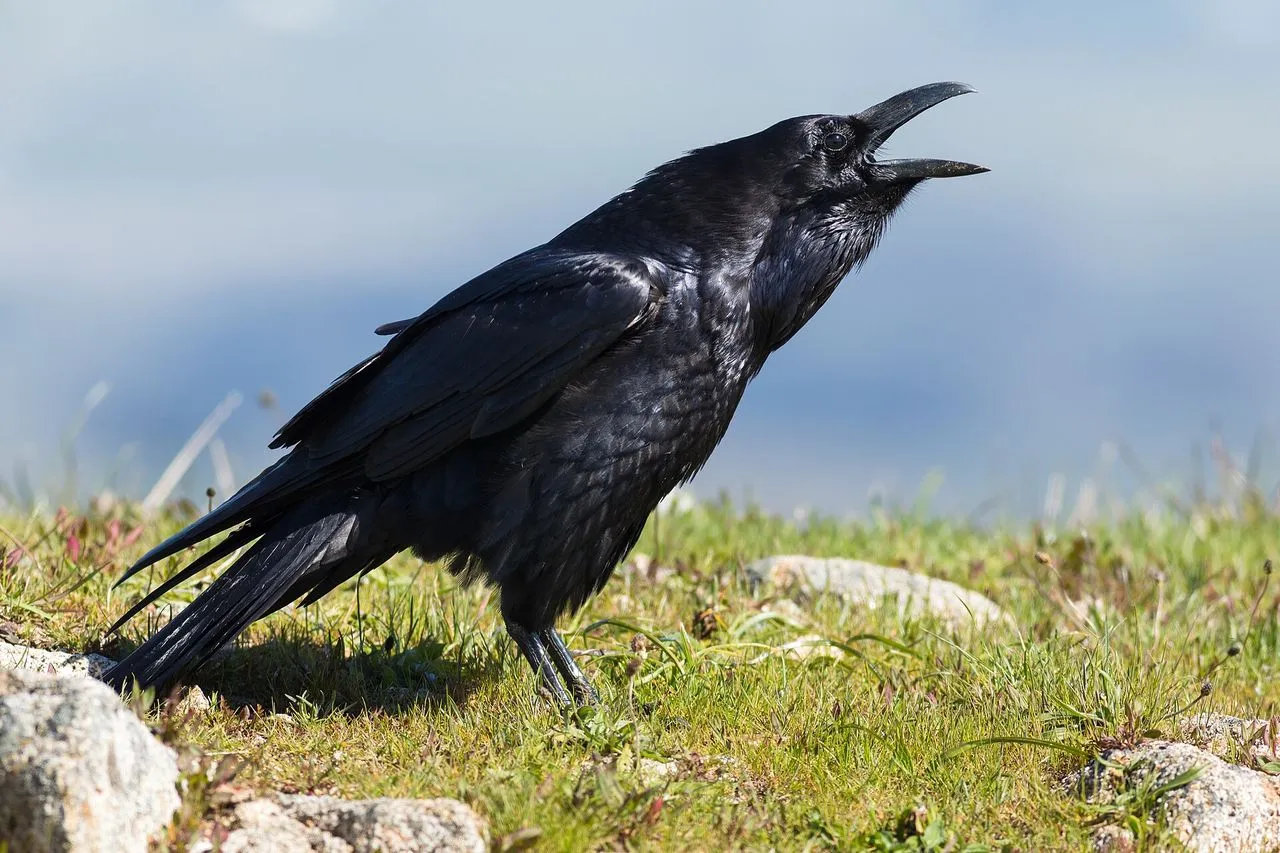
Corvus corax Linnaeus, 1758, the Common Raven, is the heaviest passerine in regular flight: large males exceed 1.5 kg, more than twice the mass of many American Crows, and the species has produced controlled studies of delayed exchange, cache protection, and social learning unusual in any wild bird.
Part of the Complete Corvids Guide.
Identification
Visual
The Common Raven is not merely a large crow. In good light the bill looks overbuilt, with a high arched culmen and nasal bristles covering much of the upper mandible. Adults show shaggy throat hackles, a heavy-headed profile, long wings, and a wedge-shaped tail that closes to a point when the bird banks. The wingbeat is slower and deeper than an American Crow's, interrupted by long glides, circling, rolls, and occasionally inverted flight in pair display.
Length is usually 22-27 in (56-69 cm), with wingspan around 45-51 in (115-130 cm). Size alone fails when a lone bird is high overhead; tail shape, flight style, and the bill-throat combination remain better characters. Juveniles are duller black-brown with a pink mouth lining early in the season, but their structure is already raven-like.
American Crow confusion is common in eastern cities and western valleys. A crow has a squared tail, flatter throat, straighter bill, shorter wings, and more continuous flapping. Chihuahuan Raven overlaps in the interior Southwest; it is smaller, shorter-tailed, and tends toward open arid grassland, with white bases to neck feathers visible only in hand or wind-ruffled close views.
| Feature | Common Raven (Corvus corax) | American Crow (C. brachyrhynchos) | Chihuahuan Raven (C. cryptoleucus) |
|---|---|---|---|
| Length | 22-27 in (56-69 cm) | 17-21 in (43-53 cm) | 19-21 in (48-53 cm) |
| Wingspan | 45-51 in (115-130 cm) | 33-39 in (85-100 cm) | About 39-43 in (100-110 cm) |
| Tail shape | Wedge-shaped; pointed when closed | Square or fan-shaped | Shorter wedge; less massive overall |
| Bill and throat | Massive arched bill; shaggy hackles | Straighter bill; flat throat | Raven-like bill; smaller, arid-country bird |
| Voice | Deep hollow "kronk" or "prruk" | Flat nasal "caw" | Higher raven calls; still deeper than crow |
Audio
Voice is diagnostic at distances where plumage is useless. The common territorial call is a deep, hollow "kronk" or "prruk," lower and more resonant than a crow's flat caw. Ravens also give knocking calls, metallic clucks, water-drop notes, harsh alarm scolds, and soft pair-contact sounds audible only at close range. Pairs often answer each other with different call types rather than identical antiphonal phrases.
The acoustic impression comes from body size and call structure, not from volume alone. A distant raven can sound nearer than it is because the low frequencies carry. A crow attempting a hoarse call still lacks the hollow, bottle-like resonance.
Distribution
The Common Raven has a Holarctic distribution across North America, Europe, North Africa, and Asia, including Arctic coasts, boreal forest, mountains, deserts, islands, farmland, and increasingly urban margins. In North America it is continuous through Alaska, Canada, the western United States, Appalachia, northern New England, and expanding parts of the Midwest and East.
Persecution and poisoning reduced ravens across much of lowland Europe and eastern North America by the early twentieth century. Legal protection, landfill food, road-kill, and reforestation have supported recovery. In Britain the species moved from western uplands into southern and eastern counties during the late twentieth and early twenty-first centuries.
Habitat
Ravens need nest sites, open foraging ground, and reliable food, but they are flexible about the mixture. Cliffs, quarry faces, tall conifers, transmission towers, ruined buildings, and coastal stacks all hold nests. High densities occur where sheep pasture, deer carcasses, seabird colonies, landfills, and road corridors supply carrion.
Breeding pairs defend large territories, especially in poor upland habitat. Non-breeding birds form mobile groups at carcasses and refuse sites; these assemblies can include dozens to hundreds, but they are not equivalent to crow winter roosts. Social rank, prior ownership of a carcass, and pair status affect access to food.
Diet and Foraging
The diet includes carrion, small mammals, eggs, nestlings, insects, grain, fruit, refuse, fish scraps, and placenta from livestock. Carrion is often central in winter and at high latitudes. Ravens locate carcasses by direct search, by following wolves, hunters, eagles, gulls, or vehicle corridors, and by attending to other ravens' movements.
Caching is routine. Ravens hide meat in snow, soil, moss, roof gutters, crevices, and vegetation, often making repeated trips from a carcass. They re-cache when observed by dominant conspecifics, and captive experiments show sensitivity to what a potential pilferer could see through a peephole. That result, published by Bugnyar and colleagues, is often discussed because the bird's behaviour changes with the visual access of the competitor, not merely with its presence.
Ravens also use displacement and distraction. At carcasses with eagles or adult territorial ravens, juveniles may grab food during conflict between others. At seabird colonies they take eggs and chicks. In human landscapes they exploit refuse, pet food, slaughter waste, and road-kill, which can bring them into conflict with conservation programmes for ground-nesting birds and desert tortoises.
Breeding Biology
Pairs are long-term and often remain on territory year-round. Courtship includes mutual preening, bill-touching, aerial rolls, tandem soaring, and display calls. Nests are large stick platforms lined with wool, moss, hair, bark, grass, and anthropogenic material. The same cliff ledge or tree can be reused for years, with substantial rebuilding.
Egg-laying begins early: February in mild lowlands, March or April in boreal and mountain regions. Clutch size is usually 3-7 eggs. Incubation is primarily by the female for about 20-25 days while the male provisions her. Young fledge at roughly 5-7 weeks and remain dependent for weeks after leaving the nest. Productivity varies strongly with food availability; pairs near predictable carrion sources can breed earlier and fledge more young.
Notes
Raven cognition literature is broad but should be stated precisely. Bernd Heinrich's field experiments documented recruitment, carcass access problems, and caching dynamics in Maine ravens. Thomas Bugnyar's group later showed tactical re-caching and sensitivity to visual access in captive and semi-free birds. Kabadayi and Osvath reported future-oriented exchange tasks in ravens, though such laboratory tasks should not be treated as simple equivalents of human planning.
The species also plays. Juveniles slide on snow, hang from branches, drop and catch objects, and perform aerial manoeuvres outside obvious feeding or predator contexts. The point is not that play is decorative; in a long-lived bird with complex social competition, low-cost motor and social rehearsal may matter.
See Also
- American Crow
- Fish Crow
- Northwestern Crow
- The Complete Raptors Guide
- The Complete Corvids Guide
- Why Are Crows Cawing at My House?: if you are hearing caws and not croaks, the species-and-cause diagnostic.
- Crow vs Raven: the canonical corvid ID problem with a 12-row side-by-side and habitat overlap notes.
- Why Corvids Are Intelligent: future planning, cache deception, and the cognitive case for raven exceptionalism.
Frequently Asked Questions
How do I identify a Common Raven?
Look for a large all-black bird with wedge-shaped tail (closes to a point in flight), shaggy throat hackles, and a massive bill with arched culmen and nasal bristles covering the basal half. Flight style includes slower, deeper wingbeats, long glides, circling, and occasional rolls. Voice is diagnostic: deep, hollow 'kronk' or 'prruk,' lower and more resonant than a crow's caw.
Why are ravens considered among the most intelligent birds?
Controlled studies have shown ravens can: delay exchange (give up immediate food for better later), protect caches from potential pilferers based on what the competitor can see, engage in tactical re-caching, and learn from observation. Bernd Heinrich documented recruitment to carcasses and problem-solving; Thomas Bugnyar's group demonstrated theory-of-mind-like abilities.
What do Common Ravens eat?
They are omnivorous with a strong emphasis on carrion, especially in winter. Diet includes small mammals, eggs, nestlings, insects, grain, fruit, refuse, and fish scraps. They locate carcasses by direct search, by following wolves, eagles, gulls, or vehicles, and by attending to other ravens. Caching is routine.
Do ravens play?
Yes, juveniles especially engage in play: sliding on snow, hanging from branches, dropping and catching objects, and aerial maneuvers outside obvious feeding or predator contexts. Play appears to provide low-cost motor and social rehearsal for a long-lived bird with complex social competition.