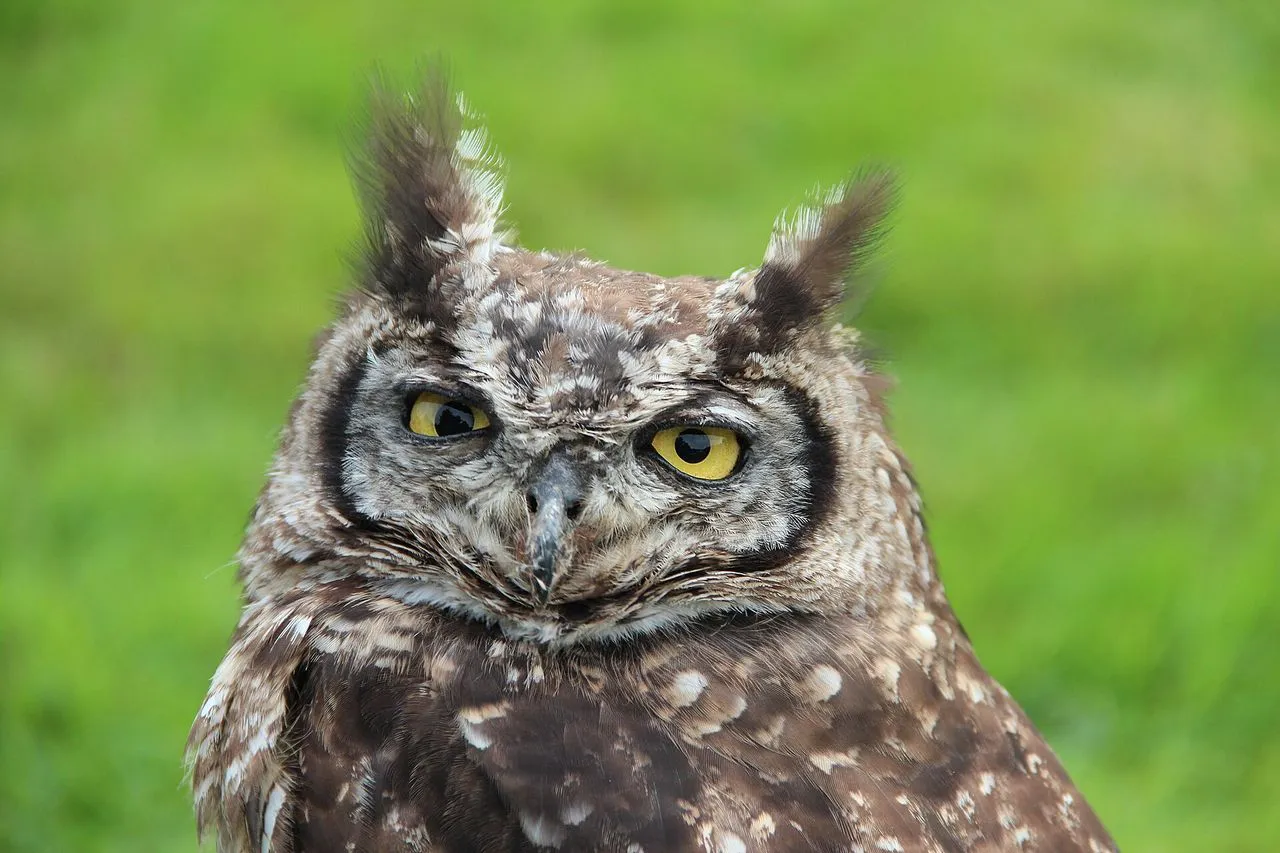
Bubo virginianus, the Great Horned Owl, is the most widely distributed large owl in the Americas and, in terms of prey diversity and ecological breadth, among the least specialised predatory birds on the continent. It was formally described by Johann Friedrich Gmelin in 1788 from Virginian specimens and takes its vernacular name from the prominent feather tufts above the crown that resemble, at a distance, a pair of horns.
Part of the Complete Owls Guide.
Identification
At 45 to 63 cm body length and 900 to 2,500 g, the Great Horned Owl is the heaviest owl across most of its range. Females are substantially larger than males, a pattern of reversed sexual size dimorphism consistent across most predatory birds and particularly pronounced here: a large female can outweigh a small male by a factor of nearly two. The species is exceeded in body length in the Americas only by the Great Grey Owl (Strix nebulosa) and is by far the more commonly encountered of the two.
| Character | Great Horned Owl (Bubo virginianus) | Long-eared Owl (Asio otus) |
|---|---|---|
| Length | 45-63 cm (18-25 in) | 31-40 cm (12-16 in) |
| Wingspan | Large, broad-winged | 86-100 cm (34-39 in) |
| Mass | 900-2,500 g (2.0-5.5 lb) | 220-435 g (7.8-15.3 oz) |
| Eyes | Yellow | Orange |
| Ear tufts | Wide-set at head sides | Closer together near crown centre |
| Main call | Deep rhythmic hoots | Single low hoo every 2-4 seconds |
Field characters:
- Ear tufts. Wide-set and prominent, visible from considerable distance on a perched bird. The spacing separates this species immediately from the Long-eared Owl (Asio otus), in which the tufts are positioned close together near the crown centre. These are feather tufts with no acoustic function; the actual ear openings are asymmetrically placed beneath the facial feathers.
- Facial disc. Round rather than heart-shaped, rust-brown to grey-brown depending on subspecies, bordered by a distinct dark ruff.
- White throat patch. A clean white bib, visible from the front in all subspecies and useful for confirmation at distance when the ear tufts are flattened.
- Eyes. Large, bright yellow iris. The combination of yellow iris and widely spaced ear tufts is the simplest two-character confirmation in the field.
- Underparts. Finely barred brown and white on the breast, with coarser barring on the flanks.
- Upperparts. Dark brown, mottled buff and grey. Plumage varies geographically: the pale B. v. subarcticus of the Canadian prairies can approach Snowy Owl paleness in winter light; the dark B. v. pacificus of the Pacific Coast is considerably browner throughout.
Voice
Bubo virginianus produces one of the most recognisable calls in North American natural history: a deep, resonant series of hoots patterned as hoo-hoo-hoooo-hoo-hoo, sometimes rendered as "who's awake, me too." The full phrasing varies between individuals and contexts, but the cadence of 3 to 8 hoots with a longer third note is consistent enough for confident identification by ear alone, without reference to habitat or time of year.
Territorial calling intensifies from December through March, with the peak in January and February when pairs are reinforcing bonds and committing to nest sites. The call carries exceptionally well in cold still air; distances of 1 to 2 kilometres are not unusual on a clear night. Males call at a noticeably lower pitch than females, and duetting pairs alternate their calls in a recognisable overlapping pattern that becomes familiar once you have heard an established pair. A pair that has held the same territory across multiple seasons will often begin calling from the same perch trees year after year.
Supplementary calls include a variety of barks, hisses, and a wavering wail from alarmed or disturbed birds. Young owls produce a persistent food-begging screech from late spring through summer, which is regularly mistaken for a Barn Owl by observers unfamiliar with juvenile Great Horned calls.
Diet
The Great Horned Owl takes a broader prey range than any other North American owl. Documented prey items from published pellet analyses and direct observation include:
- Small to medium mammals up to the size of jackrabbits and domestic cats. The owl routinely takes prey exceeding its own body weight, carrying it in the talons by flapping rather than gliding.
- Skunks (Mephitis mephitis), which it takes regularly. The Great Horned Owl has negligible olfactory sensitivity and is essentially the only significant predator of skunks across the continent. An active Great Horned Owl nest near a woodland edge often carries a persistent skunk odour from partial carcasses; this is one of the more reliable indicators of a nearby nest in late winter.
- Diurnal raptors taken from perches after dark, including Red-tailed Hawks, American Kestrels, Ospreys, and Peregrine Falcons.
- Other owls, including Barn Owls, Barred Owls (Strix varia), and smaller Strigidae species.
- Waterfowl up to the size of domestic ducks, taken from the water surface or from low roost sites.
- Reptiles, amphibians, crayfish, and large beetles in season, particularly by younger birds still developing hunting proficiency.
The dietary breadth reflects both the owl's physical capability (large talons, high grip strength relative to body mass) and its willingness to hunt across a wide range of habitats and conditions. It is genuinely an opportunistic generalist rather than a specialist that occasionally takes unusual prey.
Breeding Phenology
The Great Horned Owl breeds earlier than any other North American owl, and earlier than the vast majority of birds on the continent. Courtship calling intensifies in December, eggs are typically laid in January or February, incubation runs 30 to 37 days, and chicks hatch before deciduous leaves open. The timing is almost certainly not coincidental: the owl hunts primarily by hearing and in low light conditions, and a full deciduous canopy represents a genuine acoustic obstacle during quartering flights.
The species does not construct its own nest. It occupies the previous season's large stick nests of Red-tailed Hawks, Great Blue Herons, American Crows, and grey squirrels, and occasionally uses tree cavities or cliff ledges. Any large stick nest that was not visibly repaired and occupied by a diurnal raptor through the preceding summer is a candidate worth checking in December. The female takes sole responsibility for incubation from the first egg, brooding through temperatures that regularly reach minus 20 degrees Celsius in the northern part of the range. The male provisions all food through this period, delivering prey to the nest edge.
Clutch size is typically 1 to 3 eggs, with 2 most common. Eggs hatch asynchronously; the oldest chick is substantially larger than the youngest from the start. In poor prey years the youngest may not survive to fledging. Young birds leave the nest at 6 to 7 weeks but cannot yet fly; they climb to nearby branches using their talons and are known as "branchers" at this stage. Family groups remain loosely associated through summer, the adults continuing to provision the young into early autumn before the territory is re-established for the next breeding cycle.
Where to Find Them
Active Great Horned Owl territories can usually be located by ear between December and March. The call is loud enough to locate from a garden or open road in wooded suburban and rural areas across most of temperate North America. Once a general area is identified by sound, look in daylight for large stick nests in the canopy of mature trees. Pay particular attention to nests positioned in a dominant tree with a wide canopy view; the species favours sites with clear sightlines in multiple directions.
Daytime roost sites are in dense evergreens, spruce, fir, hemlock, where the bird sits pressed against the trunk with ear tufts flattened against the crown. Three ground signs reliably indicate an active roost: pellet accumulations on snow or bare soil, whitewash streaking down the bark below a favoured branch, and the agitated mobbing of corvids. A group of crows or ravens repeatedly diving at a fixed point in a conifer stand is worth investigating slowly and quietly.
The owl is common in suburban parks and edge habitats with mature trees and is less tied to remote woodland than its size might suggest. Cemetery woodland, golf course belts, and large garden hedgerows with adjacent open lawn all hold territories in many North American cities.
See Also
- The Complete Owls Guide: taxonomy, acoustic hunting mechanisms, pellets, and the owl/raptor non-relationship.
- Barn Owl: the continent's most acoustically precise nocturnal hunter, with a different foraging strategy and nest-box specifications.
- Barred Owl
- Snowy Owl
- Why Is an Owl Calling at Night?: the deep 4-7 hoot pattern is almost certainly this species; full ID table for the other 8 likely candidates.
- Why Is an Owl in My Yard?: if you find this species roosting in a daytime conifer, the meaning and the response.
- Great Horned Owl vs Barred Owl: ear tufts, eye colour, and voice as the four reliable separating marks; competitive dynamics with Barred Owl.
Frequently Asked Questions
How do I tell a Great Horned Owl from a Long-eared Owl?
The ear tufts are decisive. Great Horned has widely-spaced tufts at the sides of the head, while Long-eared has tufts positioned close together near the crown centre. Great Horned is also vastly larger (900-2,500 g vs about 250-435 g) and has yellow eyes versus Long-eared's orange.
Why do Great Horned Owls eat skunks?
They have negligible olfactory sensitivity and are essentially the only significant predator of skunks across North America. Active Great Horned Owl nests near woodland edges often carry persistent skunk odour from partial carcasses, which can be a reliable indicator of a nearby nest in late winter.
When do Great Horned Owls breed?
Earlier than any other North American owl. Courtship calling intensifies in December, eggs are typically laid in January or February, and chicks hatch before deciduous leaves open. The timing supports acoustic hunting before full canopy forms an acoustic obstacle during quartering flights.
Where do Great Horned Owls build their nests?
They do not construct nests. They occupy previous-season stick nests of Red-tailed Hawks, Great Blue Herons, American Crows, and grey squirrels, and occasionally use tree cavities or cliff ledges. Any large stick nest unrepaired by a diurnal raptor through summer is a candidate worth checking in December.
Sources & References
- Cornell Lab of Ornithology. (2024). All About Birds: Great Horned Owl. birds.cornell.edu
- Sibley, D.A. (2014). The Sibley Guide to Birds (2nd ed.). Knopf.
- Artuso, C., Houston, C.S., Smith, D.G. & Rohner, C. (2020). Great Horned Owl. Birds of the World. Cornell Lab of Ornithology.
- Kaufman, K. (2000). Lives of North American Birds. Houghton Mifflin.