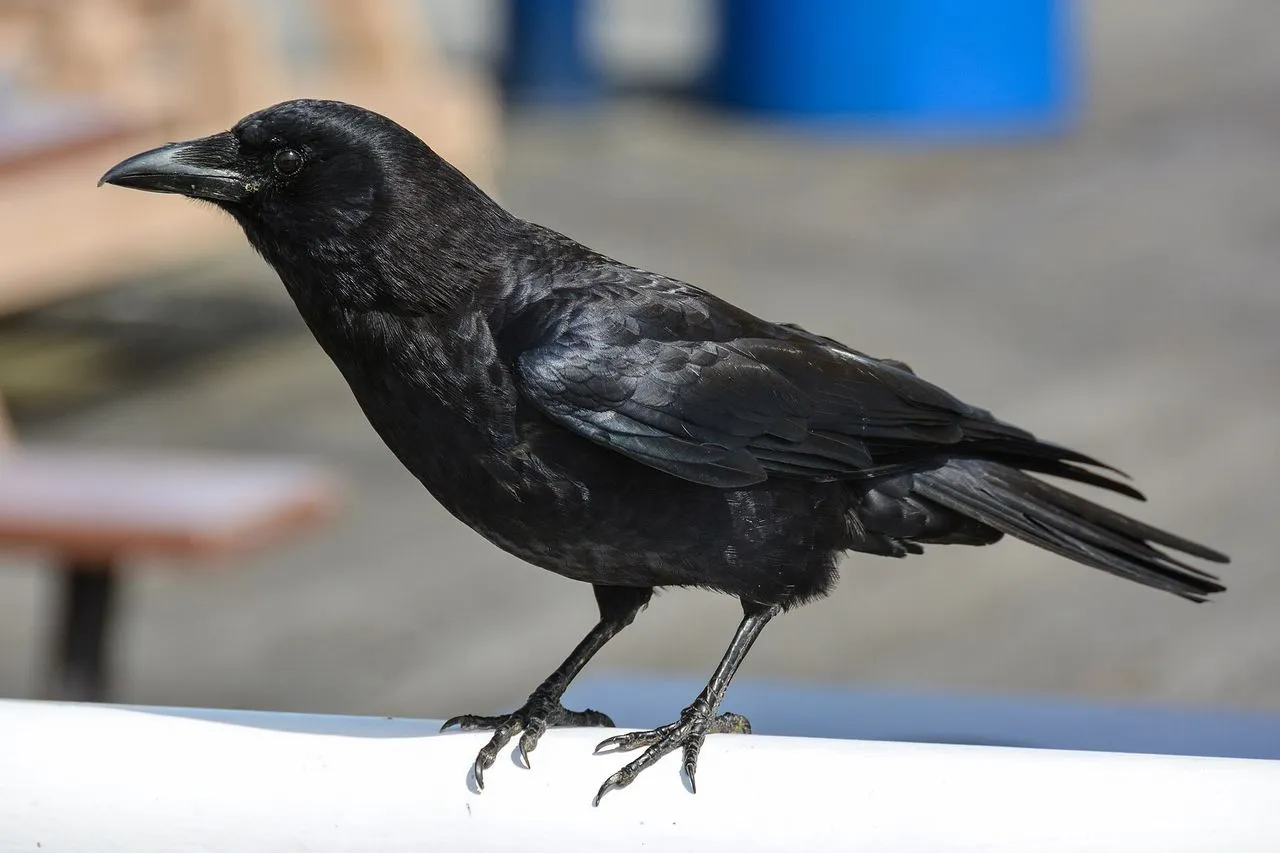
Corvus caurinus Baird, 1858, the Northwestern Crow, is the Pacific coastal crow of British Columbia and southeast Alaska, historically treated as a small marine-edge species but formally lumped with American Crow by the American Ornithological Society in 2020 after genetic and morphometric work failed to maintain a clean boundary.
Part of the Complete Corvids Guide.
Identification
Visual
Traditional field guides described Northwestern Crow as smaller than American Crow, with a shorter tail, shorter wings, slimmer bill, and slightly more rapid wingbeat. Those tendencies are real in many coastal birds from Vancouver Island northward, but they are clinal and overlap broadly with small American Crows. A lone black crow on a seawall in Victoria or Juneau cannot be identified by size with scientific confidence.
Plumage is wholly black with gloss, as in American Crow. Juveniles are duller, with browner primaries and a less polished body sheen. Bill depth varies. Coastal wear, salt, rain, and light angle often produce impressions of grey or brown that are not taxonomic characters.
If one retains the name for field description, the best candidate birds are small coastal crows feeding on intertidal invertebrates along rocky shorelines and island edges within the traditional range. Even then, records should acknowledge the current taxonomic treatment: Northwestern Crow is generally included within American Crow, Corvus brachyrhynchos.
| Feature | Northwestern-type crow (Corvus caurinus) | American Crow (C. brachyrhynchos) | Fish Crow (C. ossifragus) |
|---|---|---|---|
| Current treatment | Usually included within American Crow | Recognised species | Recognised species |
| Length | Small coastal birds; overlaps American Crow | 17-21 in (43-53 cm) | 14-16 in (36-41 cm) |
| Range clue | Pacific coast from Puget Sound to southeast Alaska | Broad North American range | Atlantic and Gulf coastal plain; inland rivers |
| Voice | Higher or hoarser caw, not diagnostic alone | Variable open caw | Nasal two-note "uh-uh" |
| Best evidence | Coastal ecology plus taxonomic caveat | Structure, call, and broad range | Repeated diagnostic calls |
Audio
Voice was once considered a useful distinction. Northwestern-type birds often give a higher, hoarser, shorter caw than interior American Crows, sometimes described as nasal or clipped. The problem is that American Crow calls vary individually, geographically, and socially. Young birds, agitated birds, and small-bodied coastal crows can all sound different from large interior birds.
Call should therefore support a coastal phenotype rather than prove a species. The diagnostic standard for Fish Crow does not apply here. There is no single two-note or tonal character that cleanly separates Northwestern-type from American Crow across the contact zone.
Distribution
The historical range ran along the Pacific coast from Puget Sound and coastal British Columbia north through southeast Alaska, closely tied to islands, inlets, beaches, and forested shorelines. Interior valleys and more southerly urban areas held American Crow phenotypes, with broad contact and intergradation around the Strait of Georgia, Puget Sound, and the lower Fraser region.
The 2020 lump followed studies showing gene flow and weak separation. This does not mean coastal crows are imaginary; it means the variation does not meet the current species-rank threshold. For natural history writing, "Northwestern Crow" remains a useful label for the small coastal ecotype, provided the taxonomic caveat is explicit.
Habitat
Habitat is maritime edge: rocky beaches, tidal flats, kelp wrack, estuaries, coniferous shoreline forest, docks, fish-cleaning stations, ferry terminals, campgrounds, and island settlements. Birds nest in trees but feed heavily where tide exposes food.
The association with human settlement is long-standing. Coastal villages, fishing harbours, refuse sites, and picnic areas supply predictable scraps. In remote areas, seabird colonies, shellfish beds, salmon streams, and marine mammal carcasses provide pulses of food.
Diet and Foraging
Diet includes mussels, clams, crabs, limpets, amphipods, fish, salmon eggs, carrion, berries, insects, eggs, nestlings, and human refuse. Intertidal foraging gives these crows much of their distinctive behaviour. They walk wrack lines, turn seaweed, prise at small invertebrates, and carry shellfish to rocks or hard surfaces.
Shell-dropping is frequent. A crow carries a mussel or clam upward, releases it onto rock or pavement, and repeats until the shell breaks or opens. Dropping height varies with substrate and shell type; excessive height wastes energy and risks theft, while insufficient height fails to fracture the shell. This is not tool use in the strict manufactured-tool sense, but it is object-substrate manipulation shaped by experience.
At salmon streams, crows feed on eggs, dead fish, and invertebrates around carcasses. Around seabird colonies they take eggs and chicks. Human refuse has probably increased local densities in some settled coastal areas, with consequences for vulnerable beach-nesting birds.
Breeding Biology
Nests are stick structures in conifers, deciduous shoreline trees, or occasionally human structures. Sites are often near forest edge with quick access to beach or tidal feeding areas. Clutch size is typically 3-5 eggs, broadly matching American Crow.
Breeding timing follows coastal climate, with many pairs nesting from March into May. The female incubates while the male provisions; both parents feed nestlings. Family groups remain together after fledging and may move along shorelines to food concentrations.
Territories can be small where food is abundant along productive coast. In leaner stretches, pairs range more widely. As with American Crow, non-breeding birds may gather at rich food sites outside the immediate nest area.
Notes
Northwestern Crow is a case study in taxonomy catching up with population biology. The old species concept emphasised average size, coastal habits, and voice. Modern treatment gives more weight to gene flow, hybrid zones, and diagnosability. The result is unsatisfying for observers who see consistent-looking small shore crows, but it is the correct caution when variation is continuous.
For field notes, record the ecology rather than forcing the rank: "small coastal American Crow / Northwestern type feeding on mussels at low tide" says more than a bare species name. It preserves the natural history that made caurinus worth naming without pretending the boundary is sharper than the evidence allows.
See Also
Frequently Asked Questions
Is the Northwestern Crow a separate species?
No, not under current taxonomy. The American Ornithological Society lumped Northwestern Crow with American Crow (Corvus brachyrhynchos) in 2020 after studies showed gene flow and weak separation across the contact zone. The name remains a useful informal label for the small coastal ecotype, provided the taxonomic caveat is explicit.
How can you tell a Northwestern Crow from an American Crow?
You often can't tell them apart with scientific confidence. Northwestern-type birds tend to be smaller, shorter-tailed, and slimmer-billed with a higher, hoarser call, but variation is clinal and overlaps broadly with small American Crows. A coastal phenotype near rocky shorelines from Vancouver Island northward is the best candidate, but a lone bird cannot be diagnosed by size alone.
Why do coastal crows drop shellfish?
Shell-dropping breaks open mussels and clams that crows can't open with the bill. A bird carries the shell upward, releases it onto rock or pavement, and repeats until the shell fractures. Drop height is calibrated by experience: too high wastes energy and risks theft, too low fails to break the shell. It is object-substrate manipulation shaped by individual learning, not manufactured tool use.
What habitats do Northwestern-type crows use?
Maritime edge: rocky beaches, tidal flats, kelp wrack, estuaries, coniferous shoreline forest, docks, fish-cleaning stations, ferry terminals, campgrounds, and island settlements. Birds nest in trees but feed heavily where tide exposes invertebrates. Salmon streams, seabird colonies, and marine mammal carcasses provide seasonal food pulses.
Sources & References
- Sibley, D.A. (2014). The Sibley Guide to Birds (2nd ed.). Knopf.
- Cornell Lab of Ornithology. (2024). All About Birds: Northwestern Crow. birds.cornell.edu
- Slager, D.L., Epperly, K.L., Ha, R.R., Rohwer, S., Wood, C., Van Hemert, C. & Klicka, J. (2020). Cryptic and extensive hybridization between ancient lineages of American crows. Molecular Ecology, 29(5), 956-969.
- American Ornithological Society. (2020). 61st Supplement to the AOS Check-list of North American Birds.