The most common cause of sustained cawing near a house is predator mobbing: an owl, hawk, snake, raccoon, or cat has been located by the local crow family group, which calls persistently from multiple angles to harass it and broadcast its location. Most bouts last 20 to 90 minutes and stop without intervention. Other causes include territorial advertisement during March to July, family group coordination, pre-roost staging in autumn and winter, food recruitment, and individual recognition of a specific human who has previously disturbed the birds.
Quick answer: crows usually caw at a house because something has their attention: a predator, a nest threat, food, a roost gathering, or another crow. One or two steady calls can be contact calls. Loud, repeated calling by several crows in one spot is often mobbing, especially if they face a tree, roofline, cat, owl, or hawk.
Quick answer: Sustained, harsh cawing from multiple American Crows converging on one spot is almost always predator mobbing. A Great Horned Owl, Cooper's Hawk, snake, raccoon, or cat has been located, and the crows are calling both to harass it and to broadcast its position to other crows in the area. The bout typically lasts 20 to 90 minutes and stops without intervention.
Best first step: Listen for how many birds are calling and from which direction. One or two birds calling slowly from a rooftop or fence line is territorial advertisement or family contact. Multiple birds calling rapidly from the same fixed point is mobbing. For mobbing, do nothing: the crows will disperse once the predator moves on.
Avoid: Trying to scare the crows away. American Crows are protected under the Migratory Bird Treaty Act outside of legal hunting seasons. More practically, this species can remember individual human faces for years. If you antagonise the local family group, documented research shows they will direct scolding at you specifically in future encounters, and that association can spread socially to crows that were not present.
Diagnosing the Call
| What you see and hear | Cadence | Duration | Likely cause | What to do |
|---|---|---|---|---|
| Multiple birds, hard rapid cawing, all converging on one fixed spot | Fast, harsh: several calls per second | 20-90 minutes | Predator mobbing: owl, hawk, snake, cat, raccoon | Wait; crows disperse when the predator moves |
| 1-2 birds, slow regular caws from perches, dawn and dusk, March to July | Measured: 1-2 calls per five seconds | Repeated bouts over days or weeks | Territorial advertisement | No action needed |
| 2-5 birds calling while moving together through the garden | Variable, conversational | Throughout the day, intermittent | Family group contact calls | No action needed |
| Building flock, calling intensifies before dusk, autumn or winter | Escalating, directional toward roost | 30-60 minutes pre-dusk | Pre-roost staging | No action needed |
| 1-2 birds, brief excited calls near a food source, then quiet | Short, excited bursts | Under 10 minutes | Food-find recruitment | No action needed |
| Calling directed at one specific person, stops when they go indoors, recurs across future visits | Persistent, targeted at individual | Recurs across encounters | Face recognition response | Do not antagonise the birds |
The Seven Causes
1. Predator mobbing
This is the single most common cause of sustained crow cawing near houses, and the acoustic signature is specific. The calls are harsh and rapid, a fast caa-caa-caa with little pause between bursts. Multiple birds converge on a fixed point rather than spreading across a wide area. At peak intensity, birds dive repeatedly at the target from multiple angles. The response then settles into a sustained lower-intensity calling phase as additional crows arrive from the surrounding territory. A typical full bout involves 4 to 12 birds and runs 20 to 90 minutes.
The predator involved is most often a Great Horned Owl roosting in a dense conifer or mature shrub. Great Horned Owls are among the most effective nest predators of American Crows, and the mobbing response directed at them is intense and persistent: crows will assemble from considerable distances, call for an extended period, and return to check the same roost site across multiple days. Barred Owls and Eastern Screech-Owls also draw mobbing. During daylight, Cooper's Hawks and Sharp-shinned Hawks are regular targets. Snakes, raccoons, and domestic cats also trigger mobbing when encountered at close range by a family group.
Identifying the mobbed animal without disturbing the scene is usually possible: listen for a second sound. A trapped owl may give contact calls. A hawk may call back. A snake or mammal is silent, so a complete absence of any second sound from the convergence point, with crows still diving, points to a non-vocal predator. A cat found under a shrub will draw 20 to 40 minutes of calling and then be followed as it moves on.
Most bouts resolve within 90 minutes. If cawing continues beyond two hours from the same fixed point, the predator may be stationary for an unusual reason: roosting in place, stuck in a confined space, or injured. That is worth investigating.
2. Territorial advertisement (March to July)
American Crows maintain year-round territories, but calling associated with territorial boundaries intensifies sharply during the breeding season. The acoustic pattern differs from mobbing: fewer birds, slower cadence, and often one or two individuals calling from prominent perches at the edge of the territory rather than a flock converging on a point. Dawn and dusk are the peak periods. Local family groups defend territories of roughly 40 to 100 hectares. If your property falls within or borders that range, predictable calling through spring and early summer is normal and will not be shortened by any intervention.
3. Family group communication
American Crows are cooperative breeders. Juveniles from previous seasons remain in the parental territory as non-breeding helpers, and the resulting family group of three to eight birds maintains constant vocal contact throughout the day. Calls coordinate movement, announce arrivals at a food source, and warn of approaching disturbances. This calling is characteristically quieter and more variable in pitch than mobbing or territorial calling, and it moves with the group rather than staying fixed to one location.
4. Pre-roost staging (autumn and winter)
In autumn and winter, crows from a wide foraging area converge on communal roosts that can hold tens of thousands of birds. In the 30 to 60 minutes before dusk, staging flocks assemble on power lines, bare trees, and rooftops along the flight line to the roost. Calling builds as more birds arrive, then the group departs together. If the cawing is concentrated in late afternoon, involves a growing number of birds, and resolves at dusk, pre-roost staging is the explanation. No action is needed or useful.
5. Food recruitment
A crow that locates a food source will call to recruit family members. Pet food left outside, an uncovered compost heap, or a road kill near the house are common triggers. The bout is short, typically under ten minutes, involves one or two birds rather than a flock, and stops once the group has assembled and moved to the food.
6. Individual face recognition
Research by John Marzluff's group at the University of Washington documented that American Crows recognise specific human faces and retain that recognition across years and locations. In a study published in Animal Behaviour (Marzluff et al., 2010), crows that had been captured while researchers wore a specific rubber mask subsequently scolded anyone wearing that mask, regardless of accompanying clothing, at different sites, for multiple years after the original capture. A second study (Cornell, Marzluff & Pecoraro, 2012) established that the recognition spreads socially: naive crows with no personal experience of the capture learned to scold the same face after observing conspecifics doing so. The recognition target is facial structure, not general human category or associated clothing.
If crows are directing calling specifically at you rather than at a point in the garden, and the intensity rises when you appear but subsides when you go indoors, individual recognition is a plausible cause. This is most likely if you have previously chased, trapped, or disturbed a member of the local family group. The Complete Corvids Guide covers this research in more detail.
7. Reflection territorial response
Less frequent than the other causes, but documented in this species. A crow that sees its own reflection in a dark window or vehicle mirror can treat it as a territorial intruder and call repeatedly while performing display postures at the glass. The calling is directed at one fixed location and involves a single bird. This differs from mobbing in every observable parameter: no flock, no convergence, no movement. It is more characteristic of cardinals and robins than of American Crows, but it occurs.
Caw, Croak, or Uh-uh?
Before diagnosing the cause, confirm the species.
The Common Raven gives a deep, hollow "kronk" or "prruk," produced in part by a substantially larger pharyngeal volume than the crow's. The acoustic difference is consistent and learnable within a field season: a raven's call carries a resonant, hollow quality that a crow's flat caw never approximates, and this difference is audible at considerable distances. Ravens are also noticeably larger, with a wedge-shaped tail that closes to a point in flight. In western North America, a raven at a rooftop is entirely plausible; in eastern cities, it is less common but expanding.
In the southeastern United States, the Fish Crow is often the species at the house. Its call is a short nasal two-note "uh-uh," with the second syllable at the same pitch or slightly lower, quite distinct from the flat caw of the American Crow. Fish Crows have expanded substantially inland along southeastern river systems since the 1970s. Any crow near a large interior southeastern river or reservoir should have its call confirmed before being assigned to Corvus brachyrhynchos.
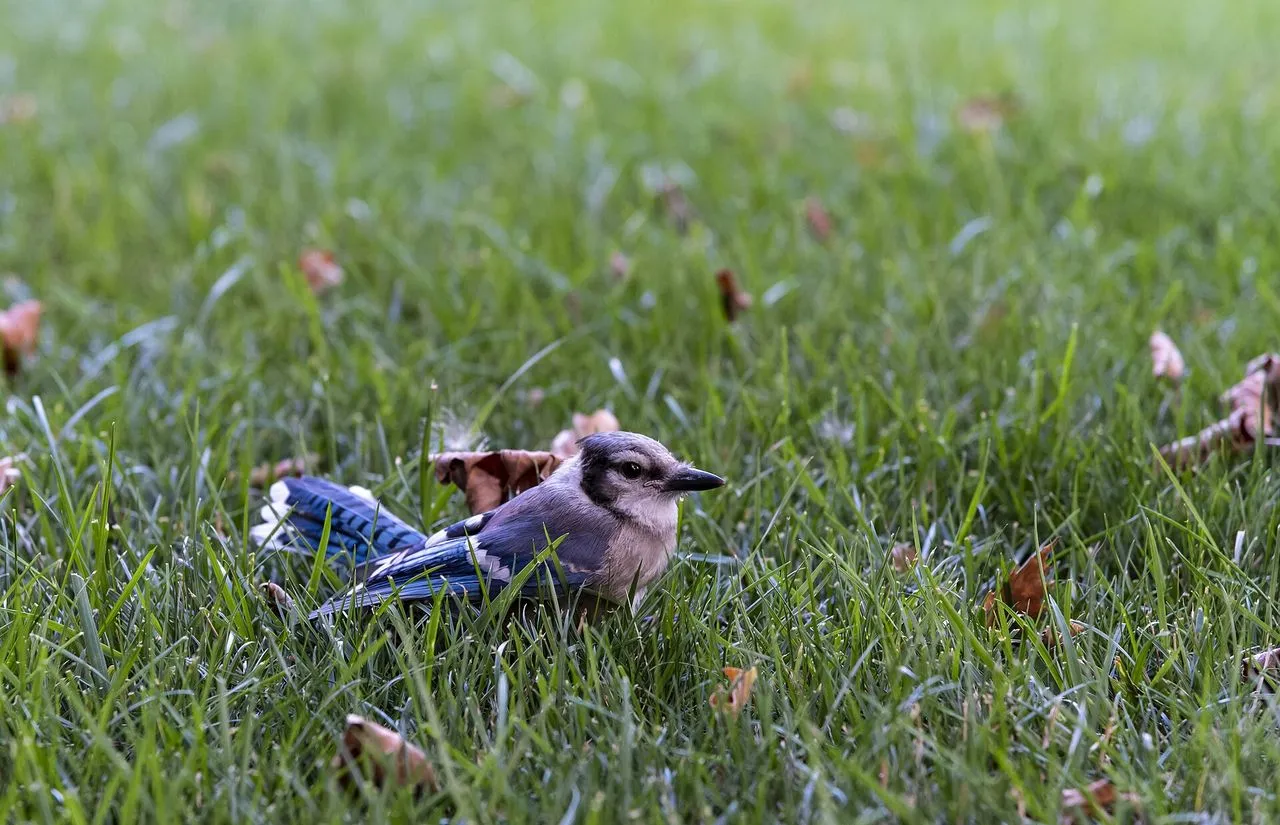
Blue Jays produce accurate mimicry of Red-shouldered Hawk calls precise enough to scatter feeder birds, and their alarm calls are occasionally mistaken for a corvid response to a predator. Blue Jays are much smaller and brightly coloured, but when hidden in foliage the call alone can be confusing at distance.
When to Act
Do nothing if the cawing involves multiple birds converging on a fixed point and lasts under two hours. Mobbing is functioning as it should. The crows will leave when the predator moves on.
Investigate if calling from the same spot continues beyond two hours. Check for a roosting owl in a dense conifer, a snake in a wall cavity, a cat in a confined space, or any other animal that may be trapped or stationary. If you find an injured bird of prey or owl that cannot leave, contact a licensed wildlife rehabilitator rather than handling it.
Adjust routine management if food recruitment bouts are frequent near the house. Covering compost, bringing pet food indoors at dusk, and securing waste bins reduces the food sources that draw the mammals crows then mob. That adjustment is worthwhile on its own grounds. For broader guidance on managing a garden for birds, the Complete Attracting Guide covers placement, food management, and seasonal adjustments across species.
See Also
- American Crow: species profile with identification, winter roost behaviour, and the face-recognition research in detail.
- The Complete Corvids Guide: family-level reference for crow, raven, jay, and magpie identification, cognition, and social behaviour.
- Common Raven: voice comparison with the American Crow; how to distinguish the deep "kronk" from a crow's caw at distance.
- Fish Crow: the southeastern species with a distinct nasal "uh-uh" call, frequently confused with American Crow in the mid-Atlantic and Gulf states.
- Great Horned Owl: the owl most commonly targeted by crow mobbing in North America.
- Cooper's Hawk: the Accipiter most likely to draw daytime crow mobbing near gardens and feeding stations.
Making peace with the local crows
Crows remember faces and hold grudges, and that cuts both ways: they also remember people who treat them well. If the cawing seems aimed at you or your pets, the slow fix beats any deterrent. Change what the local family associates with your garden. A small handful of unsalted in-shell peanuts left in the same spot a few times a week is the standard peace offering; corvid researchers use the same trick when they need a family group to tolerate them. Skip hand-feeding and keep quantities modest. The goal is neutral tolerance, not dependence, and salted or flavored nuts are unsafe for wild birds.
As an Amazon Associate, we earn from qualifying purchases, at no extra cost to you.
How can you tell what the crows are reacting to?
Stand still and look where every crow is facing. If you birdwatch from the yard often, Celestron Nature DX 8x42 Binoculars make it easier to check a roofline or tree without walking under the birds and changing their behavior. As an Amazon Associate, we earn from qualifying purchases, at no extra cost to you.
Should you scare crows away when they are cawing?
Usually, no. If the crows are mobbing a predator, they are already handling the situation. If they are using a regular evening roost, hazing may only move the noise to a neighbor. Remove easy food, keep trash covered, and watch the pattern for a few days before intervening.
Frequently Asked Questions
How long does crow mobbing usually last?
Most mobbing bouts last 20 to 90 minutes and end when the predator moves away. If crows are still converging on the same point after two hours, the predator may be roosting in place, stuck in a confined space, or injured. Check the area for a Great Horned Owl in a dense conifer, a snake in a wall gap, or another stationary animal before concluding the situation is unusual.
Can crows recognise individual people?
Yes. Research by John Marzluff's group at the University of Washington, published in Animal Behaviour in 2010, showed that American Crows remember specific human faces for years after negative encounters. Crows captured by researchers wearing a rubber mask subsequently scolded anyone wearing that mask across multiple years and locations. A follow-up study (Cornell, Marzluff & Pecoraro, 2012) showed that naive crows with no experience of the original capture learned to scold the same face after watching conspecifics do so, confirming social transmission of the recognition.
How do I tell if the bird cawing is actually an American Crow?
Common Ravens give a deep, hollow 'kronk' rather than the crow's flat 'caw,' and are noticeably larger with a wedge-shaped tail. In the southeastern United States, Fish Crows give a short nasal two-note 'uh-uh' rather than a flat caw. If the call sounds deeper or distinctly two-syllabled, check the species guides before assuming the bird is an American Crow.
Should I try to disperse or scare the crows away?
No. American Crows are protected under the Migratory Bird Treaty Act outside of legal hunting seasons. Attempting to disperse them is ineffective and risks creating an aversive association with your face. Research shows that crows which identify you as a threat will direct scolding specifically at you in future encounters, and that the association can spread to other crows that have had no direct experience of you.