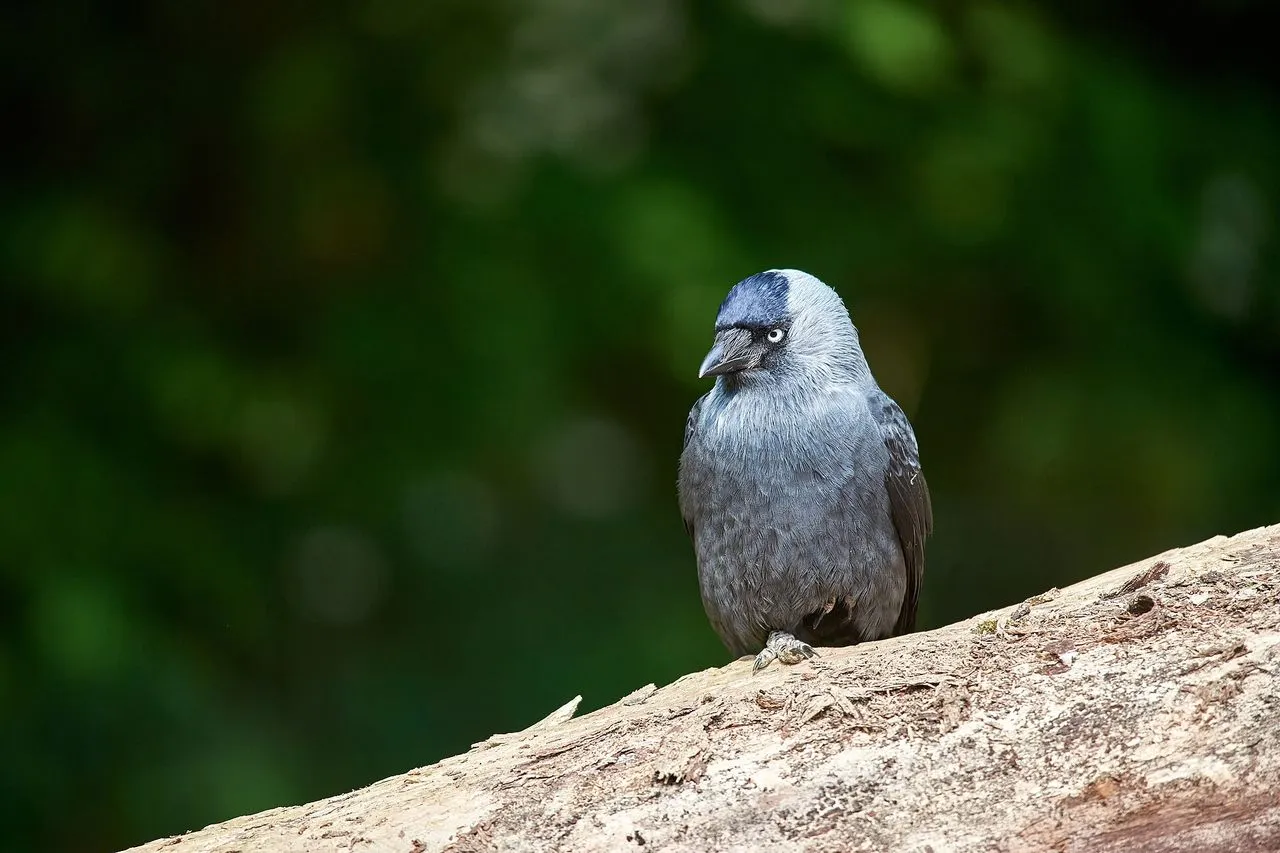
Coloeus monedula (Linnaeus, 1758), the Eurasian Jackdaw, is the small pale-eyed corvid of European chimneys, church towers, cliffs, and rookeries, weighing roughly 180-260 g and maintaining pair bonds that remain visible inside winter flocks.
Part of the Complete Corvids Guide.
Identification
Visual
Jackdaw is smaller and shorter-billed than Carrion Crow, Rook, or Hooded Crow. Adults show blackish body, grey nape and sides of neck, compact bill, short tail, and a striking pale grey-white iris. The head often looks capped: dark crown and face against greyer nape. In flight the bird is quick, buoyant, and more compact than a crow.
Rook is larger with a longer bill, bare pale face in adults, and shaggy thigh feathering. Carrion Crow is larger, all black, heavier-headed, and square-tailed. Choughs have red legs and bills and different upland or coastal cliff habits. Juvenile Jackdaws have darker eyes and less distinct grey napes, but their size and calls still separate them.
| Feature | Eurasian Jackdaw (Coloeus monedula) | Rook (Corvus frugilegus) | Carrion Crow (C. corone) |
|---|---|---|---|
| Length | 13-15 in (34-39 cm) | 17-18 in (44-46 cm) | 18-19 in (45-47 cm) |
| Eye | Pale grey-white in adults | Dark | Dark |
| Face and bill | Compact bill; grey nape | Bare pale face in adults; long bill | Fully feathered black face; heavier bill |
| Nesting | Cavities, chimneys, towers | Colonial tree rookeries | Solitary tree, cliff, or structure nests |
| Voice | Bright metallic "chak" | Nasal colony cawing | Harsh measured caw |
The pale eye matters socially as well as visually. Jackdaws nest in cavities, and experimental work by Gabrielle Davidson and colleagues showed that the pale iris can function as a deterrent signal to conspecifics inspecting occupied nest holes.
Audio
The common call is a sharp "chak" or "kya," often given in flight. Flocks produce constant clipped contact notes, unlike the deeper cawing of crows or the nasal crowd noise of rooks. Around colonies, calls are frequent and individually variable.
Jackdaw voice is one of the easiest ways to detect birds moving over towns at dawn or dusk. The sound is bright, short, and metallic compared with Carrion Crow. Paired birds often call together, maintaining contact within larger groups.
Distribution
Eurasian Jackdaw occupies most of Europe, parts of North Africa, western and central Asia, and extends eastward depending on treatment of related forms. It is widespread in Britain and Ireland, common in lowland farmland, towns, cliffs, and old buildings.
Many populations are resident, but northern and eastern birds can move south or west in winter. Winter flocks may include rooks, Carrion Crows, and other corvids, feeding in fields by day and roosting communally at night.
Habitat
Jackdaws require cavities or cavity-like structures for nesting and open ground for feeding. Natural sites include cliffs, tree holes, and rock crevices. Human sites include chimneys, church towers, castles, barns, ventilation shafts, quarries, and nest boxes.
Feeding habitat includes pasture, lawns, arable fields, parks, school grounds, coastal turf, and rubbish sites. The species thrives where old masonry or mature trees stand near short grass. Modern sealed buildings can remove nest sites even when feeding habitat remains.
Diet and Foraging
Diet includes beetles, leatherjackets, worms, grain, seeds, fruit, carrion, eggs, small scraps, and household refuse. Jackdaws walk with quick steps, probing turf and dung, picking insects from livestock areas, and joining rooks behind ploughs.
They are less powerful scavengers than Carrion Crows and Ravens but exploit small carrion and scraps readily. At feeding sites they often rely on numbers, speed, and social tolerance rather than dominance. Food caching occurs but is not a defining feature.
Social foraging is conspicuous. Pairs remain close within flocks, and dominance relationships affect access to food and nest sites. Classic studies by Konrad Lorenz overstated some interpretations but correctly drew attention to pair cohesion and social rank in jackdaw groups.
Breeding Biology
Jackdaws nest in cavities, often colonially. The nest is built from sticks, wool, grass, hair, paper, and assorted debris. Chimneys may be filled with large quantities of sticks, sometimes creating fire or ventilation hazards; that is a direct result of repeated cavity packing, not random mess.
Clutch size is usually 4-6 eggs. Incubation lasts about 17-18 days, mainly by the female, with male provisioning. Young fledge after about 28-35 days. Colonies can be noisy and competitive, with disputes over cavities common early in the season.
Pair bonds are strong. Mated birds feed together, preen, call in contact, and maintain association outside the breeding season. Non-breeders inspect cavities and may prospect for future sites.
Notes
Taxonomy has shifted: Jackdaw is often placed in Coloeus rather than Corvus, reflecting its distinct lineage from larger crows. Older books may list it as Corvus monedula; both names refer to the same familiar bird, but current usage increasingly favours Coloeus monedula.
The pale eye is not merely an attractive mark. In a cavity-nesting corvid, a visible eye looking out of a dark hole can signal occupancy and reduce intrusion. This is the kind of specific functional detail that makes Jackdaw biology more interesting than its ubiquity suggests.
Roost behaviour is also worth separating from rookery behaviour. In winter, Jackdaws may travel kilometres from town chimneys or village nest sites to join large mixed corvid roosts in woods, reedbeds, or shelterbelts. Morning departure is often ordered in small parties, with paired birds leaving together and calling continuously until they settle on feeding grounds.
In towns, blocked chimneys and renovation can remove breeding cavities rapidly. Nest boxes with entrance dimensions suitable for Jackdaws can replace some sites, but placement should avoid active flues and should account for the quantity of sticks a pair may carry.
That practical detail is often where building conservation and bird conservation meet.
See Also
Frequently Asked Questions
How do I distinguish a Jackdaw from other British corvids?
Jackdaw is much smaller than Rook, Carrion Crow, or Hooded Crow, with a compact bill, short tail, blackish body with a grey nape, and a striking pale grey-white iris. The pale eye is the most distinctive single feature in adults. Voice is bright, short, and metallic, a clipped 'chak' or 'kya' rather than the cawing of larger crows.
Why do Jackdaws nest in chimneys?
Jackdaws are obligate cavity nesters and chimneys mimic natural rock crevices and large tree holes. Pairs fill flues with sticks, wool, paper, and assorted debris, sometimes in quantities that create fire or ventilation hazards. Modern sealed buildings and renovation can remove breeding sites rapidly, even where feeding habitat remains intact.
What does the Jackdaw's pale eye signal?
Experimental work by Gabrielle Davidson and colleagues showed the pale iris can function as a deterrent signal to conspecifics inspecting occupied nest holes. In a cavity-nesting corvid, a visible eye looking out of a dark hole signals occupancy and reduces intrusion attempts by rival jackdaws prospecting for nest sites.
Do Jackdaws mate for life?
Pair bonds are strong and typically long-term. Mated birds feed together, preen, call in contact, and maintain association outside the breeding season, pairs remain visibly close even inside large winter flocks. Konrad Lorenz's classic studies overstated some interpretations but correctly drew attention to pair cohesion and social rank in jackdaw groups.
Sources & References
- Svensson, L., Mullarney, K. & Zetterström, D. (2010). Collins Bird Guide (2nd ed.). HarperCollins.
- British Trust for Ornithology. (2024). BirdFacts: Jackdaw. bto.org
- Cramp, S. & Perrins, C.M. (1994). Handbook of the Birds of Europe, the Middle East and North Africa, Vol. VIII. Oxford University Press.
- Madge, S. & Burn, H. (1994). Crows and Jays: A Guide to the Crows, Jays and Magpies of the World. Helm.