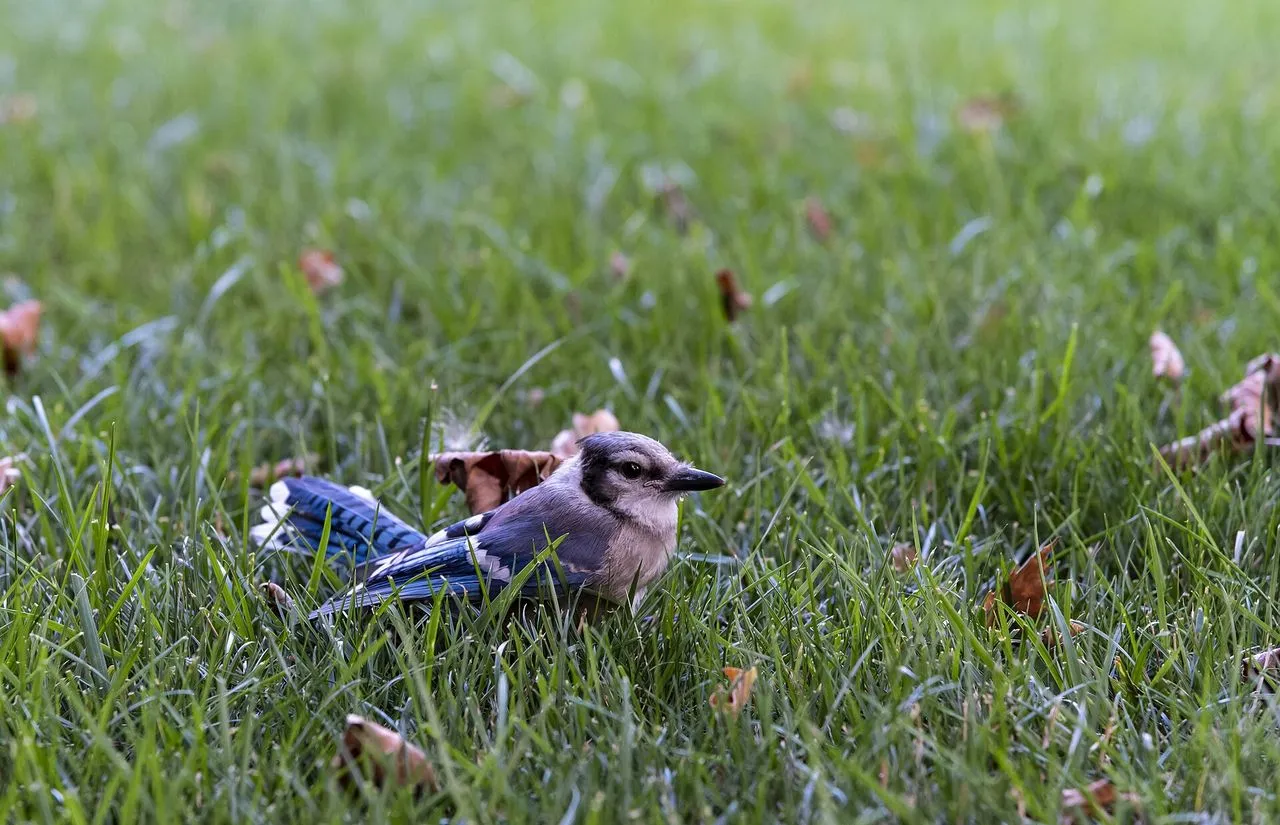
Cyanocitta cristata (Linnaeus, 1758), the Blue Jay, is a medium-large corvid of eastern North America with a breeding range extending from the Atlantic coast west to the eastern edge of the Great Plains and from southern Canada south to the Gulf of Mexico. It is a partial migrant: year-round resident across most of its range, but populations in the northern extent undertake visible southward movements in autumn, often in loose flocks of dozens to hundreds along ridges and coastal concentration points.
Part of the Complete Corvids Guide.
Identification
Field Marks
The Blue Jay is unmistakable throughout most of its range. No other corvid within its primary territory combines all of:
- Crest. Blue, prominent; raised when alert or alarmed, flattened when feeding or threatening.
- Upperparts. Bright blue, with flight feathers and tail barred black and white; two bold white wing bars visible on the folded wing.
- Underparts. White to pale grey-white.
- Collar. A complete black necklace across the throat and sides of the neck, connecting the black lores and eye-ring.
- White corners. White terminal spots on the outer tail feathers and on the secondary tips, conspicuous in flight.
The blue is structural colour, not pigment. The feather barbs contain organised arrays of spherical air-filled melanin granules that scatter short wavelengths preferentially through Tyndall scattering, the same physical mechanism that makes the sky blue. A Blue Jay feather crushed or submerged appears brown-black because the nanostructure is destroyed, leaving only the underlying melanin.
Confusion Species
Within its primary range there is one consistent source of confusion: Steller's Jay (Cyanocitta stelleri), which overlaps Blue Jay in the Rocky Mountain foothills and Great Plains. Steller's Jay has an entirely black head and neck, no white face markings, and no white wing bars. Where ranges meet, head colour resolves the identification immediately.
| Feature | Blue Jay (Cyanocitta cristata) | Steller's Jay (C. stelleri) | Florida Scrub-Jay (Aphelocoma coerulescens) |
|---|---|---|---|
| Length | 10-12 in (25-30 cm) | 11-13 in (28-33 cm) | About 11 in (28 cm) |
| Crest | Prominent blue crest | Prominent dark crest | No crest |
| Head pattern | White face; black necklace | Black to charcoal head and upper breast | Blue head; whitish forehead and throat |
| Wing marks | Blue, black, and white bars | Blue wings; no white wing bars | Plain blue wings; no white bars |
| Usual range | Eastern North America | Western conifer and montane forest | Peninsular Florida scrub only |
Voice and Mimicry
The Blue Jay has one of the most varied vocal repertoires of any North American passerine, used with evident flexibility rather than as a stereotyped fixed-action set. The most commonly heard vocalisation is the loud, descending "jay-jay" contact and alarm call. Other documented calls include a liquid "queedle" series used between paired birds and a hard rattling call during aggressive displacements at feeders.
The most discussed element of the Blue Jay's vocal repertoire is its mimicry of Red-shouldered Hawk (Buteo lineatus) calls. The imitations are acoustically precise, spectrographic analysis places them within the range of natural Red-shouldered Hawk variation, and are accurate enough to cause small birds to scatter. Mimicry of Red-tailed Hawk (Buteo jamaicensis) and Broad-winged Hawk (Buteo platypterus) has also been documented, though less frequently.
Two non-exclusive hypotheses account for this behaviour. The first is alarm function: a Blue Jay detecting a hawk produces the hawk's own call, alerting conspecifics and other species to the threat without giving a distinctive corvid alarm call that would identify the caller's location to the predator. The second is competitive feeder displacement: a Blue Jay arriving at a feeder occupied by other species produces hawk calls, clears the feeder, and feeds without competition. Feeder-context observations of the latter sequence are common; hawk mimicry also occurs in forested habitat away from feeders, which keeps the alarm-function hypothesis viable.
Acorn Caching and Oak Dispersal
The most ecologically consequential behaviour in this species is acorn caching. Blue Jays transport acorns in an expandable gular pouch, the combined capacity of the pharynx and oesophagus, carrying up to five large acorns per trip and caching them individually in soil or leaf litter at distances up to a mile from the source tree. Cache recovery rates confirm spatial memory for specific cache locations across months; unrecovered acorns in suitable germination sites produce oak seedlings.
Scott Darley-Hill and W. Carter Johnson documented in a 1981 study the acorn-transport rates and dispersal-distance distributions for Blue Jays at source trees in Virginia, establishing that a single jay can move thousands of acorns per season. The significance of this became apparent from paleoecological work on post-glacial tree range expansions. Oaks spread northward following the retreat of the Laurentide Ice Sheet at approximately 350–500 metres per year, a rate that wind dispersal and squirrel caching cannot account for. Wind-dispersed acorns travel metres; squirrels cache within their home territories. The Blue Jay's dispersal distances, load sizes, and directional movement, partially migratory populations move north in spring, carrying cached seeds, fit the gap in the models. The current consensus, supported by pollen-record analysis and dispersal modelling, is that Blue Jays were the primary vector for the post-glacial northward colonisation of eastern North America by oaks.
A significant proportion of the mature oak forest now standing across the northeastern United States and southeastern Canada was established from seeds a Blue Jay carried north and did not recover.
Feeder Behaviour and Habitat
At feeding stations Blue Jays are dominant over nearly all other songbirds, displacing smaller species by direct arrival. They are subordinate to larger woodpeckers and to raptors.
Food preferences at feeders, in approximate order of selectivity: whole peanuts in shell, large-striped sunflower seeds (preferred over black-oil), cracked corn, and whole acorns when provided. Blue Jays are platform feeder species by preference, they select, load the gular pouch, and depart rather than hulling seeds in place.
Away from feeders, habitat preference runs strongly toward mature deciduous and mixed forest with abundant mast-producing trees: oak, beech, hickory. In suburban areas, large trees in open-canopy settings, parks, golf courses, mature residential streets, hold consistent populations. The species requires mature trees for nesting and does not establish in areas dominated by young second-growth.
See Also
- Steller's Jay
- California Scrub-Jay
- American Crow
- The Complete Attracting Guide
- The Complete Corvids Guide
- Why Are Crows Attacking Other Birds?: the larger-corvid analogue for the same mobbing and nest-predation behaviours.
- Why Corvids Are Intelligent: the cognitive science behind acorn caching, hawk mimicry, and corvid problem-solving.
Frequently Asked Questions
How do I identify a Blue Jay?
Look for the prominent blue crest, blue wings and tail with bold white bars, white face with black line through the eye, and a complete black necklace across the throat. The white corners of the tail are visible in flight. Blue is structural colour, crushed or wet feathers appear brown.
Why do Blue Jays imitate hawk calls?
Two hypotheses: (1) alarm function, alerting other birds to predators without giving a distinctive corvid alarm that would reveal the caller's location; (2) competitive displacement, clearing a feeder of other birds by producing hawk calls. Both occur, and hawk mimicry also happens away from feeders.
What's the significance of Blue Jays in oak forest history?
Blue Jays are credited with post-glacial northward dispersal of oaks. While wind-dispersed acorns travel metres and squirrels cache within their territory, Blue Jays carry up to 5 acorns per trip and cache them up to a mile away, fitting the 350-500 metres/year northward spread rate that wind and squirrels cannot explain.
What do Blue Jays prefer at bird feeders?
Food preferences, in order: whole peanuts in shell, large-striped sunflower seeds (preferred over black-oil), cracked corn, and whole acorns when provided. Blue Jays are platform feeder users, they select food, load their expandable gular pouch, and depart rather than hulling seeds in place.
Sources & References
- Ehrlich, P.R., Dobkin, D.S. & Wheye, D. (1988). The Birders Handbook. Simon & Schuster.
- Cornell Lab of Ornithology. (2024). All About Birds: Blue Jay. birds.cornell.edu
- Sibley, D.A. (2014). The Sibley Guide to Birds (2nd ed.). Knopf.
- Darley-Hill, S. & Johnson, W.C. (1981). 'Acorn dispersal by the Blue Jay (Cyanocitta cristata).' The Wilson Bulletin, 93(3): 400-402.