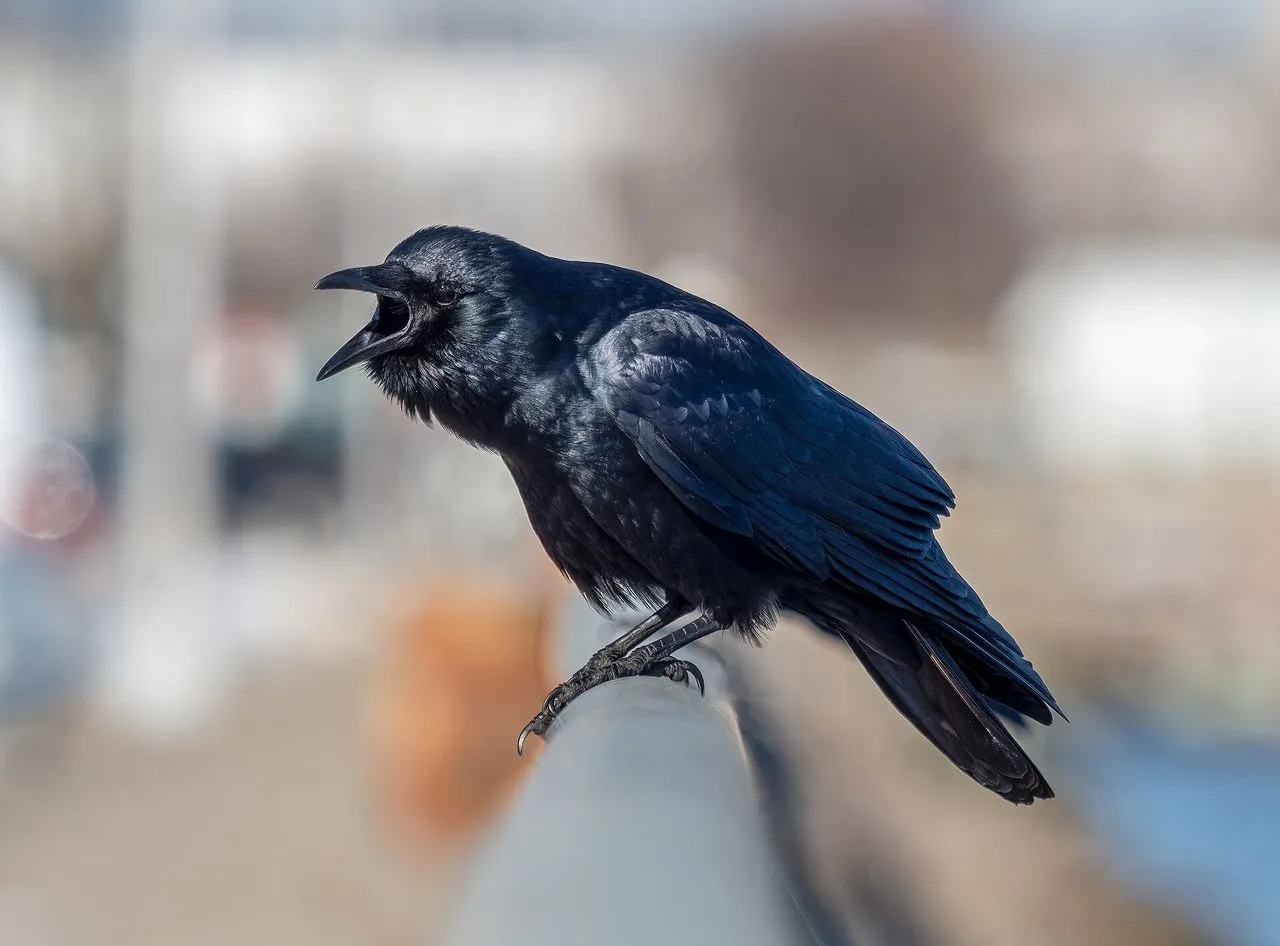
Corvus ossifragus Wilson, 1812, the Fish Crow, is the southeastern North American crow whose name preserves an older coastal association with fish, shellfish, and tidal refuse; in modern field work it is more often located by a nasal two-note call than by any visible structural character.
Part of the Complete Corvids Guide.
Identification
Visual
Fish Crow is smaller on average than American Crow, but the overlap is large enough that size alone is unsafe. Typical length is about 14-16 in (36-41 cm), compared with 17-21 in (43-53 cm) for many American Crows. The bill may appear slightly slimmer, the wings a little shorter, and the tail proportionately shorter, but a lone bird on a parking-lot lamp or flying across a marsh creek cannot be identified confidently by those traits.
Plumage is black with purplish or bluish gloss, often less greenish than American Crow, though light angle makes this unreliable. Juveniles are duller and browner, again paralleling American Crow. In direct mixed flocks, Fish Crows can look more compact and buoyant, with quicker wingbeats. That impression is useful only after the call has established the species.
| Feature | Fish Crow (Corvus ossifragus) | American Crow (C. brachyrhynchos) |
|---|---|---|
| Length | 14-16 in (36-41 cm) | 17-21 in (43-53 cm) |
| Structure | Smaller on average; slimmer bill; shorter tail | Larger on average; heavier bill; longer tail |
| Voice | Nasal two-note "uh-uh" or "nyuh-uh" | Fuller, open "caw" |
| Habitat clue | Coasts, rivers, reservoirs, urban waterfronts | Broader woodland, farmland, suburban, and urban habitats |
| Identification standard | Repeated calls required | Structure plus typical call usually sufficient |
The main field trap is inland range expectation. Fish Crow is no longer simply a salt-marsh bird. Reservoirs, rivers, landfills, shopping centres, and suburban retention ponds now hold birds well away from tidewater. A small crow in Atlanta, Richmond, Nashville, or along the Ohio drainage is not automatically American Crow.
Audio
Voice is the separator. Fish Crow gives a short, nasal, often two-syllabled "uh-uh" or "nyuh-uh," with the second note level or lower. The tone is pinched and toy-horn-like. American Crow gives a fuller, more open "caw," usually with stronger attack and less nasal constriction.
The classic field test is to wait. Fish Crows in loose groups call frequently while moving between rooftops, river edges, and feeding sites. Begging juveniles and agitated adults produce more variable notes, but the nasal quality persists. A single odd American Crow call should not be forced into Fish Crow; repeated calls from the same bird, especially the downslurred two-note version, are decisive.
Distribution
Fish Crow breeds along the Atlantic and Gulf coastal plains from southern New England through Florida and west to eastern Texas, with inland extensions along major rivers and reservoirs. Since the late twentieth century it has expanded northward and inland, documented through Christmas Bird Counts, breeding bird atlases, and eBird records.
The expansion is not mysterious. Reservoir construction created inland aquatic edges; landfills and urban refuse supplied year-round food; milder winters reduced survival constraints; and river corridors provided movement routes. In the Mid-Atlantic and Southeast, Fish Crow can be locally common in cities where the nearest tidal marsh is many kilometres away.
Habitat
Original habitat includes tidal marsh, barrier islands, estuaries, coastal pine woods, river swamps, and maritime forest. The modern habitat list is wider: urban waterfronts, retention ponds, sewage lagoons, marinas, poultry facilities, landfills, orchards, suburban campuses, and large bridges.
The species prefers edges where food is exposed and trees or structures provide nesting and lookout sites. It is less tied to continuous woodland than many breeding passerines and often feeds in open human-made spaces. Along coasts it works wrack lines, mudflats, docks, crab traps, and fish-cleaning stations.
Diet and Foraging
The diet is omnivorous: fish scraps, stranded fish, crabs, molluscs, insects, fruit, grain, eggs, nestlings, carrion, refuse, and road-kill. Fish Crow raids colonial waterbird nests and can be a serious egg predator on barrier islands when human food subsidies increase crow density near colonies.
Foraging is usually in pairs or small groups. Birds walk shorelines, pick through tidal debris, inspect garbage containers, follow mowing equipment, and search exposed mud. In inland cities they behave much like American Crows at dumpsters and parking lots, but mixed groups often sort themselves by voice rather than by visible feeding method.
Food caching occurs but is less conspicuous in the literature than in jays and ravens. Short-term hiding of bread, meat scraps, and other portable items is expected in urban birds. The more important ecological point is subsidy: refuse and fish waste can maintain unnaturally high crow numbers near nesting colonies of terns, skimmers, and plovers.
Breeding Biology
Fish Crows usually nest in trees, often pines, live oaks, or other tall trees near water, but urban nests may be placed in ornamental trees or structures. The nest is a stick cup lined with bark strips, grass, moss, hair, paper, or other soft material. Clutch size is commonly 3-5 eggs.
Breeding begins earlier in the southern part of the range, with eggs often from March or April. Incubation is by the female, with male provisioning. Young fledge after roughly a month in the nest. Family groups remain together after fledging and may join larger loose flocks around food sources.
Cooperative breeding is less developed than in American Crow, but retained offspring and extended family associations occur. As with other Corvus, social structure is more fluid outside the breeding season, especially where landfills, waterfronts, and agricultural fields concentrate birds.
Notes
The species epithet ossifragus means bone-breaking, a name Wilson applied in the early nineteenth century from coastal feeding observations rather than from a specialised osteophagous diet. It has led to overinterpretation; the Fish Crow is not a vulture-like bone specialist.
The Fish Crow problem is a useful discipline for observers. Many birders want visible field marks; this species punishes that habit. In the Atlantic and Gulf states, any small black crow near water, waste, or a major river should be identified by voice or left as Corvus sp. That restraint is better ornithology than a confident but silent record.
See Also
Frequently Asked Questions
How do I identify a Fish Crow?
Voice is the primary ID tool. Fish Crow gives a short, nasal, often two-syllabled 'uh-uh' or 'nyuh-uh,' with the second note level or lower. The tone is pinched and toy-horn-like. Visually, it averages slightly smaller than American Crow with a slightly slimmer bill, but size overlap is large. In mixed flocks, they can look more compact with quicker wingbeats.
Where is the Fish Crow found?
Breeds along Atlantic and Gulf coastal plains from southern New England through Florida to eastern Texas, with inland extensions along major rivers and reservoirs. Since the late 20th century, has expanded dramatically northward and inland, now common in cities many kilometres from tidal marsh, following reservoir construction, landfills, and river corridors.
Does the Fish Crow actually eat fish?
The name is historical (from older coastal observations), not a dietary stricture. Diet is omnivorous: fish scraps, stranded fish, crabs, molluscs, insects, fruit, grain, eggs, nestlings, carrion, and refuse. It does raid colonial waterbird nests and can be a significant egg predator when human food subsidies increase crow density near colonies.
What's the best way to separate Fish Crow from American Crow?
Listen. Repeated calls of the characteristic nasal two-note 'uh-uh' are decisive. Wait for the bird to call, Fish Crows in loose groups call frequently while moving between sites. A single odd call shouldn't be forced into species identification; repeated calls from the same bird, especially the downslurred two-note version, are diagnostic.
Sources & References
- Ehrlich, P.R., Dobkin, D.S. & Wheye, D. (1988). The Birders Handbook. Simon & Schuster.
- Cornell Lab of Ornithology. (2024). All About Birds: Fish Crow. birds.cornell.edu
- Sibley, D.A. (2014). The Sibley Guide to Birds (2nd ed.). Knopf.
- McGowan, K.J. (2001). 'Fish Crow (Corvus ossifragus).' The Birds of North America, No. 600.