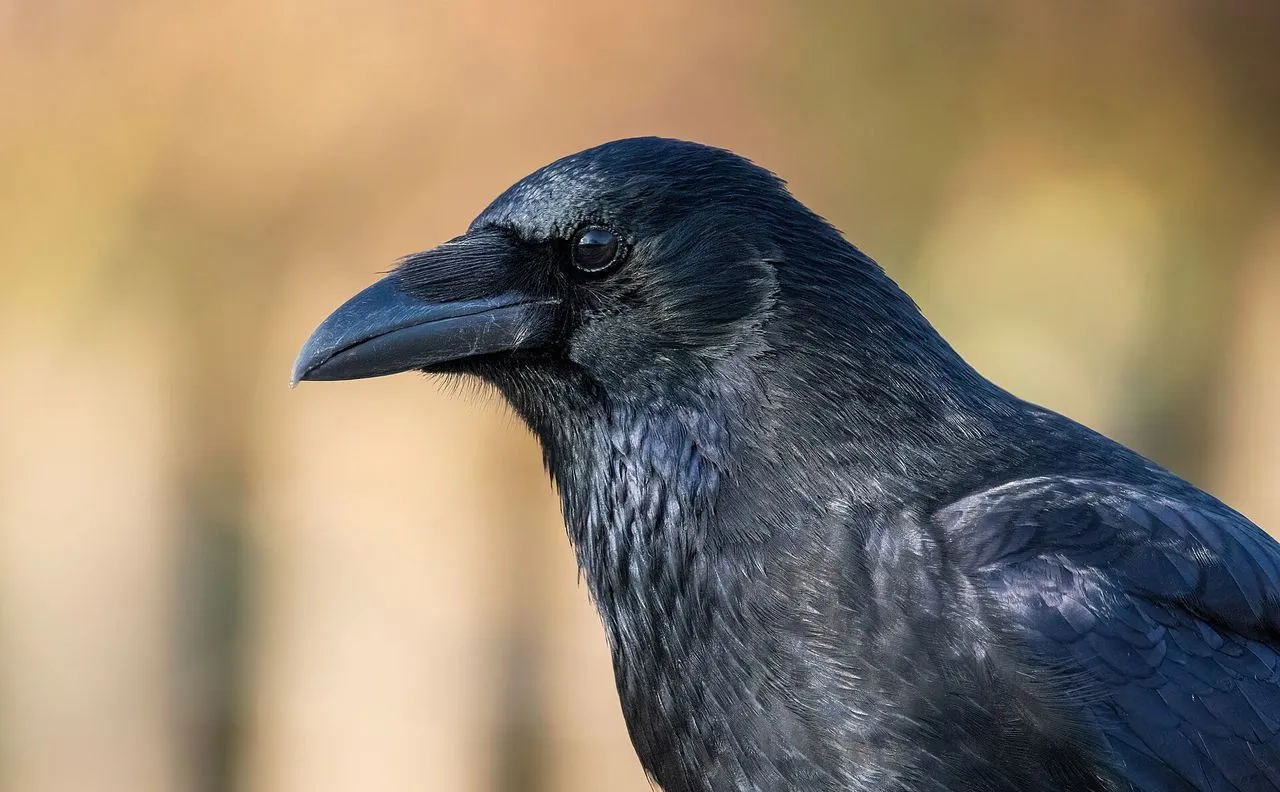
Corvus corone Linnaeus, 1758, the Carrion Crow, is the all-black lowland crow of western Europe and the default large corvid across most of Britain, where a single breeding pair may hold a farmland or suburban territory year-round while non-breeders gather at carcasses and refuse.
Part of the Complete Corvids Guide.
Identification
Visual
Carrion Crow is a medium-large all-black corvid, smaller and neater than Common Raven, heavier-billed than Rook away from the Rook's bare-faced adult stage, and larger than Jackdaw. Length is roughly 45-47 cm. The bill is black and moderately strong, the forehead slopes into the culmen, and the tail is squared rather than wedge-shaped.
Rook separation is the common British problem. Adult Rooks show a bare grey-white face at the bill base, peaked crown, shaggy thigh feathering, and looser flocking behaviour on farmland. Juvenile Rooks lack the bare face and can look crow-like, but they often show a more peaked head, slimmer bill, and association with rookeries or feeding flocks. Carrion Crow is usually in pairs or small family groups during breeding season.
| Feature | Carrion Crow (Corvus corone) | Rook (C. frugilegus) | Eurasian Jackdaw (Coloeus monedula) |
|---|---|---|---|
| Length | 18-19 in (45-47 cm) | 17-18 in (44-46 cm) | 13-15 in (34-39 cm) |
| Face | Fully feathered black face | Bare grey-white face in adults | Dark face; pale iris in adults |
| Bill | Moderately heavy; black | Longer, pointed; pale base in adults | Short, compact bill |
| Social setting | Pairs or family groups on territories | Feeding flocks; colonial rookeries | Pairs within flocks; cavity colonies |
| Voice | Harsh measured caw | Nasal, social cawing | Sharp metallic "chak" |
Common Raven is much larger, with wedge tail, longer wings, deeper bill, throat hackles, and soaring flight. Jackdaw is smaller, shorter-billed, grey-naped in many views, and pale-eyed.
Audio
The typical call is a harsh, repeated "caw" or "kraa," lower and rougher than Rook's cawing but less resonant than Raven. Carrion Crow calls often come in measured series from an exposed perch, with the body dipping during delivery.
Rook voices are generally more nasal and social in a colony or flock context. Raven calls are deeper, hollow, and varied. Jackdaw gives sharper "chak" and "kya" notes. In poor visibility, voice plus social setting usually resolves the identification.
Distribution
Carrion Crow occupies western Europe, including most of England, Wales, and southern and eastern Scotland, as well as France, Iberia, parts of central Europe, and other regions depending on taxonomic treatment. To the east and north it meets Hooded Crow, Corvus cornix, in one of Europe's best-known avian hybrid zones.
In Britain, Carrion Crow predominates through England and Wales. Hooded Crow replaces it in much of Ireland, northern and western Scotland, and some islands. Hybrid and backcross birds occur where the ranges meet, especially in Scotland. The two were long treated as subspecies by some authorities and as species by others; current European treatments commonly recognise both species.
Habitat
Carrion Crows use farmland, pasture, moor edge, woodland edge, river valleys, coastal cliffs, towns, parks, golf courses, and road corridors. They need trees, cliffs, pylons, or structures for nesting and open ground for foraging. Dense unbroken forest is less favoured than edge and mixed landscapes.
Urban pairs hold territories in parks and residential districts, feeding on refuse, road-kill, invertebrates, and nest contents. Rural pairs patrol fields, hedges, lambing areas, pheasant pens, and carrion sources. The species is adaptable, but it is not randomly distributed; territorial spacing reflects food and nest-site availability.
Diet and Foraging
Carrion Crow is omnivorous: earthworms, beetles, leatherjackets, grain, fruit, eggs, nestlings, small mammals, carrion, road-kill, refuse, and afterbirth. It walks fields after ploughing, searches shorelines, opens bags, probes dung, and attends carcasses.
The name is accurate but incomplete. Carrion matters, especially in winter and in pastoral landscapes, but live prey and plant food are also important. Lamb predation is a contentious subject: crows do kill weak or compromised lambs in some circumstances and scavenge dead ones in many more. Field evidence must separate killing from post-mortem feeding, which public debate often fails to do.
Caching occurs with surplus food, usually meat, bread, or eggs, hidden in grass, soil, roof spaces, or vegetation. Crows also use simple object manipulation, dropping shellfish or hard items where coastal opportunities exist.
Breeding Biology
Pairs are territorial and often long-term. The nest is a stick platform lined with wool, hair, grass, bark, and softer material, placed in trees, pylons, cliffs, or buildings. Breeding begins in spring, with eggs often laid from March or April. Clutch size is usually 3-5 eggs.
The female incubates for about 18-20 days while the male provisions her. Young fledge after roughly 4-5 weeks and remain dependent for some time. Family groups may stay on territory into autumn, while non-breeders form loose flocks where territories are unavailable.
Territorial crows strongly mob raptors and owls. Buzzards, Red Kites, foxes, cats, and humans near nests may be scolded or dived at. The same pair that removes eggs from a hedge-nesting passerine may drive off a predator that would have taken other nests; ecological effects are not one-directional.
Notes
The Carrion-Hooded Crow hybrid zone is a central case in speciation research. The two forms differ strikingly in plumage but only modestly across much of the genome. Assortative mating, narrow genomic regions linked to plumage, and social selection appear to help maintain the zone despite gene flow.
For British observers, Carrion Crow is often overlooked because it is common. That is a field error. A territorial pair's spacing, calls, food routes, and seasonal tolerance of fledglings provide a compact study of corvid social ecology within a few streets or fields.
When mapping records near the Hooded Crow boundary, photographs are more valuable than brief notes. The relevant evidence is not only whether grey is present, but its distribution across mantle, breast, flanks, wings, and undertail coverts.
See Also
Frequently Asked Questions
How do I distinguish a Carrion Crow from a Rook?
Adult Rooks show a bare grey-white face at the bill base, a peaked crown, shaggy thigh feathering, and feed in social flocks at colonial rookeries. Carrion Crow has a fully feathered black face, flatter crown, heavier-looking bill, and is usually in pairs or small family groups holding a territory year-round. Juvenile Rooks lack the bare face but show a slimmer bill and looser flock behaviour.
Where is the Carrion Crow-Hooded Crow hybrid zone?
The two species meet through parts of Scotland, central Europe, northern Italy, and elsewhere. Hybrid and backcross birds occur where ranges overlap, showing mottled grey and black plumage. Genomic studies show that despite gene flow, narrow regions linked to plumage and mate choice maintain the recognisable forms, making the zone a central case in modern speciation research.
Do Carrion Crows kill lambs?
They do kill weak or compromised lambs in some circumstances and scavenge dead ones much more often. Field evidence must separate killing from post-mortem feeding, which public debate frequently fails to do. Lamb predation is real but the visual shock of crows at a carcass typically reflects scavenging rather than active predation on healthy stock.
What do Carrion Crows eat?
The species is omnivorous: earthworms, beetles, leatherjackets, grain, fruit, eggs, nestlings, small mammals, carrion, road-kill, refuse, and afterbirth. The name emphasises carrion, important in winter and pastoral landscapes, but live prey and plant food matter too. Surplus food is often cached in grass, soil, roof spaces, or vegetation.
Sources & References
- Svensson, L., Mullarney, K. & Zetterström, D. (2010). Collins Bird Guide (2nd ed.). HarperCollins.
- British Trust for Ornithology. (2024). BirdFacts: Carrion Crow. bto.org
- Cramp, S. & Perrins, C.M. (1994). Handbook of the Birds of Europe, the Middle East and North Africa, Vol. VIII. Oxford University Press.
- Madge, S. & Burn, H. (1994). Crows and Jays: A Guide to the Crows, Jays and Magpies of the World. Helm.