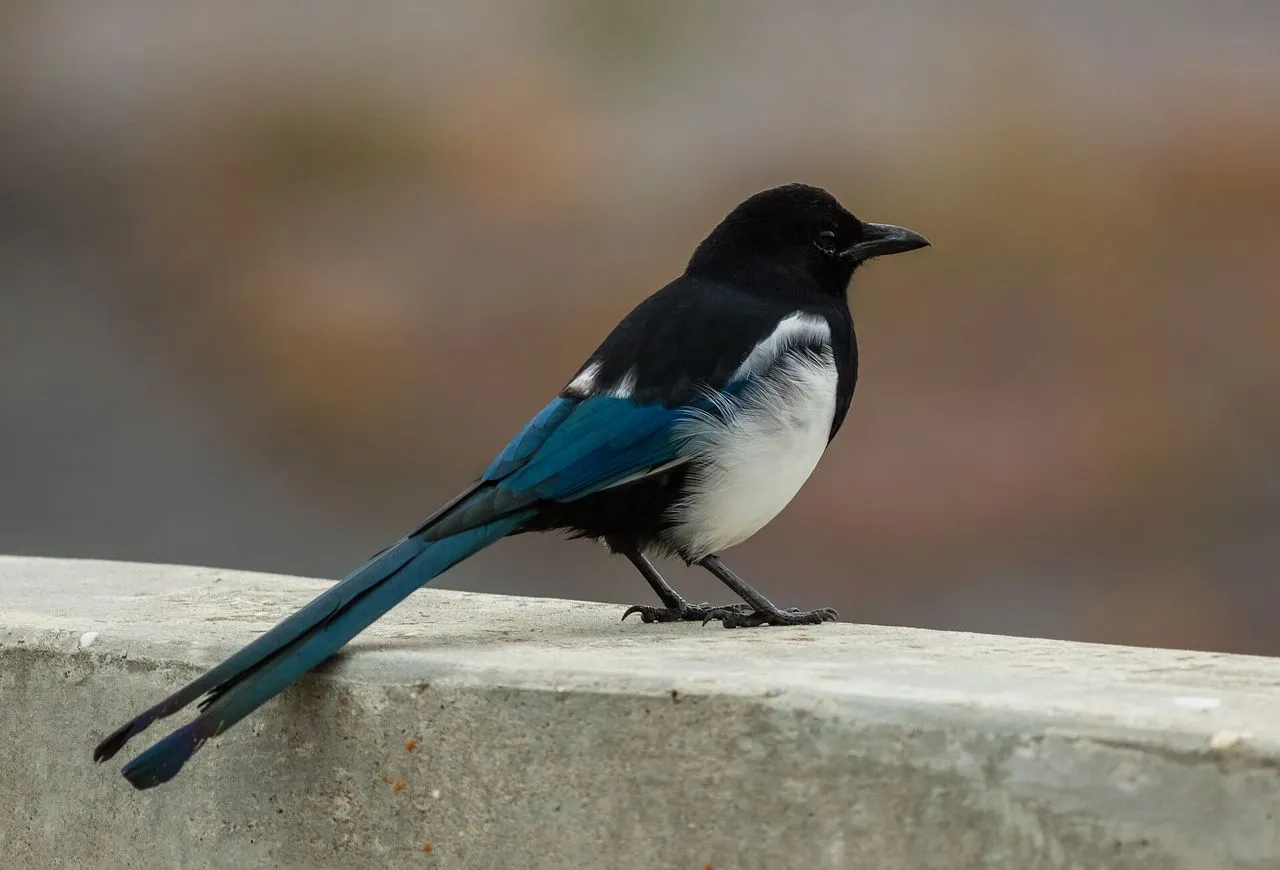
Pica hudsonia (Sabine, 1823), the Black-billed Magpie, is the long-tailed pied corvid of western North America, building roofed stick nests that can exceed 1 m across and feeding with equal competence on grasshoppers, ticks, grain, carrion, and ranch-yard refuse.
Part of the Complete Corvids Guide.
Identification
Visual
Black-billed Magpie is unmistakable across most of its range: black head, breast, back, and bill; white belly and scapulars; white wing patches; and an exceptionally long graduated tail with green and bronze iridescence. Total length is 17-24 in (45-60 cm), but nearly half of that can be tail. In flight, the white wing panels flash strongly against black primaries.
Yellow-billed Magpie is similar but geographically restricted to California's Central Valley and has a yellow bill, yellow bare skin around the eye, and slightly different voice. American Crow and Common Raven lack the white panels and long tail. Northern Mockingbird has white wing patches but is much smaller, grey, and not structurally corvid-like.
| Feature | Black-billed Magpie (Pica hudsonia) | Yellow-billed Magpie (Pica nuttalli) |
|---|---|---|
| Length | 17-24 in (45-60 cm) | 17-21 in (43-54 cm) |
| Bill and bare skin | Black bill; dark face skin | Yellow bill; yellow bare skin around eye |
| Range | Western interior North America | California Central Valley only |
| Tail | Very long; green-bronze gloss | Very long; similar gloss |
| Voice | Rough chatter; western open country | Similar chatter, usually range-limited |
Sexes are similar, with males averaging larger and longer-tailed. Juveniles have shorter tails and duller plumage, but the pied pattern is already evident. On the ground, the bird walks and hops with tail lifted clear of vegetation; in flight it looks laboured but direct, with shallow wingbeats and a trailing tail.
Audio
The principal call is a rapid, rough chatter, often rendered "mag-mag-mag" or "yak-yak-yak." Alarm calls are harsh and persistent, especially around nests or carcasses. Softer contact notes occur between pair members. The vocal repertoire is varied, but unlike Fish Crow or raven, voice is not usually needed for identification because structure and pattern are decisive.
At a carcass or predator, several magpies may call simultaneously, producing a dry rattling chorus. Their scolding often attracts other scavengers and raptors, a mixed cost and benefit in open country.
Distribution
The species occupies western North America from Alaska and western Canada south through the Great Plains, Great Basin, Rocky Mountain states, and parts of the interior West. It is absent from much of the humid eastern United States and from the Pacific coastal strip south of British Columbia. The Great Plains distribution has shifted with settlement, shelterbelts, grazing, and persecution.
Most populations are resident. Local movements follow winter food, snow depth, and carrion availability. In severe weather birds concentrate around feedlots, ranches, roads, and towns.
Habitat
Black-billed Magpies prefer open and semi-open country with scattered trees or shrubs for nesting: riparian cottonwood, willow draws, sagebrush steppe with trees, shelterbelts, ranchland, pasture, prairie edge, and suburban open space. They avoid closed forest and treeless expanses without nesting substrate.
The species is closely associated with large mammals, both wild and domestic. Bison, cattle, deer, elk, horses, and sheep create insects, dung-associated prey, ticks, afterbirth, carcasses, and disturbed ground. Roads add carrion; ranch buildings add refuse and nest sites.
Diet and Foraging
Diet is broad: beetles, grasshoppers, caterpillars, spiders, small mammals, eggs, nestlings, carrion, grain, fruit, ticks, and human scraps. In summer, insects can dominate. In winter, carrion and refuse become more important. Magpies often feed on road-kill with ravens, crows, eagles, gulls, and coyotes nearby.
The tick-removal behaviour from ungulates is genuine but easily romanticised. Magpies take ectoparasites from backs and faces of large mammals, but they also peck at wounds, scavenge tissue, and exploit whatever food is available. Their relation to livestock is therefore neither simple mutualism nor simple pest status.
Caching occurs with meat and other portable items, usually short-term. At carcasses, magpies may snatch small pieces and hide them in grass, snow, or soil. Their long tail and ground agility let them work close to larger scavengers while avoiding direct contact.
Breeding Biology
The nest is one of the most conspicuous structures built by any North American passerine. It is a bulky stick dome with a side entrance, mud cup, and lining of grass, rootlets, and hair, placed in thorny shrubs, willows, cottonwoods, shelterbelts, or occasionally human structures. Old nests persist and are used by owls, kestrels, squirrels, and other species.
Clutch size is commonly 6-9 eggs, larger than many corvids. Incubation lasts about 16-18 days, mostly by the female while the male feeds her. Young fledge after about 24-30 days. Pairs are territorial during breeding, though neighbouring birds may gather at rich food sources outside the nesting area.
Nest predation, weather, and persecution affect success. Historically, magpies were shot and trapped heavily because of perceived impacts on gamebirds and livestock. Modern evidence supports local nest predation on songbirds and gamebirds but not the broad extermination campaigns once applied.
Notes
Black-billed Magpie and Eurasian Magpie were long treated as conspecific by some authorities; most current North American lists separate them, with genetic, vocal, and biogeographic evidence supporting species rank. The Beringian history of Pica remains relevant: the American bird is not an isolated curiosity but part of a northern magpie complex.
For field interpretation, the species is a scavenger, predator, insectivore, seed eater, and commensal around ranches. Reducing it to "thief" or "pest" misses the ecological fact that open-country carrion systems are built from exactly such opportunists.
In winter, note whether birds are paired, in family groups, or in loose feeding aggregations. The distinction helps separate territorial spacing from temporary concentration around carcasses, grain spills, feedlots, or shelterbelts.
See Also
Frequently Asked Questions
How do I distinguish a Black-billed Magpie from a Yellow-billed Magpie?
Bill colour is decisive: Black-billed has an all-black bill, while Yellow-billed shows a yellow bill and yellow bare skin around the eye. Range also separates them cleanly, Yellow-billed Magpie is restricted to California's Central Valley, while Black-billed occupies the rest of the western interior from Alaska south through the Rockies and Great Plains.
Why are Black-billed Magpie nests so large and conspicuous?
Magpies build a bulky stick dome with a side entrance, mud cup, and softer lining, often exceeding 1 m across, placed in thorny shrubs, willows, or cottonwoods. The domed roof reduces aerial predation on eggs and young. Old nests persist for years and are subsequently used by owls, kestrels, squirrels, and other species.
Do Black-billed Magpies really clean ticks off cattle and deer?
Yes, but the relationship is more opportunistic than mutualistic. Magpies take ticks and other ectoparasites from the backs and faces of large mammals, but they also peck at open wounds, scavenge tissue, and exploit any available food. The behaviour is real, not invented, but it shouldn't be romanticised into a clean cleaning service.
What do Black-billed Magpies eat?
Diet is broad: beetles, grasshoppers, caterpillars, spiders, small mammals, eggs, nestlings, carrion, grain, fruit, ticks, and human scraps. Insects dominate in summer; carrion and refuse become more important in winter. Magpies also cache portable items short-term, hiding meat pieces in grass, snow, or soil near carcasses.
Sources & References
- Sibley, D.A. (2014). The Sibley Guide to Birds (2nd ed.). Knopf.
- Cornell Lab of Ornithology. (2024). All About Birds: Black-billed Magpie. birds.cornell.edu
- Ehrlich, P.R., Dobkin, D.S. & Wheye, D. (1988). The Birders Handbook. Simon & Schuster.
- Kaufman, K. (2000). Birds of North America. Houghton Mifflin.