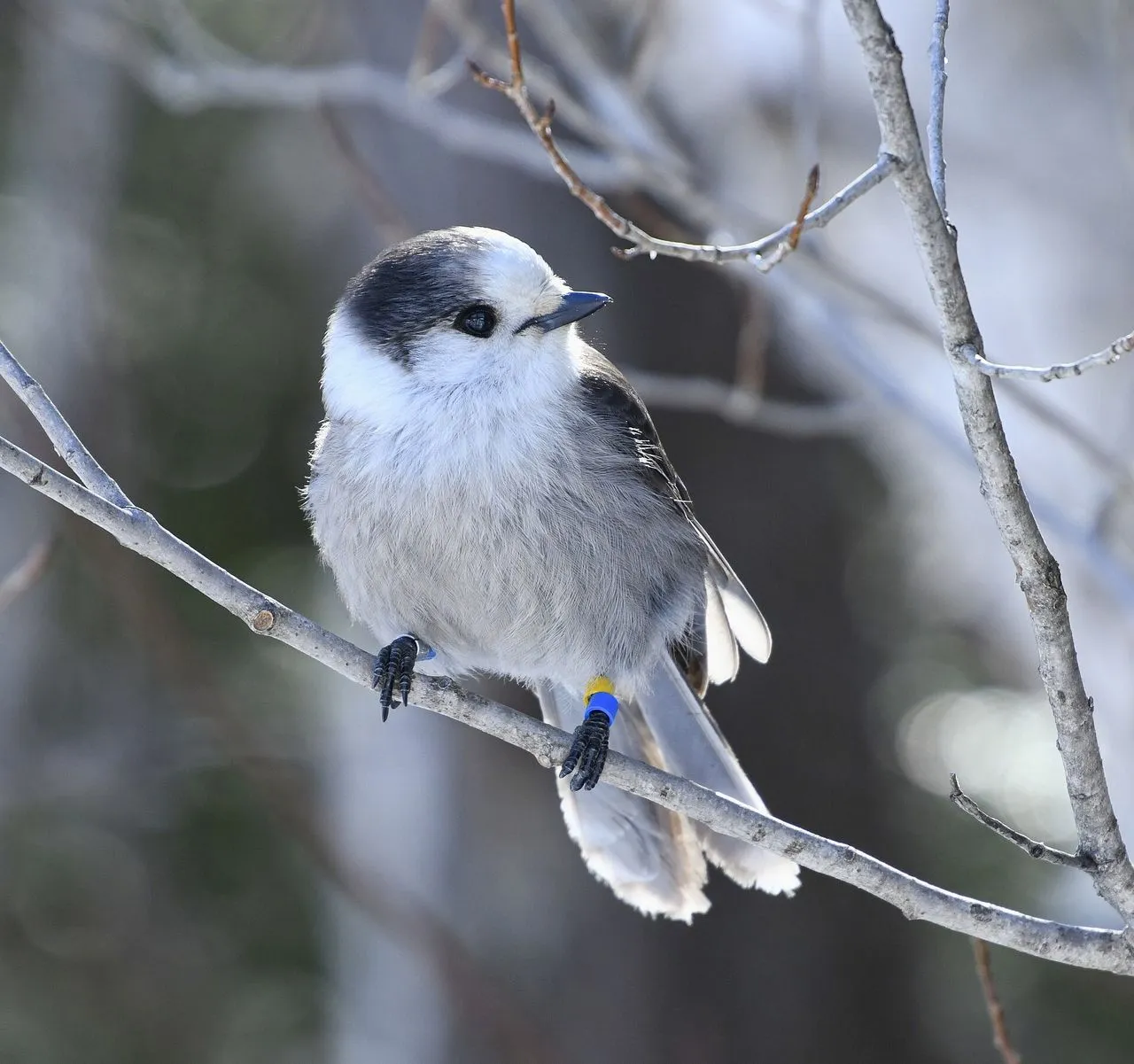
Perisoreus canadensis (Linnaeus, 1766), the Canada Jay, survives boreal winters by storing thousands of food pieces in bark and lichen, using enlarged salivary glands to coat items in adhesive saliva that freezes or dries onto branches before midwinter nesting begins.
Part of the Complete Corvids Guide.
Identification
Visual
Canada Jay is a soft-plumaged, long-tailed boreal jay, about 10-12 in (25-31 cm) long, grey overall with a pale forehead, white throat and face, dark grey nape, and darker wings and tail. It lacks a crest. The body often looks rounded and loose-feathered, especially in cold weather, an insulation effect rather than fatness.
Adults show a neat pale face and darker rear crown. Juveniles are sooty grey overall, with little contrast, and can look like a different species in early summer. The change into adult-like plumage occurs by late summer. In the field, the combination of grey plumage, pale face, long tail, quiet behaviour, and boreal conifers is distinctive.
Blue Jay and Steller's Jay are larger-patterned, crested, and brighter blue. Clark's Nutcracker is larger, longer-winged, and black-white-grey with white wing and tail flashes. Boreal Chickadee is much smaller and brown-capped.
| Feature | Canada Jay (Perisoreus canadensis) | Steller's Jay (Cyanocitta stelleri) | Clark's Nutcracker (Nucifraga columbiana) |
|---|---|---|---|
| Length | 10-12 in (25-31 cm) | 11-13 in (28-33 cm) | 11-12 in (28-30 cm) |
| Crest | Absent | Long triangular crest | Absent |
| Plumage | Grey, pale-faced, soft-feathered | Black head; deep blue body | Grey body; black wings with white flashes |
| Habitat | Boreal and subalpine conifer forest | Western conifer and mixed forest | Open western mountains and pine zones |
| Voice | Soft whistles and subdued scolds | Harsh descending shacks | Harsh nasal calls; more open-country carrying |
Audio
Canada Jay is less vocally conspicuous than crows and Cyanocitta jays. Calls include soft whistles, low chatters, subdued scolds, and contact notes between family members. Alarm calls can be harsh, but many encounters begin with silence: a bird appears at shoulder height on a spruce limb and watches.
The quietness has practical significance. In dense boreal forest, Canada Jays often detect observers before being detected. Listening for faint conversational notes among a family group is more useful than expecting a Blue Jay-like scream.
Distribution
The range follows the North American boreal forest from Alaska across Canada to Newfoundland, with southward extensions in the Rocky Mountains, Cascades, Sierra Nevada, Adirondacks, northern New England, and upper Great Lakes. It is strongly associated with cold coniferous forest and is mostly resident.
The species was long known in popular North American usage as Gray Jay or Canada Jay, with "Canada Jay" restored by the American Ornithological Society in 2018. The older camp name "whiskey jack" derives from Wisakedjak, a figure in Algonquian traditions; it should not be treated as a throwaway nickname without that origin.
Habitat
Habitat is spruce, fir, pine, tamarack, and mixed boreal forest, especially areas with black spruce, white spruce, balsam fir, and lichen-covered branches suitable for cache placement. Bog edges, old burns with regenerating conifers, subalpine forest, and remote campsites are typical.
Territories are year-round. The birds do not solve winter by migrating; they solve it by caching and by holding space with known food stores. Mature conifers matter because bark flakes, branch crotches, and epiphytic lichens provide storage surfaces. Simplified young stands may provide cover but fewer cache sites.
Diet and Foraging
Canada Jay eats arthropods, berries, fungi, small vertebrates, eggs, nestlings, carrion, suet, bread, meat scraps, and camp food. The species is famous for boldness around people, but natural foraging is methodical: gleaning bark and foliage, searching ground, attending carcasses, and inspecting cavities.
Caching is the central behaviour. Food is manipulated in the bill, coated with sticky saliva from seasonally enlarged glands, and wedged behind bark, under lichens, or among conifer needles. Items can include berries, mushroom pieces, insects, meat, suet, and carrion fragments. Unlike many temperate jays that rely heavily on autumn mast, Canada Jays cache perishable material across seasons and depend on cold conditions to preserve it.
Long-term work by Dan Strickland and colleagues in Algonquin Provincial Park linked warmer autumn temperatures to reduced reproductive success, plausibly through cache spoilage. The mechanism is straightforward: if food stored in September and October degrades before February and March nesting, the pair enters breeding with less usable capital.
Breeding Biology
Canada Jays nest in late winter, often while snow is deep and temperatures remain below freezing. This timing is possible because cached food provisions adults and young before fresh spring insects are available. Nest building can begin in February in many areas.
The nest is a well-insulated cup of twigs, bark strips, lichens, feathers, fur, and plant fibres, usually placed close to the trunk in a dense conifer. Clutch size is commonly 2-5 eggs. The female incubates for about 18 days while the male feeds her. Young fledge after roughly 22-24 days.
Family structure is unusual. After fledging, broods may be reduced socially: one juvenile commonly remains on the natal territory through winter while siblings disperse or are driven off. The retained juvenile benefits from parental stores and territory knowledge, then usually leaves before the next breeding season.
Notes
The Canada Jay is a climate-sensitivity species not because it is delicate, but because its breeding schedule is built around frozen food storage. A few degrees of autumn warming can matter if it changes the microbial fate of cached meat and fruit.
For observers, the ethical point is simple. Feeding Canada Jays at campsites produces close views but can alter movement, predation risk, and cache contents. A bird taking a sandwich crust may store it for future nest provisioning. That should make the handout feel less harmless, not more charming.
See Also
- Eurasian Jay
- Steller's Jay
- Common Raven
- The Complete Attracting Guide
- The Complete Corvids Guide
- Clark's Nutcracker: the other widespread western mountain corvid; both species rely on cached food for winter survival.
Frequently Asked Questions
How do I identify a Canada Jay?
Look for a grey jay with pale forehead, white throat and face, dark grey nape and wings, and a long rounded tail. No crest. The plumage appears loose and rounded, especially in cold weather. Juveniles are sooty grey with little contrast. The combination of grey plumage, pale face, and boreal conifer habitat is distinctive.
Why does the Canada Jay nest in winter?
Canada Jays nest in late winter (February-March) while snow is deep because they rely on cached food stored in autumn. Enlarged salivary glands coat berries, insects, and meat in sticky saliva, then wedge the food behind bark, under lichens, or among needles. This cached food provisions adults through incubation and feeds nestlings before spring insects emerge.
Are Canada Jays affected by climate change?
Yes, research by Dan Strickland and colleagues in Algonquin Provincial Park linked warmer autumn temperatures to reduced reproductive success. The mechanism: cached perishable food (meat, berries) degrades before winter nesting if temperatures are too warm, leaving breeding pairs with insufficient food reserves.
What do Canada Jays eat?
They eat arthropods, berries, fungi, small vertebrates, eggs, nestlings, carrion, suet, bread, meat scraps, and camp food. They are famously bold around people, but natural foraging is methodical, gleaning bark and foliage, searching ground, attending carcasses, and inspecting cavities.
Sources & References
- Ehrlich, P.R., Dobkin, D.S. & Wheye, D. (1988). The Birders Handbook. Simon & Schuster.
- Cornell Lab of Ornithology. (2024). All About Birds: Canada Jay. birds.cornell.edu
- Sibley, D.A. (2014). The Sibley Guide to Birds (2nd ed.). Knopf.
- Strickland, D. et al. (2011). 'Extreme variability in clutch size in a boreal food-storing bird.' Proceedings of the Royal Society B, 278(1704): 133-138.