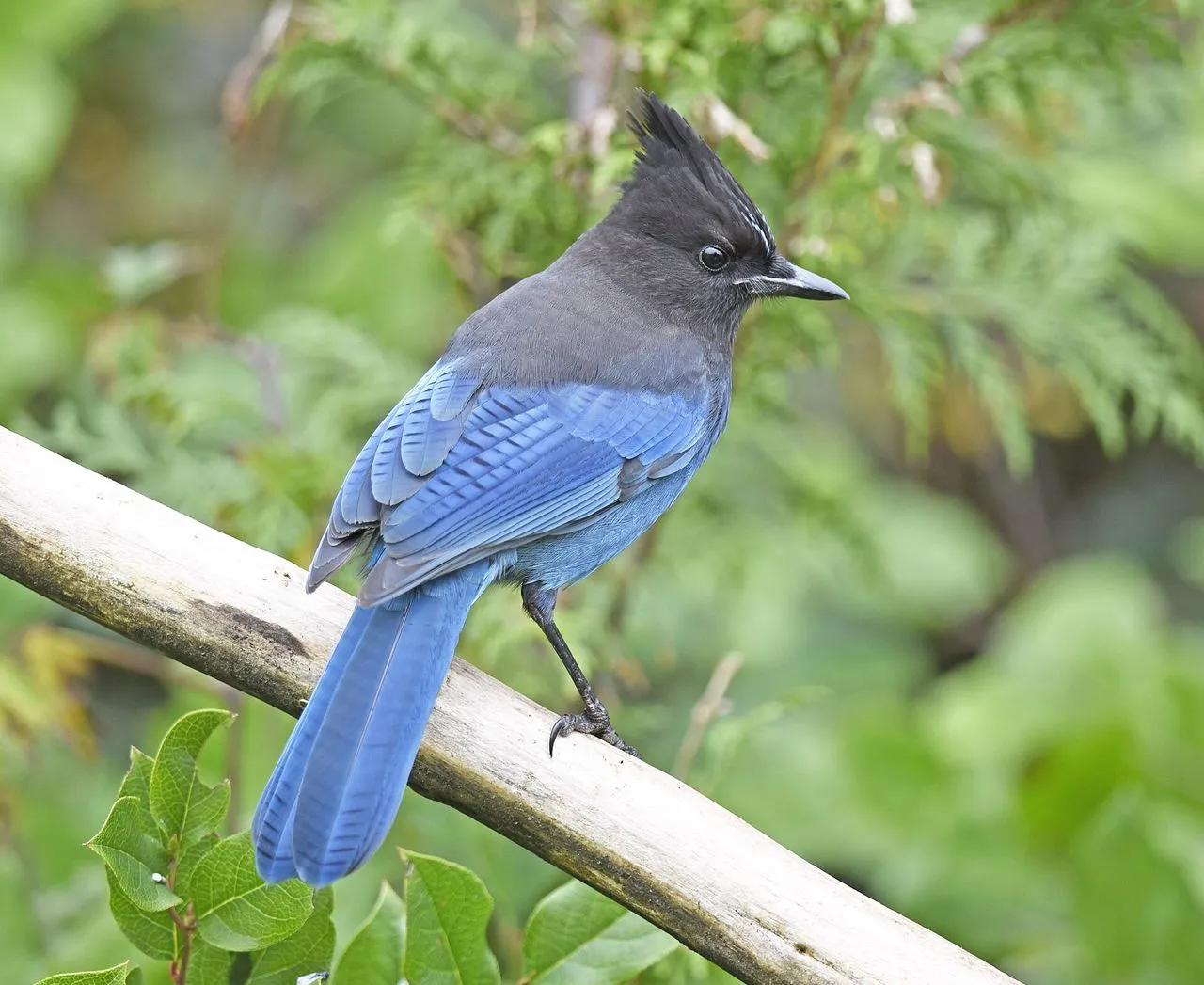
Cyanocitta stelleri (Gmelin, 1788), Steller's Jay, is the crested jay of western North American conifer forest, named from Georg Wilhelm Steller's eighteenth-century Alaska collections and immediately separable from Blue Jay by its black head, dark crest, and blue body without white wing bars.
Part of the Complete Corvids Guide.
Identification
Visual
Steller's Jay is a large, crested jay, about 11-13 in (28-33 cm) long. The head, throat, breast, and upper back are black to charcoal, contrasting with deep blue wings, rump, belly, and tail. The crest is long and triangular, raised when alert. Many coastal birds have blue or pale streaking on the forehead; interior Rocky Mountain birds often show more white or pale blue forehead marks. Subspecies variation is visible but should not distract from the main character: dark hood plus crest plus blue body.
Blue Jay overlap occurs locally in the Rockies, especially foothill and plains-edge zones. Blue Jay has a white face, black necklace, white wing bars, and paler underparts. Steller's lacks those white facial and wing markings and appears darker-headed at any distance. Woodhouse's Scrub-Jay lacks a crest and has a grey-brown back; Pinyon Jay is crestless, shorter-tailed, and more uniformly blue-grey.
| Feature | Steller's Jay (Cyanocitta stelleri) | Blue Jay (C. cristata) | Woodhouse's Scrub-Jay (Aphelocoma woodhouseii) |
|---|---|---|---|
| Length | 11-13 in (28-33 cm) | 10-12 in (25-30 cm) | About 11-12 in (28-30 cm) |
| Crest | Long, dark, triangular | Prominent blue crest | No crest |
| Head pattern | Black to charcoal hood | White face; black necklace | Blue head; grey-brown back |
| Wing marks | Blue wings; no white bars | Blue, black, and white bars | Plain blue wings; no white bars |
| Habitat | Western conifer and montane forest | Eastern woodland and suburbs | Interior scrub, pinyon-juniper, oak woodland |
The blue is structural, produced by feather nanostructure rather than blue pigment. Worn birds can look duller in late summer, but the dark head remains.
Audio
The common call is a harsh, descending "shack-shack-shack" or "shaar," often louder and rougher than Blue Jay. Steller's Jays also give rattles, low conversational notes, whistles, and alarm scolds. In campsites the birds maintain contact with short nasal calls while moving through canopy and picnic areas.
Mimicry is frequent. Red-tailed Hawk, Red-shouldered Hawk in overlap areas, Northern Pygmy-Owl, domestic animals, and mechanical sounds have all been reported. As with Blue Jay, hawk mimicry may function in alarm and in competitive displacement, but specific context matters. A jay giving a hawk call from dense conifer while mobbing is not doing the same thing as a bird clearing a feeder.
Distribution
The range runs from coastal Alaska and British Columbia south through the Pacific Northwest, Sierra Nevada, Cascades, Rocky Mountains, and highlands into Mexico and Central America. It is the western counterpart of Blue Jay in broad ecological terms, though the two are not simple east-west replacements because Steller's is much more tied to coniferous and montane forest.
Movements are mostly resident, with local downslope shifts in winter and irregular wandering when cone or mast crops fail. In settled mountain towns it is present year-round, using feeders, campgrounds, ski areas, and refuse.
Habitat
Primary habitat is coniferous and mixed forest: Douglas-fir, spruce, fir, pine, cedar, redwood, and montane oak-conifer mixtures. It also occupies wooded suburbs, parks, campgrounds, riparian corridors in dry mountains, and coastal forest edges.
The species is comfortable around humans where trees remain. It is one of the characteristic birds of western campgrounds, not because campgrounds are natural habitat, but because they combine mature conifers, openings, water, and predictable food scraps. In continuous closed forest it often moves through middle and upper canopy but descends quickly to food.
Diet and Foraging
Steller's Jay eats insects, spiders, acorns, conifer seeds, berries, fruit, eggs, nestlings, small vertebrates, carrion, suet, peanuts, bread, and refuse. It forages by gleaning branches, probing bark, walking on ground, raiding campsites, and opening seeds or nuts from perches.
Caching is regular. Acorns, pine seeds, peanuts, and other portable foods are hidden in soil, moss, bark crevices, needle litter, and roof gutters. The bird's role in oak and pine dispersal is less singularly documented than the Blue Jay's post-glacial oak story, but local seed movement by Steller's Jay is ecologically real in mixed western woods.
At feeders it is dominant over smaller passerines and often over scrub-jays when it has height advantage. Birds load food and leave rather than feeding continuously in place, a corvid pattern that reduces theft and predation exposure while building reserves.
Breeding Biology
Pairs are monogamous within a season and often remain together across years in stable territories. Nests are bulky cups of twigs, rootlets, leaves, moss, mud, and plant fibres, placed in conifers or dense shrubs, often 10-30 ft above ground but variable.
Clutch size is usually 2-6 eggs. Incubation lasts about 16 days, largely by the female, with the male feeding her. Nestlings fledge after roughly 16-18 days but remain dependent and noisy for weeks. Adults defend nest areas vigorously, scolding squirrels, accipiters, owls, humans, and domestic cats.
Nest predation is substantial, including by squirrels, snakes, corvids, and raptors. In turn, Steller's Jays take eggs and nestlings of other birds, a normal but often emotionally overread part of corvid ecology.
Notes
Steller's Jay hybridises with Blue Jay where ranges meet. Hybrids can show intermediate head pattern, crest, and wing markings; they are uncommon but instructive because they show how closely related the two Cyanocitta species remain.
The species also illustrates the danger of judging corvids by campground behaviour alone. A bird stealing tortilla chips from a picnic table is using the same food-searching flexibility that, in forest, finds beetle larvae, acorns, and cone seeds. Human food changes the setting, not the underlying foraging problem.
See Also
- Blue Jay
- California Scrub-Jay
- Eurasian Jay
- The Complete Attracting Guide
- The Complete Corvids Guide
- Clark's Nutcracker: the higher-elevation corvid sharing the western mountain forest with Steller's Jay.
Frequently Asked Questions
How do I identify a Steller's Jay?
Look for a large crested jay with black head, throat, breast, and upper back contrasting with deep blue wings, rump, belly, and tail. The long triangular crest is raised when alert. Coastal birds may show blue or pale streaking on the forehead; interior birds often have more white. Blue Jays in overlap areas have white face, black necklace, and white wing bars.
Where is Steller's Jay found?
Range runs from coastal Alaska and British Columbia south through the Pacific Northwest, Cascades, Sierra Nevada, Rocky Mountains, and highlands into Mexico and Central America. It is the western counterpart of Blue Jay but is much more tied to coniferous and montane forest rather than deciduous woodland.
Does Steller's Jay mimic hawk calls like Blue Jay?
Yes, mimicry is frequent. Red-tailed Hawk, Red-shouldered Hawk in overlap areas, Northern Pygmy-Owl, domestic animals, and mechanical sounds have all been reported. As with Blue Jay, hawk mimicry may function in alarm contexts or competitive displacement at feeders, but specific context matters.
What do Steller's Jays eat?
They eat insects, spiders, acorns, conifer seeds, berries, fruit, eggs, nestlings, small vertebrates, carrion, suet, peanuts, bread, and refuse. Caching is regular, acorns, pine seeds, peanuts, and other portable foods are hidden in soil, moss, bark crevices, and needle litter. Their role in oak and pine dispersal is ecologically real in western mixed forests.
Sources & References
- Ehrlich, P.R., Dobkin, D.S. & Wheye, D. (1988). The Birders Handbook. Simon & Schuster.
- Cornell Lab of Ornithology. (2024). All About Birds: Steller's Jay. birds.cornell.edu
- Sibley, D.A. (2014). The Sibley Guide to Birds (2nd ed.). Knopf.
- Walker, L.E. (2020). 'Steller's Jay (Cyanocitta stelleri).' The Birds of the World, Cornell Lab of Ornithology.