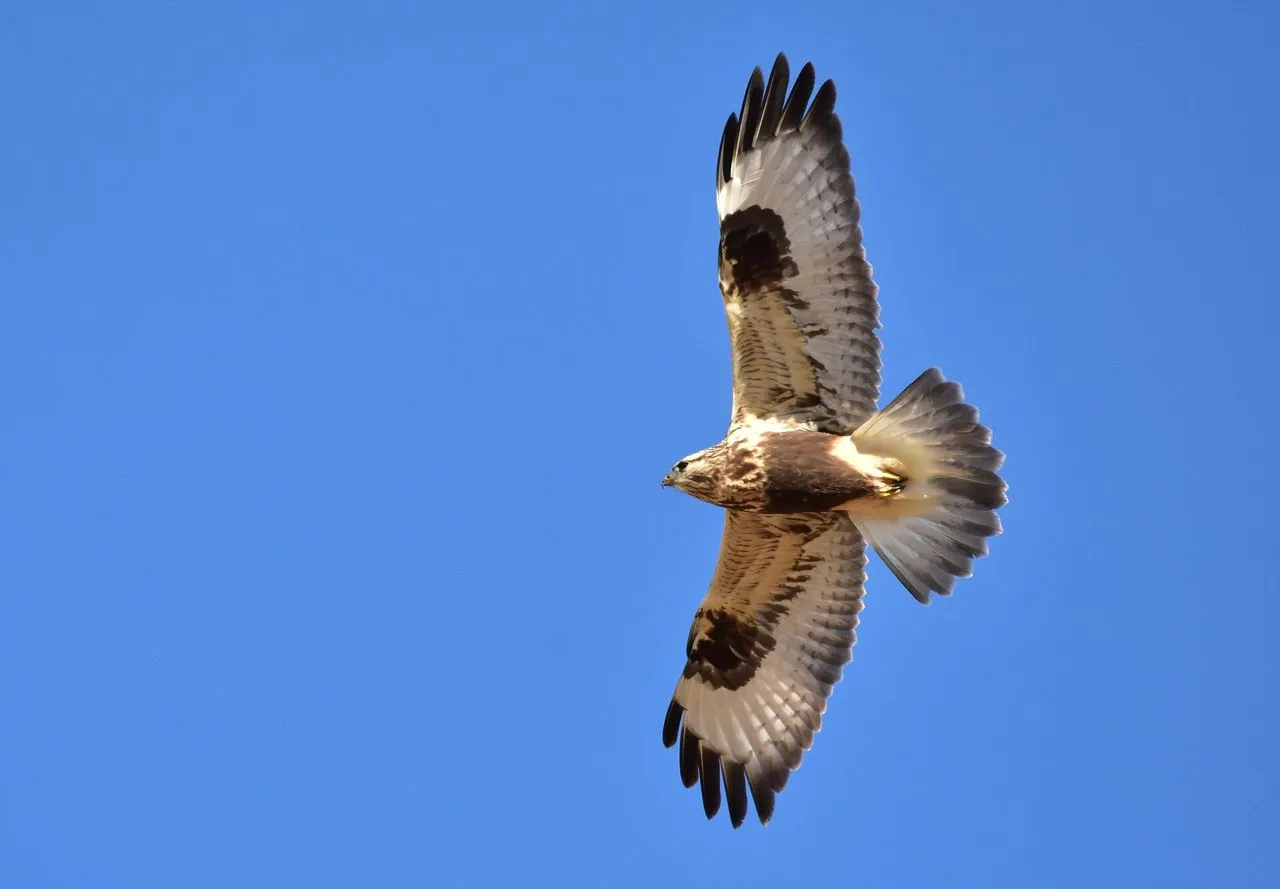
'Raptor' is an ecological term, not a taxonomic group, diurnal birds of prey span two orders. Accipitridae includes hawks, eagles, kites, harriers, and Old World vultures. Falconidae includes falcons and caracaras. Key identifications: buteos (broad-winged, heavy) vs accipiters (short-winged, long-tailed for forest pursuit); falcons have a toothed bill for killing prey.
There is no single taxonomic group called "raptors": the word names an ecological guild of diurnal predatory birds, defined by hunting with talons, and it straddles two orders that are considerably more distant from each other than most field guides let on.
I'm Dr. James Whitfield, formerly with the British Trust for Ornithology and past 12,000 hours of fieldwork across North America and Europe. This guide is structured around what is actually useful when you have a bird in your binoculars for thirty seconds before it disappears: shape, flight style, and hunting behaviour. Plumage detail comes later, once you know what order you are looking at.
Taxonomy
The birds conventionally labelled raptors sit in two distinct orders with different evolutionary histories.
Accipitriformes contains the family Accipitridae: hawks, kites, harriers, eagles, and Old World vultures, alongside the Osprey's own family Pandionidae. This is the lineage most people picture when they think "bird of prey". Species in this order share a genuine common ancestor, and the anatomical similarities between a Red-tailed Hawk and a Bald Eagle reflect that shared origin rather than superficial convergence.
Falconiformes contains the family Falconidae: falcons and caracaras. This is where the taxonomy becomes counterintuitive. Molecular phylogenetics, drawing on genomic data gathered since the early 2000s, has established that Falconidae is not the sister group of Accipitridae. Falcons are instead more closely related to the passerines and parrots. A Peregrine Falcon is, in evolutionary terms, closer to a Budgerigar than it is to a Red-tailed Hawk. The hooked bill, the talons, the diet of vertebrate prey: these are convergent features that evolved independently in the two orders, not shared inheritance from a common raptor ancestor. The caracaras, often overlooked in North American birding guides, belong here too, as the basal lineage of the family.
The practical consequence for a birder is that the similarities between a buteo and a falcon are architectural solutions to a shared ecological problem, arrived at by two separate lineages over separate spans of geological time. The differences in wing structure, syrinx anatomy, and breeding biology run deeper than the superficial resemblances.
New World vultures (Cathartidae) appear in many popular raptor guides. Their exact phylogenetic placement remains contested, they are not Accipitridae, and they are treated separately in this series.
Silhouette Identification
Beyond 100 metres, plumage colour becomes unreliable. Silhouette is consistent across all lighting conditions, readable at 500 metres or more in clear air, and often sufficient to identify a bird to group level before any other character is assessed. There are four primary silhouette types among North American diurnal raptors.
| Shape | Wings | Tail | Typical size | What the shape implies |
|---|---|---|---|---|
| Buteo | Broad, rounded; primary "fingers" splayed at tips | Short, wide, fanned | Medium to large | Thermal soarer; still-hunter attacking from height |
| Accipiter | Short, rounded | Long, narrow | Small to medium | Woodland ambush; short-burst acceleration through cover |
| Falcon | Long, pointed, swept back | Medium, tapered | Small to large | Fast direct flight; speed sustained over distance |
| Harrier | Long, narrow; held in shallow V-dihedral | Long | Medium | Low quartering flight; partial acoustic hunter |
Buteo
The buteo is the archetype most people visualise when they hear the word "hawk": broad wings with splayed primary fingers at the tips, a short fanned tail, and a heavy-chested profile. Buteo jamaicensis (Red-tailed Hawk) is the North American template. In soaring flight the wings are held flat or very slightly raised; the bird tilts slowly in thermals, gaining altitude with minimal wingbeats. The wide, slotted wingtip reduces induced drag at low airspeeds, which is the aerodynamic mechanism behind the buteo's efficiency in slow thermal soaring over open country. When a buteo glides between thermals it adopts a narrower wing profile, reducing drag for the descent, then re-broadens the wings as it enters the next thermal column.
The full species profile: Red-tailed Hawk.
Accipiter
Short, rounded wings and a long tail: this is the woodland hawk, built for acceleration and tight-angle pursuit through tree canopy. The long tail acts as a rudder during rapid directional changes, and the short wings generate high lift at low speeds, which matters when the bird is threading through dense cover at speed. Accipiter cooperii (Cooper's Hawk) and Accipiter striatus (Sharp-shinned Hawk) are the familiar North American pair. The default flight pattern is diagnostic even when silhouette is ambiguous: three to five rapid wingbeats, then a brief glide, repeated. A Cooper's Hawk arriving at a garden feeder does so fast, low, and already committed to a target before it clears the shrubbery.
Falcon
Long, pointed, swept-back wings with relatively high wing loading: a bird built for speed rather than slow soaring. The silhouette at distance resembles a drawn anchor. Falco peregrinus (Peregrine) and Falco sparverius (American Kestrel) span the size range of the family. Wing loading in falcons is higher than in buteos of comparable size, producing a stiffer, faster wingbeat that looks more mechanical and deliberate than the fluid accipiter stroke. The kestrel adds one behaviour absent in the other shape categories: sustained wind-hover, holding a fixed point in the air above open ground on rapidly beating wings while scanning for prey below.
The full species profile: American Kestrel.
Harrier
Long, narrow wings held in a shallow V-dihedral, a long tail, and a tilting flight that rocks continuously in crosswinds. Northern Harrier (Circus hudsonius) is the sole North American representative; the Eurasian equivalent, Circus cyaneus, is its close relative. The V-dihedral provides passive pitch stability, allowing the bird to maintain low-altitude quartering flight without constant active correction against wind variation. Harriers possess a rudimentary facial disc, structurally analogous to the full disc of owls, that funnels sound toward the ear openings and assists prey detection in dense ground vegetation. This acoustic adaptation is what allows harriers to locate voles moving through grass they cannot directly see.
Flight Style
Shape tells you the category; flight style confirms it.
Buteos use thermals to gain altitude, then glide between them in long descending arcs, covering ground without sustained flapping. Ridge lift from hillsides and escarpments provides fixed soaring points independent of thermal activity, which is why ridgeline watchpoints see raptors on days too cool for strong thermal development. Away from soaring conditions, buteos spend extended periods perched on elevated structures, scanning below.
Accipiters use the flap-flap-glide cadence. Three to five rapid wingbeats, then a brief glide, repeated at consistent intervals. In active pursuit the pattern breaks down entirely, but in transit the default cadence is reliable enough to use as a field character when silhouette alone is inconclusive at range.
Falcons fly direct, fast, and stiff-winged. The Peregrine's wingbeats look powerful and deliberate. The kestrel alternates hovering and gliding, descending toward prey in a stepped sequence: hover, partial drop, hover again, then the final strike. This stepped descent appears to allow repeated assessment of a target's position before committing.
Harriers tilt and recover in crosswinds, rarely flapping more than necessary. The slow, low, rocking flight over open marsh or rough grassland is unmistakable once you have seen it. A bird tilting like an unbalanced plate at five metres above a wet field is a Northern Harrier until proved otherwise.
Hunting Behaviour by Group
Buteos are predominantly still-hunters, a strategy sometimes called sit-and-wait predation. The bird selects an elevated perch with a clear view over open ground, holds that position for extended periods while scanning for movement, then drops in a short stoop. Prey is primarily small mammals: voles, mice, ground squirrels, and in larger buteo species, rabbits. Some species, including the Rough-legged Hawk (Buteo lagopus), regularly hover in wind to extend their ground-scan range before committing to a drop. The Red-tailed Hawk's prevalence on utility poles and fence posts along roadsides is not incidental: road margins in agricultural landscapes concentrate small mammals in predictable linear corridors of short vegetation, and the poles provide the height advantage that still-hunting requires.
How do you identify a raptor in flight?
Quick answer: identify raptors by silhouette before color. Broad wings and a short tail usually point toward a buteo or eagle. Long tail and quick woodland bursts suggest an accipiter. Pointed wings and direct speed suggest a falcon. Low, tilting flight over marsh often means harrier.
A field guide helps once the bird lands or circles long enough for details. The Sibley Guide to Birds, 2nd Edition is useful for checking wing shape, age patterns, and similar species after the sighting. As an Amazon Associate, we earn from qualifying purchases, at no extra cost to you.
Accipiters rely on surprise and short-burst speed. The standard attack is an approach through cover, using woodland edge, hedgerow, or garden shrubbery as concealment, followed by a burst into a target flock. Pursuit success in open-ground chases is substantially lower than in ambush conditions, which is why accipiters rarely continue an open pursuit beyond 100 to 200 metres. Urban feeders have become significant hunting sites in recent decades because the dense, habituated flocks of House Sparrows and Doves that develop around supplementary feeding are concentrated, predictable, and often less vigilant than their rural equivalents.
Falcons split between two primary strategies by size and habitat. Large species such as the Peregrine stoop: they gain altitude, fold the wings, and dive on airborne prey at speeds documented above 200 km/h, striking with the clenched foot. Smaller species such as the American Kestrel hover over open ground, locate prey visually and possibly via UV-reflective vole urine trails (to which Falco species appear behaviourally sensitive), then drop in stages.
Harriers quarter low over open ground and marsh in repeated slow passes. On locating prey audibly or visually, they execute a rapid vertical loop and drop. The acoustic component of harrier hunting is well-documented: experiments in which harriers had their ear openings experimentally obscured showed measurable reductions in capture rates on cryptic prey moving through dense vegetation.
Owls Are Not Raptors
Owls are placed in the order Strigiformes, which is phylogenetically distant from both Accipitriformes and Falconiformes. The forward-facing eyes, hooked bill, and talons of owls evolved independently from those of diurnal raptors, driven by similar predatory ecological pressures on a separate lineage. This is convergent evolution, not shared inheritance. An owl and a buteo hunting the same field share a functional resemblance and nothing more.
Short-eared Owls, Snowy Owls, and Burrowing Owls hunt by day and are sometimes counted in "raptor lists" for convenience. The convenience is understandable, but the category is ecologically constructed rather than phylogenetically real. For the mechanisms that separate nocturnal from diurnal hunters at the level of visual anatomy, feather structure, and auditory processing, see the Barn Owl profile.
Common Confusions
Turkey Vulture vs. buteo. Cathartes aura shares the airspace above open country with soaring buteos at the same altitudes. The separation is straightforward on flight behaviour: Turkey Vultures hold their wings in a pronounced V-dihedral and rock continuously; they almost never flap, riding thermals with remarkable efficiency. They do not stoop or hunt live prey. A large dark bird that has made no wingbeats in three minutes of continuous watching is a Turkey Vulture.
Cooper's Hawk vs. Sharp-shinned Hawk. Both are accipiters with similar plumage, and the size difference between them is the most cited but least reliable character on isolated birds in flight. A Cooper's is roughly crow-sized, a Sharp-shinned roughly robin-sized, but in the absence of a direct comparison those references are difficult to apply. The tail tip is more useful: Cooper's typically shows a rounded tail tip; Sharp-shinned shows a squared or slightly notched tip. Both characters vary with how much the tail is spread and with feather wear, and experienced observers regularly disagree on individual birds.
Osprey. Osprey (Pandion haliaetus) resembles a large buteo at first glance, but carries its wings in a distinctive gull-like kink, bent back at the wrist, and is always associated with open water. It plunge-dives feet-first for fish, a behaviour no other North American raptor shares. At any water body with fish, an Osprey is the first candidate for any large, pale-bellied raptor circling overhead.
Notable Species
- Red-tailed Hawk (Buteo jamaicensis): the commonest buteo across North America; year-round resident throughout the continental USA and southern Canada.
- American Kestrel (Falco sparverius): smallest North American falcon; in sustained population decline since the 1970s across much of its range.
- Falco peregrinus, Peregrine Falcon: recovered from near-extinction caused by DDT-induced eggshell thinning; now nesting on building ledges in most major cities in North America and Europe.
- Accipiter cooperii, Cooper's Hawk: the accipiter most likely encountered at a suburban feeder, particularly in winter; has urbanised substantially over the past 30 years.
- Circus hudsonius, Northern Harrier: the quartering marsh hawk; the white rump patch is visible at any range and sufficient for identification in the field.
- Haliaeetus leucocephalus, Bald Eagle: adults unconfusable; immatures take five years to acquire the white head and tail and are frequently misidentified against Turkey Vultures and other large dark raptors.
Where to See Raptors
Open country and farmland produce the highest day-to-day raptor diversity with the least effort. Red-tailed Hawks on utility poles, American Kestrels on roadside wires, Northern Harriers crossing fields at five metres: these are predictable sightings across the continent in any open agricultural landscape.
Ridge and escarpment habitat during migration concentrates birds that are otherwise spread thinly across the landscape. Hawk Mountain Sanctuary in Pennsylvania records tens of thousands of Broad-winged Hawks (Buteo platypterus) in a single autumn season; peak days in mid-September produce counts of several thousand per hour, all funnelled by the ridge into a visible stream. The Hawk Migration Association of North America (HMANA) maintains standardised count protocols and a public database of multi-decade trend data across established watchpoints.
Wetland and coastal marsh for Northern Harriers and Ospreys. An Osprey is a near-certainty over any open water holding fish between April and October across most of the continental USA.
Urban and suburban habitat is now productive raptor country that is routinely underestimated. Peregrine Falcons nest on bridge ledges and building cornices in most major cities. Cooper's Hawks visit garden feeders regularly in winter, exploiting the concentrated songbird flocks. A Cooper's typically returns to a productive feeder site repeatedly within the same day.
- Why Are Vultures Circling Over My House?: thermal soaring vs death omen, with species ID for Turkey vs Black Vulture and the olfactory mechanism.
- Cooper's Hawk vs Sharp-shinned Hawk: the canonical accipiter ID problem with a 12-row table.
- Red-tailed vs Red-shouldered Hawk: the eastern buteo diagnostic, including the primary windows of Red-shouldered.
- Northern Goshawk: the largest North American accipiter; field profile and the 2023 American Goshawk split.
- Birdwatching Binoculars Beginners Guide: choosing binoculars suited to long-range raptor identification.
Quick answer: what counts as a raptor?
Raptors are birds of prey that hunt or scavenge with strong feet, hooked bills, sharp eyesight, or a mix of those traits. Hawks, eagles, falcons, owls, kites, harriers, osprey, and vultures are all usually grouped as raptors, even though they hunt in different ways.
How to identify raptors in the field
Start with shape before color. Broad wings and a short tail often point toward a buteo hawk. Long pointed wings suggest a falcon. A bird holding its wings in a shallow V while circling may be a vulture. Size helps, but distance can trick you.
Useful gear for distant birds
Raptors are often too far away for naked-eye details, so binoculars matter more than a long list of field marks. Look for a pair you can hold steady and carry comfortably. This Amazon search for bird watching binoculars for raptor identification is a sensible starting point if you are comparing options. As an Amazon Associate, we earn from qualifying purchases, at no extra cost to you.
FAQ: raptors
Are owls raptors?
Yes. Owls are raptors, even though most hunt at night and have a different body plan from hawks and falcons.
Are vultures birds of prey?
Yes, vultures are generally treated as birds of prey. They feed mostly on carrion rather than hunting live prey, but they share the hooked bill and soaring habits people associate with raptors.