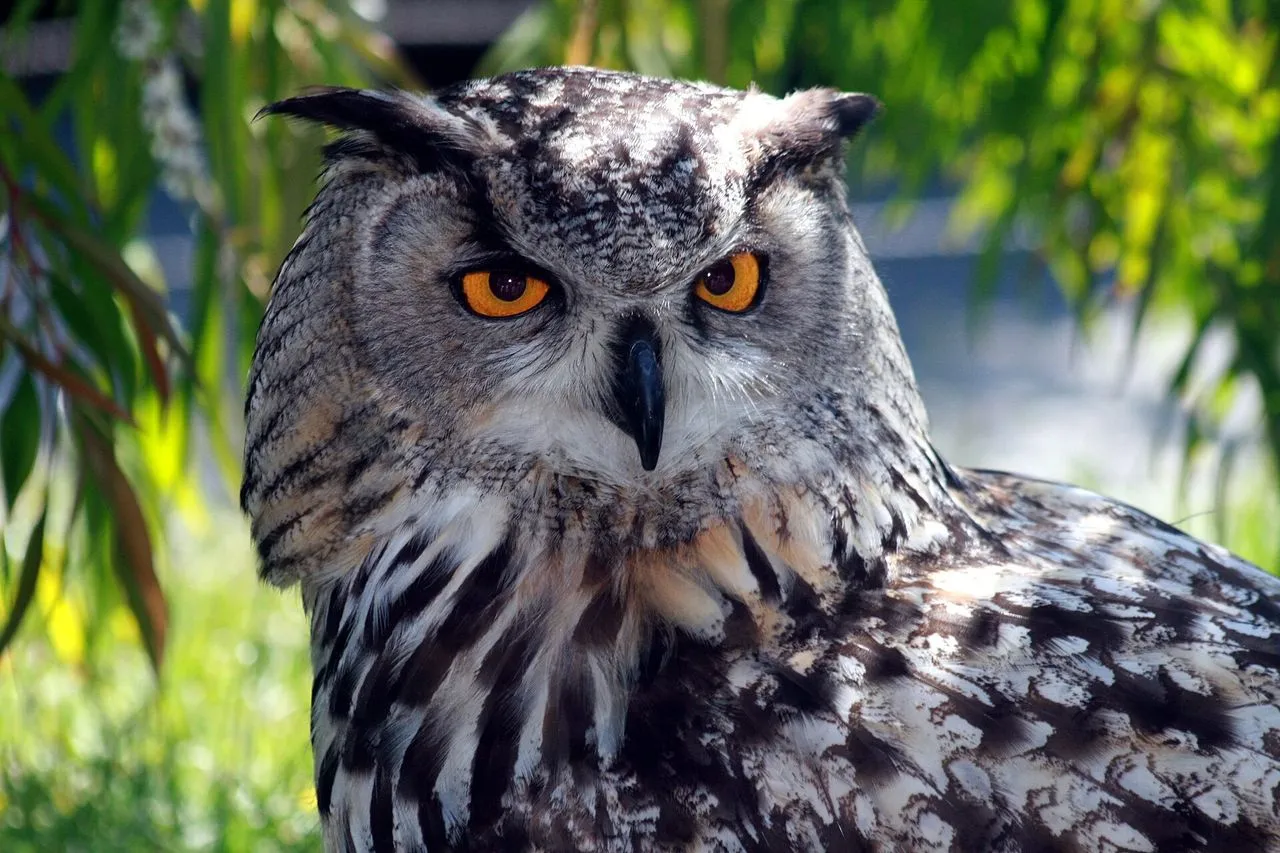
Bubo bubo (Linnaeus, 1758), the Eurasian Eagle-Owl, is a 1.5-4.2 kg predator with a wingspan that can exceed 180 cm, making it the largest owl regularly occurring in Europe.
Part of the Complete Owls Guide.
Identification
| Character | Eurasian Eagle-Owl (Bubo bubo) | Long-eared Owl (Asio otus) |
|---|---|---|
| Length | 59-73 cm (23-29 in) | 31-40 cm (12-16 in) |
| Wingspan | 138-188 cm (54-74 in) | 86-100 cm (34-39 in) |
| Mass | 1.5-4.2 kg (3.3-9.3 lb) | 220-435 g (7.8-15.3 oz) |
| Eyes | Orange to orange-red | Orange |
| Ear tufts | Massive, widely spaced | Long but on a slim head |
| Usual nest | Cliff ledge or quarry face | Abandoned stick nest |
Visual
This is a massive owl: body length 59-73 cm, wingspan 138-188 cm, with females substantially larger than males. The head carries large, widely spaced feather tufts. Eyes are orange to orange-red, set in a broad facial disc. Upperparts are mottled brown, buff, and black; underparts are heavily streaked on the breast and barred below.
In flight the size is apparent. The wings are broad and long, the wingbeats deep, and the silhouette more eagle-like than any medium owl. A perched bird on a cliff ledge can look almost mammalian in bulk. Long-eared Owl shares ear tufts and orange eyes but is less than one quarter the mass and far slimmer.
Audio
The male territorial call is a deep, resonant oo-hu, usually repeated at intervals of several seconds. Females call at a higher pitch. The sound carries over rock valleys, quarries, and forested slopes, especially in cold still conditions. Courtship calling begins in winter in many regions, with peak territorial activity before egg laying.
Alarm calls include barks, growls, and bill-snapping. Near nests the species should not be approached; adults are powerful enough to injure an observer, and disturbance at exposed cliff sites can cause egg chilling or chick falls.
Distribution
The range extends from Iberia and Scandinavia across continental Europe, the Middle East, Russia, Central Asia, and into parts of East Asia. It occupies a wide climatic range, from Mediterranean cliffs to boreal forest edges and steppe mountains. Populations suffered severe persecution in western Europe but have recovered in several countries following legal protection and reintroduction.
British status is contentious. Breeding has occurred, but many records involve escapes or descendants of captive birds, and the question of natural recolonisation remains debated. The species is native to parts of Europe close enough for vagrancy to be plausible, but individual British birds require careful provenance assessment.
Habitat
Eurasian Eagle-Owls use cliffs, rocky escarpments, ravines, large quarries, open forest edges, semi-open mountains, steppe, and boreal clearings. They require secure nesting ledges or equivalent sites and access to medium-sized prey. Dense closed forest alone is less suitable than broken terrain with hunting openings.
Human-made quarries can provide excellent nesting structure if disturbance is limited. Forestry edges, moorland margins, reservoirs, and agricultural valleys may all be hunted from a central rocky nesting area.
Diet and Hunting
The prey range is broad and size-limited mainly by handling ability. Mammals include rats, rabbits, hares, hedgehogs, squirrels, mustelids, fox cubs, and young deer in some regions. Birds include corvids, gulls, ducks, pheasants, grouse, herons, and other raptors. The species also kills other owls, including Tawny and Long-eared Owls, where territories overlap.
Hunting is mostly nocturnal perch-and-pounce or low searching flight along slopes, forest edges, and open ground. The owl uses prominent rocks, trees, pylons, and cliff ledges as lookouts. Prey remains around nests can be conspicuous: plucked birds, mammal bones, pellets, and partial carcasses accumulate on ledges and below roosts.
Breeding Biology
Nesting is usually on cliff ledges, quarry faces, rock shelves, steep banks, or occasionally large stick nests and ground sites. No nest is built beyond scraping a shallow depression. Egg laying can begin very early, from February or March in temperate Europe. Clutch size is usually 1-3 eggs, with 2 common.
Incubation lasts about 34-36 days and is by the female. The male supplies prey. Young remain on or near the ledge for weeks and may move around the cliff before full flight. Productivity depends on prey, weather, and freedom from disturbance. Human climbing, quarry work, and nest photography can all cause failure if they occur near active sites.
Notes
The Eurasian Eagle-Owl is sometimes described only through size, but its ecological importance lies in dominance. It can suppress medium predators locally, take diurnal raptors at roost, and occupy territories measured in several square kilometres. In landscapes where it has returned after persecution, other large birds alter roost and nest-site choices. That effect is not romantic; it is the practical consequence of reintroducing or protecting a top nocturnal predator with the talon span to kill a buzzard.
Field evidence around territories is correspondingly large-scaled. Pellets may contain rabbit skull fragments, hedgehog spines, corvid feathers, gull remains, and the bones of other raptors. Plucking posts and feeding ledges can sit hundreds of metres from the nest, so prey remains alone do not prove the exact nesting cliff. This distinction matters for protection: once a territory is suspected, observers should avoid trying to refine the nest position unless they are licensed or directly involved in monitoring.
The species also exposes weaknesses in simple native-versus-non-native debate. In western Europe many populations are recovering from historical persecution, while in Britain individual birds may be escapes, deliberate releases, or natural wanderers. The ecological behaviour is the same in each case, but the conservation and legal interpretation differs. Records therefore need photographs, moult condition, rings or jesses if visible, and context, not just an excited report of a very large owl.
See Also
Frequently Asked Questions
How large is the Eurasian Eagle-Owl compared to other owls?
It is Europe's largest owl, weighing 1.5-4.2 kg with a wingspan of 138-188 cm. By comparison, Long-eared Owl shares orange eyes and ear tufts but is less than one quarter the mass. The flight silhouette is more eagle-like than typical owl, with deep wingbeats and broad long wings.
What does a Eurasian Eagle-Owl eat?
Prey range is extremely broad: rats, rabbits, hares, hedgehogs, squirrels, mustelids, fox cubs, and young deer in some regions. Birds include corvids, gulls, ducks, pheasants, grouse, and herons. It also kills other raptors, including Tawny Owl, Long-eared Owl, and even buzzards where territories overlap.
Is the Eurasian Eagle-Owl native to Britain?
British status is contentious. Breeding has occurred, but many records involve escapes or descendants of captive birds, and the question of natural recolonisation remains debated. The species is native to parts of Europe close enough for vagrancy to be plausible, but individual British birds require careful provenance assessment.
Where do Eurasian Eagle-Owls nest?
Nesting is usually on cliff ledges, quarry faces, rock shelves, or steep banks, with no constructed nest beyond a shallow scrape. Egg laying begins as early as February or March in temperate Europe. Clutch size is usually 1-3 eggs, with 2 most common.
Sources & References
- Mikkola, H. (1983). Owls of Europe. T & AD Poyser.
- del Hoyo, J., Elliott, A. & Sargatal, J. (eds.) (1999). Handbook of the Birds of the World, Vol. 5. Lynx Edicions.
- Penteriani, V. & Delgado, M. del M. (2019). The Eagle Owl. T & AD Poyser.
- Cramp, S. (ed.) (1985). The Birds of the Western Palearctic, Vol. 4. Oxford University Press.