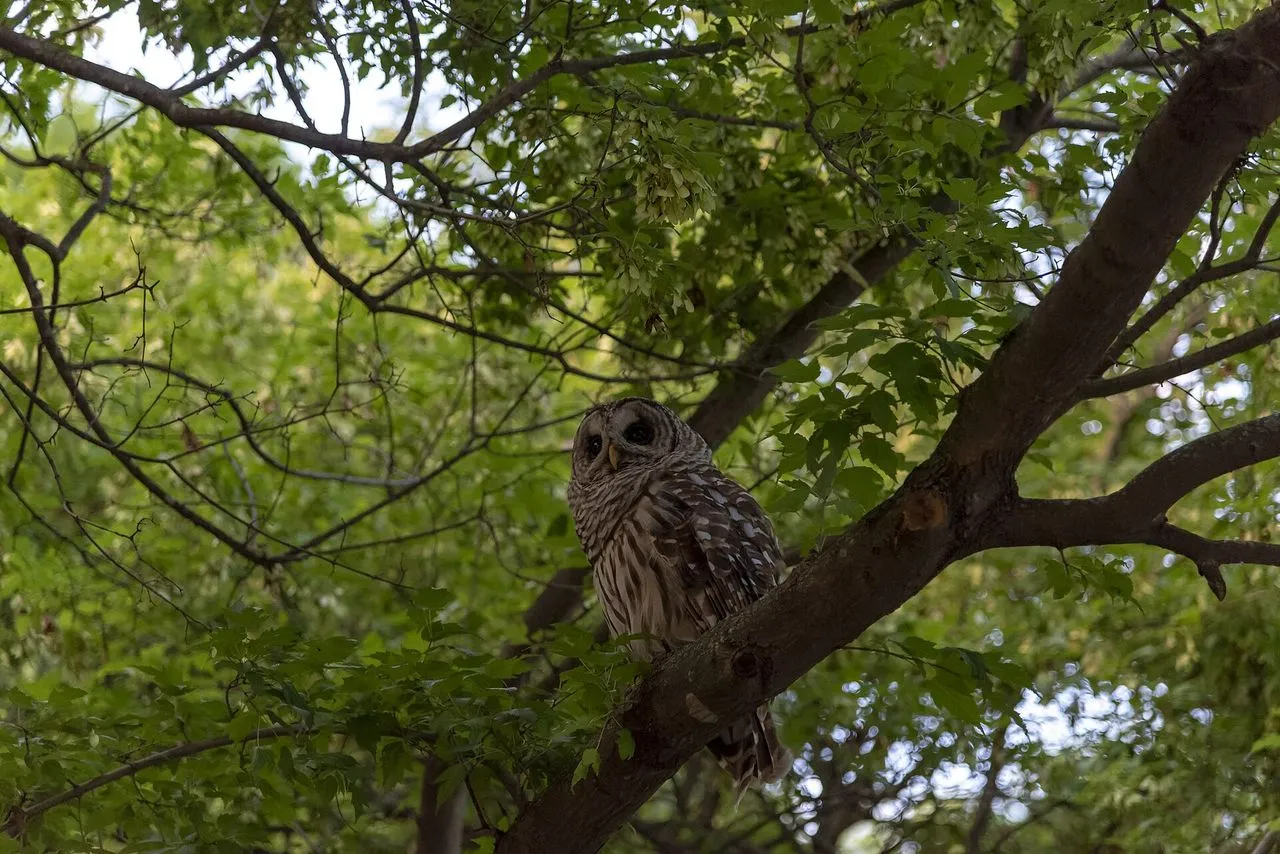
Strix varia (Barton, 1799), the Barred Owl, is a 470-1,050 g forest owl whose dark eyes and barred breast separate it immediately from the yellow-eyed large owls of North America.
Part of the Complete Owls Guide.
Identification
| Character | Barred Owl (Strix varia) | Great Horned Owl (Bubo virginianus) |
|---|---|---|
| Length | 40-63 cm (16-25 in) | 45-63 cm (18-25 in) |
| Wingspan | 96-125 cm (38-49 in) | Noted as large and broad-winged |
| Eyes | Dark brown to black | Bright yellow |
| Ear tufts | Absent | Wide-set and prominent |
| Main call | Who cooks for you, who cooks for you-all | Deep rhythmic hoots |
| Core habitat | Mature forest near water | Woodland edge, parks, open-country edges |
Visual
Barred Owl is large, round-headed, and ear-tuftless, 40-63 cm long with a wingspan of 96-125 cm. The face is pale grey-brown with concentric darker rings, the eyes are dark brown to black, and the bill is yellow. Upperparts are mottled brown and white. The breast shows horizontal barring across the upper chest and vertical streaking down the belly, giving the species its English name.
The dark eyes are decisive. Great Horned Owl has yellow eyes and ear tufts; Spotted Owl has dark eyes but is darker overall, with white spots rather than strong barring and streaking. In the Pacific Northwest, Barred and Spotted owls require careful separation, but in the East the Barred Owl is usually the only large dark-eyed owl present.
Flight is broad-winged and quiet, usually within or along forest rather than across open fields. Daytime views often come from a bird roosting low in swamp forest or being mobbed by crows.
Audio
The classic song is the eight-note phrase often rendered as who cooks for you, who cooks for you-all. It is loud, rhythmic, and carries well through humid forest. Pairs duet with cackles, hoots, screams, and ascending caterwauls that can sound mammalian to inexperienced listeners. Calling occurs year-round but increases in late winter and spring.
Unlike Great Horned Owl, the Barred Owl's voice is less deeply resonant and more conversational in rhythm. A pair calling at close range can produce a chaotic sequence of hoots and yelps lasting several minutes.
Distribution
Historically the species occupied eastern North America from the Gulf Coast through the Great Lakes, New England, and southern Canada, extending west through boreal and riparian corridors. During the twentieth century it expanded across the northern Great Plains and Rocky Mountain corridors into the Pacific Northwest.
That westward expansion has conservation consequences. In Washington, Oregon, and northern California, Barred Owls compete with and displace Northern Spotted Owls (Strix occidentalis caurina) through territorial aggression, higher reproductive output, and broader habitat tolerance. The issue is not resemblance but ecological replacement.
Habitat
Barred Owls favour mature forest with large trees, cavities, and shaded understory, especially near water. Bottomland hardwoods, cypress-tupelo swamp, riparian forest, mixed oak woodland, hemlock ravines, and mature suburban forest all support territories. They tolerate fragmented landscapes better than Spotted Owls, provided enough canopy and prey remain.
Wet forest is especially productive because amphibians, crayfish, small mammals, and roost sites occur together. In suburban areas the species may use wooded parks, greenbelts, and large residential lots with old trees.
Diet and Hunting
The diet is broad. Mammalian prey includes mice, voles, shrews, chipmunks, squirrels, young rabbits, and rats. Wetland prey is prominent: frogs, salamanders, crayfish, fish, snakes, and aquatic insects. Birds up to jay or small duck size are taken, especially at roosts. Earthworms are also recorded after rain, a reminder that large owls are not above low-energy prey when abundant.
Hunting is mostly perch-and-pounce from low or mid-level branches. The owl listens and watches, drops to ground or water edge, and returns to cover. It may wade into shallow water or take crayfish from stream margins. Compared with Great Horned Owl, it is less powerful but more associated with closed, damp forest.
Breeding Biology
Breeding begins early. Pairs call through winter, and eggs are usually laid from February to April depending on latitude. Nest sites include large tree cavities, broken-top hollows, old stick nests, squirrel dreys, and occasionally nest boxes of sufficient size. The species does not build a nest.
Clutch size is usually 2-3 eggs. Incubation lasts about 28-33 days and is mainly by the female. Young leave the nest at 4-5 weeks before strong flight, climbing and fluttering through nearby branches. Adults defend fledglings vigorously and may strike people who approach too closely; this behaviour is defensive, not evidence of abnormal aggression.
Notes
The Barred Owl's success is partly anatomical and partly behavioural: it is large enough to take substantial prey, small enough to manoeuvre in forest, vocal enough to hold territories, and flexible enough to eat amphibians, mammals, birds, and invertebrates. In the East this makes it a common mature-forest owl. In the Pacific Northwest it makes it a direct management problem for Spotted Owl recovery. Any account of the species that treats its expansion as a simple success story is incomplete.
Its tolerance of people is also easy to misread. Barred Owls may remain perched while walkers pass underneath, particularly in parks, but they are not domesticated or dependent on people. Feeding them mice for photographs, a practice that has appeared at some urban sites, changes hunting behaviour and can draw birds toward roads. The appropriate field method is passive: listen for the territorial phrase, check wet woodland edges in daylight for pellets and whitewash, and leave active nest areas alone once located.
In winter, unfrozen seepages and swamp margins can concentrate prey and keep pairs detectable even when upland woods are quiet. These wet pockets are often the most efficient places to listen after dusk.
See Also
- Great Horned Owl
- Eastern Screech-Owl
- Tawny Owl
- Cooper's Hawk
- The Complete Owls Guide
- Why Is an Owl Calling at Night?: the iconic who-cooks-for-you cadence is this species; full diagnostic for the other 8 temperate-zone owls.
- Great Horned Owl vs Barred Owl: the four-mark diagnostic for the two most common large North American owls.
Frequently Asked Questions
How do I tell a Barred Owl from a Great Horned Owl?
The dark eyes are decisive. Great Horned Owl has yellow eyes and prominent widely-spaced ear tufts, while Barred Owl has dark brown to black eyes and a round, ear-tuftless head. Barred Owl is also slimmer and lacks the white throat bib of Great Horned.
What does a Barred Owl sound like?
The classic song is an eight-note phrase rendered as 'who cooks for you, who cooks for you-all', loud and rhythmic. Pairs also duet with cackles, hoots, screams, and ascending caterwauls. Calling increases in late winter and spring but occurs year-round.
Why are Barred Owls a conservation concern in the Pacific Northwest?
Their twentieth-century westward expansion brought them into the range of Northern Spotted Owls (Strix occidentalis caurina), which they displace through territorial aggression, higher reproductive output, and broader habitat tolerance. The issue is ecological replacement, not resemblance.
What do Barred Owls eat?
Their diet is unusually broad: mice, voles, squirrels, rabbits, and other mammals; frogs, salamanders, crayfish, fish, and snakes from wetlands; birds up to jay or small duck size; and earthworms after rain. Hunting is mostly perch-and-pounce from low to mid-level branches.
Sources & References
- Cornell Lab of Ornithology. (2024). All About Birds: Barred Owl. birds.cornell.edu
- Sibley, D.A. (2014). The Sibley Guide to Birds (2nd ed.). Knopf.
- Mazur, K.M. & James, P.C. (2020). Barred Owl (Strix varia). Birds of the World. Cornell Lab of Ornithology.
- Kaufman, K. (2000). Lives of North American Birds. Houghton Mifflin.