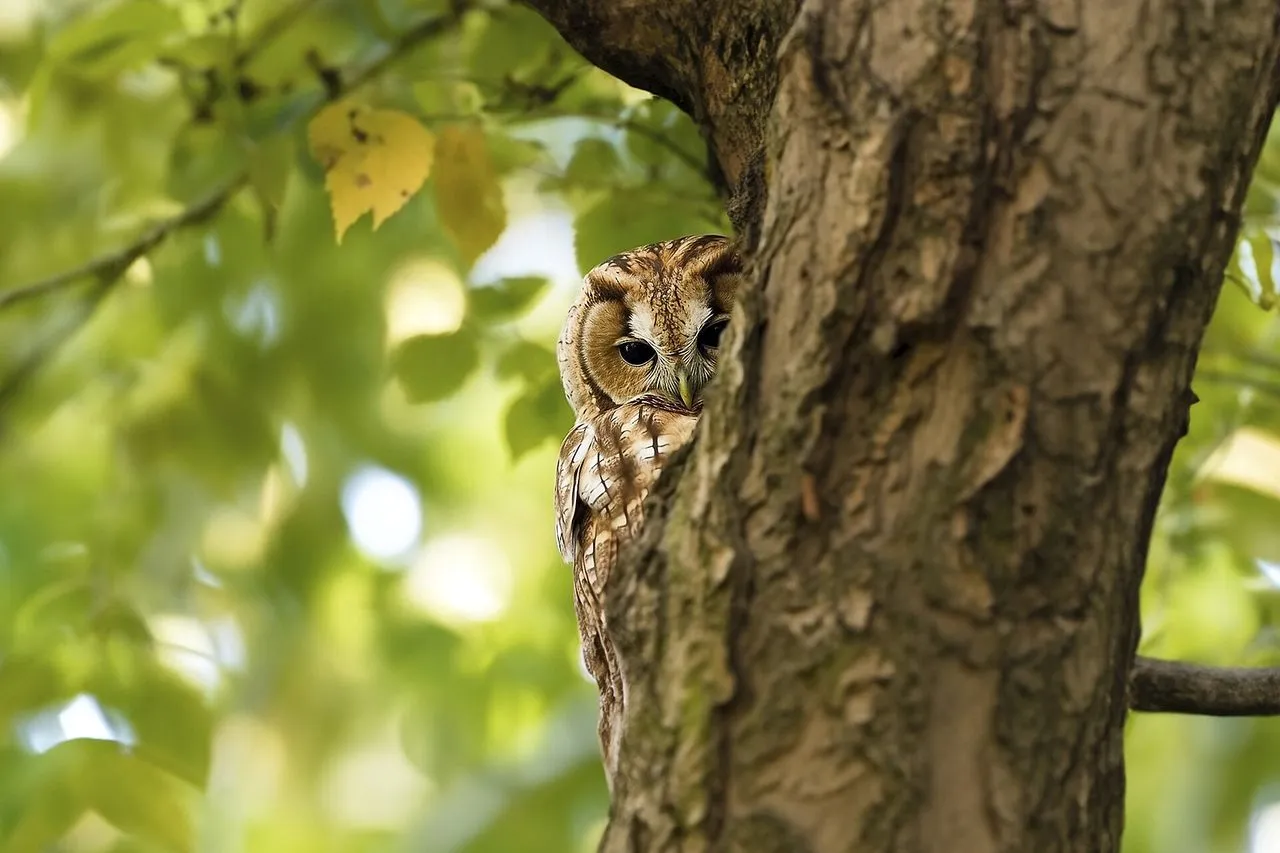
Strix aluco (Linnaeus, 1758), the Tawny Owl, is a 385-800 g woodland owl whose familiar hoot is produced by the male while the sharp ke-wick is most often the female contact call.
Part of the Complete Owls Guide.
Identification
| Character | Tawny Owl (Strix aluco) | Long-eared Owl (Asio otus) |
|---|---|---|
| Length | 37-43 cm (15-17 in) | 31-40 cm (12-16 in) |
| Wingspan | 81-96 cm (32-38 in) | 86-100 cm (34-39 in) |
| Mass | 385-800 g (13.6-28.2 oz) | 220-435 g (7.8-15.3 oz) |
| Eyes | Dark | Orange |
| Ear tufts | Absent | Long and usually obvious |
| Primary voice | Male hoooooo and female ke-wick | Low single hoo repeated every 2-4 seconds |
Visual
Tawny Owl is stocky, round-headed, and ear-tuftless, 37-43 cm long with a wingspan of 81-96 cm. The eyes are dark, giving the face a different expression from the yellow-eyed Little Owl or Long-eared Owl. Plumage varies from grey-brown to rufous-brown, with mottled upperparts and streaked underparts. The facial disc is plain and rounded, bordered subtly rather than sharply.
In Britain it is the common large woodland owl but is seen less often than heard. Daytime birds roost close to trunks in ivy, dense conifers, holly, or mature deciduous trees. When flushed, the flight is broad-winged and direct through woodland, with little of the buoyant open-ground style of Barn Owl or Short-eared Owl.
Juveniles leave the nest before full flight and appear as grey downy branchers in May and June. They are often reported as abandoned. In nearly all cases the adults are nearby and continue feeding them after dark.
Audio
The classic British night sound is not a single bird saying "twit-twoo". It is usually a duet or exchange: the female's sharp ke-wick followed by the male's long, wavering hoooooo. Males also give the full hooting phrase alone, especially during autumn territory reinforcement and winter pair activity.
Tawny Owls call in every month, but activity increases from September through early spring. Calm, dry evenings after dusk are best. The hoot carries well through woodland and suburban gardens, though traffic noise can obscure the lower frequencies.
Distribution
The species occurs across much of Europe and into western Asia, with Britain holding a large resident population. It is widespread in England, Wales, and lowland Scotland but absent from Ireland as a native breeding bird. Continental populations occupy deciduous, mixed, and some coniferous woodland where cavities and prey are available.
Tawny Owls are strongly sedentary. Established adults may hold the same territory for years, and juveniles dispersing in autumn face high mortality if vacant woodland territories are scarce. This territorial stability explains why garden listeners often hear birds from the same direction across many winters.
Habitat
The core habitat is mature deciduous or mixed woodland with large cavity-bearing trees. The species also uses wooded parks, churchyards, old orchards, estates, suburban gardens, and farmland copses. It is less dependent on open rough grassland than Barn Owl and less tied to dense conifers than Long-eared Owl.
Large trees matter because nest cavities must be spacious. Beech, oak, ash, lime, and old pollards can provide suitable hollows. Where cavities are limited, large nest boxes are accepted, but they must be placed with regard to heat, rain, and access by Grey Squirrels and Stock Doves.
Diet and Hunting
Tawny Owl is an adaptable perch-and-pounce predator. Wood mice (Apodemus sylvaticus), Bank Voles (Myodes glareolus), Field Voles, Common Shrews, rats, moles, small rabbits, frogs, beetles, earthworms, and small birds all occur in diet samples. In urban territories, rats and small birds may be more prominent; in oak woodland, mice and voles dominate.
Hunting is mainly from fixed perches within woodland or along rides and edges. The owl drops to the ground or low vegetation and returns to cover. It can hunt in very low light but is not as acoustically specialised as Barn Owl. Wet nights may increase earthworm taking, particularly by inexperienced juveniles.
Breeding Biology
Nesting is in tree cavities, broken trunks, old crow nests, squirrel dreys, building holes, and nest boxes. Egg laying commonly begins in March, earlier in mild years. Clutch size is usually 2-4 eggs. Incubation lasts about 30 days and begins with the first egg, so chicks differ in size.
The female incubates and broods while the male supplies prey. Young leave the nest at about 32-37 days, before they can fly properly, and climb through nearby branches. This brancher stage is normal. Removing a grounded juvenile to a rescue centre without evidence of injury often reduces its survival prospects.
Notes
Tawny Owl is the owl most likely to be heard from a British garden, but its commonness is uneven. Territories require connected tree cover and cavities; newly built estates with small ornamental trees may hear birds from adjacent woodland but not hold a pair. The species also shows sensitivity to road mortality, especially juveniles dispersing across suburban networks. Listening records from fixed gardens, repeated through autumn and winter, can give a useful local index of territory persistence.
The species is also a poor candidate for casual nest inspection. Many nests are in deep cavities where contents cannot be seen without climbing or inserting a camera, and adults may defend at close range. A safer breeding confirmation is behavioural: repeated food-carrying at dusk, the location of begging branchers, and fresh pellets below a known cavity tree. In occupied gardens, retaining ivy, mature trees, and dark commuting routes is more useful than installing a box in an otherwise over-lit, over-tidied space.
Autumn calling should not be dismissed as random noise. It is when juveniles disperse, adults reassert boundaries, and vacant territories are most likely to be detected by patient listening from fixed points.
See Also
Frequently Asked Questions
What does a Tawny Owl actually sound like?
The classic 'twit-twoo' is a duet between two birds, not a single bird's call. The female gives a sharp ke-wick and the male answers with a long, wavering hoooooo. Males also give the full hooting phrase alone, especially during autumn territory reinforcement and winter pair activity.
Are Tawny Owls in Ireland?
No. The species is widespread across England, Wales, and lowland Scotland but absent from Ireland as a native breeding bird. The strict sedentary nature of established adults, combined with the sea barrier, has prevented natural colonisation.
What should I do if I find a young Tawny Owl on the ground?
Leave it alone. Young leave the nest at 32-37 days before they can fly properly, and climb through nearby branches. This brancher stage is normal and adults continue to feed them after dark. Removing a grounded juvenile to a rescue centre without evidence of injury often reduces its survival prospects.
Where do Tawny Owls nest?
In tree cavities, broken trunks, old crow nests, squirrel dreys, building holes, and nest boxes. Large mature trees with spacious hollows are preferred. Egg laying commonly begins in March, earlier in mild years, with clutches of 2-4 eggs and incubation of about 30 days.
Sources & References
- Mikkola, H. (1983). Owls of Europe. T & AD Poyser.
- Cramp, S. (ed.) (1985). The Birds of the Western Palearctic, Vol. 4. Oxford University Press.
- Southern, H.N. (1970). The natural control of a population of Tawny Owls (Strix aluco). Journal of Zoology, 162, 197-285.
- BTO. (2024). BirdFacts: Tawny Owl. British Trust for Ornithology.