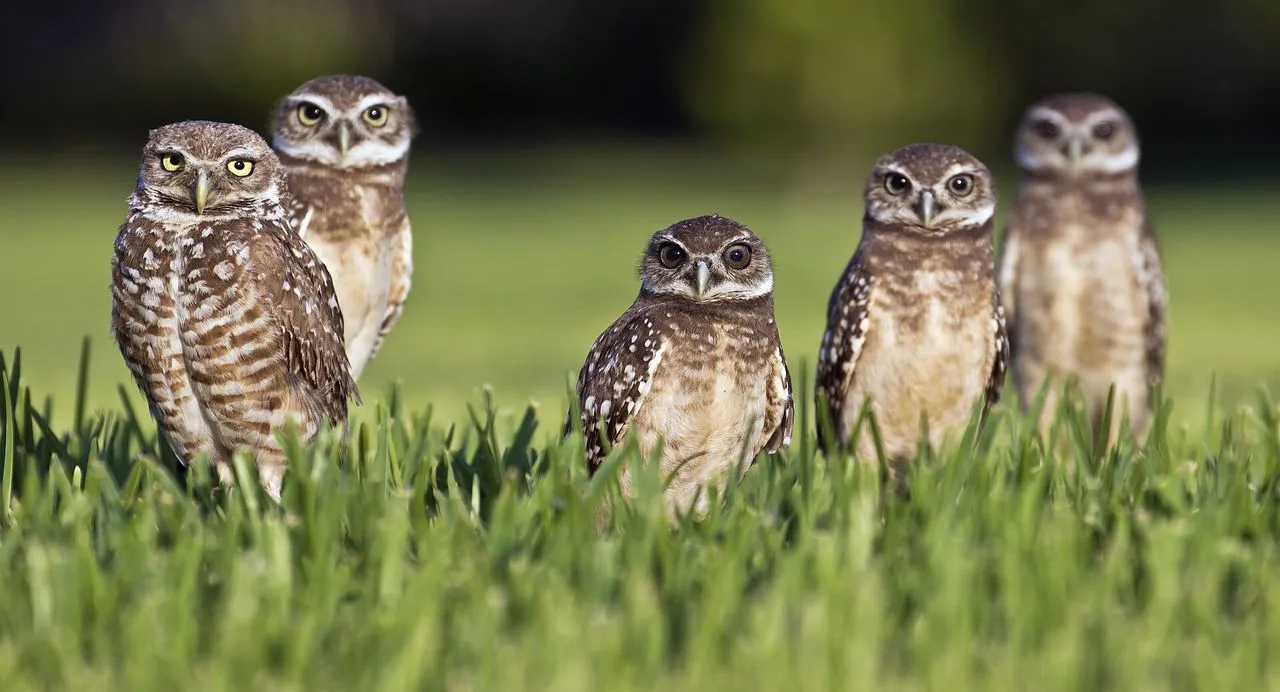
Athene cunicularia (Molina, 1782), the Burrowing Owl, is a 140-240 g open-country owl with long bare-looking legs, reduced ear asymmetry, and a nesting biology tied to mammal burrows.
Part of the Complete Owls Guide.
Identification
| Character | Burrowing Owl (Athene cunicularia) | Short-eared Owl (Asio flammeus) |
|---|---|---|
| Length | 19-28 cm (7.5-11 in) | 34-43 cm (13-17 in) |
| Wingspan | 50-61 cm (20-24 in) | 85-110 cm (33-43 in) |
| Mass | 140-240 g (4.9-8.5 oz) | 206-475 g (7.3-16.8 oz) |
| Usual view | Upright at a burrow entrance | Quartering low over open ground |
| Active period | Day and night | Often daylight or crepuscular |
| Nest site | Mammal burrow | Ground scrape in dense vegetation |
Visual
Burrowing Owl is small, upright, and terrestrial in posture. Length is 19-28 cm, wingspan 50-61 cm, and the bird often appears taller than its mass suggests because it stands high on long legs at the burrow entrance. The head is round, without ear tufts. Eyes are bright yellow beneath pale eyebrows, producing a severe expression useful at distance.
Upperparts are brown with white spotting; underparts are pale with brown barring, especially in adults. Juveniles are plainer below, often with buffy breasts and less distinct spotting. In flight the species shows rounded wings and a direct, low path close to the ground. It frequently bobs when alarmed and may run rather than fly for short distances.
No other North American owl regularly stands in daylight beside a ground burrow in short grass. Short-eared Owl shares open habitats but is larger, longer-winged, and usually seen quartering rather than standing at a fixed burrow mouth.
Audio
The male advertising call is a soft, two-syllable coo-cooo, given from the burrow entrance or a nearby mound, most often at dusk and during the early breeding season. Alarm calls include chucking, rasping, and chatter notes. Young birds are known for a defensive hissing sound that resembles a rattlesnake, produced from within the burrow when threatened. The mimicry claim is plausible in function but should not be overstated; the acoustic resemblance is strongest to a mammalian predator at the burrow entrance, not to a distant human listener.
Distribution
The species occurs in western North America, Florida, the Caribbean, Central America, and much of South America in suitable open habitats. In Canada and the northern Great Plains it has contracted sharply from former breeding areas. Western North American populations are partly migratory, with northern breeders moving south into the southwestern United States and Mexico. Florida birds are largely resident and use both natural and artificial burrows in dry prairie, pasture, and urban grassland.
Habitat
Burrowing Owls require open ground with low vegetation, available burrows, and enough prey within short commuting distance. Classic habitat includes prairie dog towns, ground-squirrel colonies, badger diggings, desert grassland, grazed pasture, airfields, golf-course margins, agricultural edges, and vacant urban lots.
The owl usually does not dig a complete burrow from scratch, although it can modify soil and enlarge existing entrances. It depends heavily on burrowing mammals: prairie dogs (Cynomys spp.), Richardson's Ground Squirrels (Urocitellus richardsonii), California Ground Squirrels (Otospermophilus beecheyi), and badgers. Control of these mammals removes nest sites as effectively as direct destruction of owl nests.
Diet and Hunting
Diet shifts strongly with season and region. Insects are crucial in warm months: grasshoppers, crickets, beetles, moths, and cicadas can form the bulk of prey deliveries to young. Vertebrates include deer mice, voles, kangaroo rats, pocket mice, small ground squirrels, lizards, frogs, snakes, and small birds.
Hunting methods are more varied than the bird's comic posture suggests. It runs after insects, pounces from low perches, hovers briefly, hawks flying insects, and pursues prey on foot near the burrow. Daylight hunting is routine, particularly in morning and late afternoon. Night hunting increases during incubation and chick-rearing, when adults must provision rapidly while avoiding heat stress.
Breeding Biology
Burrowing Owls nest underground. The burrow tunnel may extend 1-3 m before reaching the nest chamber. The female lays 6-12 eggs, with large clutches more common where insects and small mammals are abundant. Incubation lasts about 28-30 days and is mainly by the female while the male guards and provisions.
The lining of dung around the burrow entrance and nest chamber is one of the species' more specific behaviours. Mammal dung, especially from cattle or horses, attracts dung beetles and other insects, increasing prey availability immediately around the nest. It may also affect odour cues for predators, but the insect-attraction function is well supported by field experiment.
Young appear at the entrance before they can fly, often at two weeks after hatching, and retreat quickly when alarmed. Family groups remain around the burrow complex after fledging. Artificial burrow systems can support breeding pairs where natural burrows have been lost, but they do not solve the larger problem if surrounding foraging habitat is converted or sprayed heavily for insects.
Notes
The Burrowing Owl is a test case in the conflict between tidy land use and ecological function. The short grazed grass, mammal diggings, bare soil, and insect abundance it needs are precisely the features removed by intensive development, rodent eradication, and uniform crop management. Conservation measures that protect only the immediate burrow fail if the prairie dog town, pasture structure, or insect prey base disappears. A 10 m buffer around a burrow is not habitat; it is a marker around the last visible symptom of a much larger system.
Predation pressure is also mediated by perch availability. Fence posts, irrigation structures, and utility poles give Red-tailed Hawks, Swainson's Hawks, and corvids hunting positions over colonies, while also providing the owls with lookout posts. Management therefore has to be local rather than formulaic. In some grasslands, removing artificial raptor perches near nesting concentrations may improve productivity; in others, the same posts are used constantly by adult owls. The relevant question is which predator benefits most from a structure at that site.
See Also
Frequently Asked Questions
Do Burrowing Owls dig their own burrows?
Usually not. They depend on burrows excavated by mammals such as prairie dogs (Cynomys spp.), Richardson's Ground Squirrels, California Ground Squirrels, and badgers, though they can modify and enlarge existing entrances. Control of these mammals removes nest sites as effectively as direct destruction of owl nests.
Why do Burrowing Owls line their burrows with dung?
Mammal dung, especially from cattle or horses, attracts dung beetles and other insects, increasing prey availability immediately around the nest. The insect-attraction function is well supported by field experiment, and may also affect odour cues for predators.
Are Burrowing Owls active during the day?
Yes. Daylight hunting is routine, particularly in morning and late afternoon. They are the only North American owl that regularly stands in daylight beside a ground burrow in short grass. Night hunting increases during chick-rearing when adults must provision rapidly while avoiding heat stress.
What do Burrowing Owls eat?
Diet shifts with season and region. Insects dominate in warm months: grasshoppers, crickets, beetles, moths, and cicadas. Vertebrates include deer mice, voles, kangaroo rats, pocket mice, small ground squirrels, lizards, frogs, snakes, and small birds.
Sources & References
- Cornell Lab of Ornithology. (2024). All About Birds: Burrowing Owl. birds.cornell.edu
- Sibley, D.A. (2014). The Sibley Guide to Birds (2nd ed.). Knopf.
- Poulin, R., Todd, L.D., Haug, E.A., Millsap, B.A. & Martell, M.S. (2020). Burrowing Owl. Birds of the World. Cornell Lab of Ornithology.
- Kaufman, K. (2000). Lives of North American Birds. Houghton Mifflin.