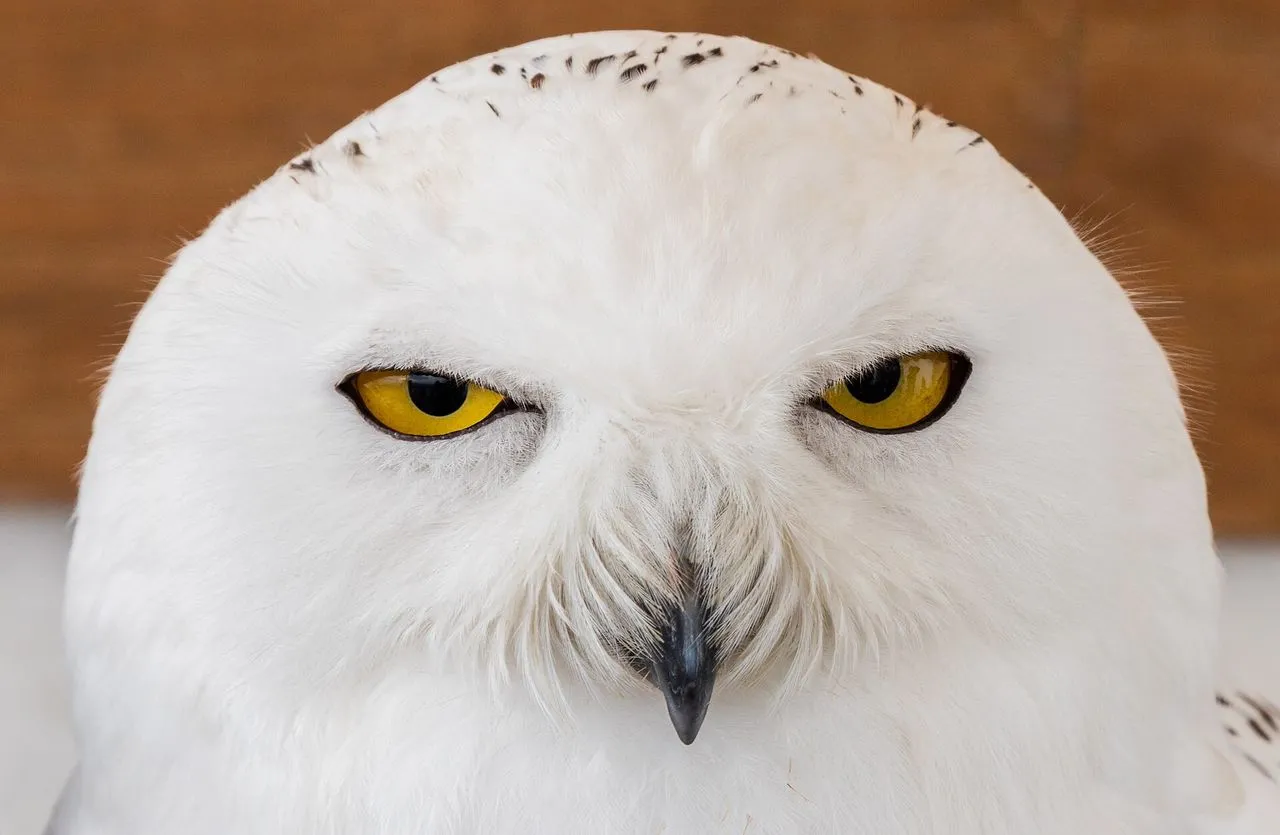
Bubo scandiacus (Linnaeus, 1758), the Snowy Owl, is a 1.2-2.7 kg Arctic owl whose breeding output can swing from no nesting to clutches of 7-11 eggs depending on lemming density.
Part of the Complete Owls Guide.
Identification
| Character | Adult male Snowy Owl (Bubo scandiacus) | Female or juvenile Snowy Owl (Bubo scandiacus) |
|---|---|---|
| Length | 53-66 cm (21-26 in) | 53-66 cm (21-26 in) |
| Wingspan | 125-150 cm (49-59 in) | 125-150 cm (49-59 in) |
| Mass | Within 1.2-2.7 kg (2.6-6.0 lb) range | Within 1.2-2.7 kg (2.6-6.0 lb) range; females larger |
| Plumage | May become nearly white with age | More heavily barred on crown, back, wings, underparts |
| Field certainty | Exact ageing rarely justified at distance | Heavy barring suggests female or juvenile, with overlap |
| Usual winter habitat | Open tundra-analogue sites | Open tundra-analogue sites |
Visual
Snowy Owl is unmistakable in broad terms: large, long-winged, white to heavily barred, with a round head, small dark bill, yellow eyes, and dense feathering over the legs and toes. Length is 53-66 cm and wingspan 125-150 cm. Females are larger and generally more heavily barred than males. Adult males may become nearly white with age, though few are completely unmarked. Juveniles and adult females show dark bars across the crown, back, wings, and underparts.
In flight the wings are broad and powerful rather than buoyant in the manner of a Short-eared Owl. The bird often sits on the ground, a fence post, a dune crest, a hay bale, an airport light standard, or a hummock, choosing any slight elevation that gives a view over open terrain. Ear tufts are absent externally, unlike the related Great Horned Owl and Eurasian Eagle-Owl.
Confusion is most likely with pale plastic bags, distant gulls on fields, or white raptors in heat shimmer. The posture resolves it: a Snowy Owl sits upright and compact, with the head appearing large and the body deep-chested.
Audio
Snowy Owls are usually silent on wintering grounds. On breeding territories males give a deep, barking hoo that can carry several kilometres across tundra in still air. Females produce harsher calls, and both sexes may hiss, snap the bill, or bark when defending nests. Vocal identification is therefore mainly relevant in Arctic breeding areas, not at temperate winter observation sites.
Distribution
The breeding range is circumpolar Arctic tundra, generally north of the tree line across Alaska, northern Canada, Greenland, Scandinavia, and Russia. Nesting latitude shifts with snowmelt and prey availability, but the species is fundamentally tied to open tundra rather than forest edge.
Winter distribution is variable. Many birds remain in the Arctic or sub-Arctic; others move south into southern Canada, the northern United States, coastal New England, the Great Lakes, the northern Plains, and occasionally farther south. In Europe, wintering birds occur in Iceland, the British Isles in small numbers, northern Scandinavia, and continental coastal zones during stronger movements.
Habitat
Breeding habitat is treeless tundra with raised dry nesting sites, wet sedge meadows, polygon ground, gravel ridges, and abundant lemmings. Nests are placed on low mounds or ridges that shed water and provide visibility. The nest is a scrape, not a built structure.
Winter habitat resembles tundra structurally: coastal dunes, saltmarsh, airports, reclaimed land, prairie, agricultural stubble, frozen lake margins, and barrier islands. Airports attract Snowy Owls because they provide short grass, open sightlines, and small mammals; they also create collision risk and management conflicts.
Diet and Hunting
On the breeding grounds, Brown Lemmings (Lemmus trimucronatus) and Collared Lemmings (Dicrostonyx groenlandicus) dominate many diets. A breeding pair with large young may deliver several lemmings per hour in peak conditions. When lemmings are scarce, ptarmigan chicks, ducks, shorebirds, passerines, Arctic ground squirrels, and hares become more important.
In winter the diet broadens. Documented prey includes meadow voles, deer mice, rats, muskrats, rabbits, ducks, grebes, gulls, alcids, pheasants, and shorebirds. Coastal birds may hunt over dunes and tidal flats, taking waterbirds at night or in low light. Hunting is visual and often diurnal, especially during Arctic summer when darkness is absent. The owl watches from the ground or a low perch, then flies directly to prey with deep wingbeats.
Breeding Biology
Snowy Owls nest on the ground. The female scrapes a shallow depression on a raised tundra mound, sometimes reusing a general area but not a durable nest. Egg laying begins after snowmelt, often May to June. Clutch size is highly prey-dependent: 3-5 eggs in moderate years, 7-11 in strong lemming years, and no breeding at all in poor years.
Incubation begins with the first egg and lasts roughly 32 days, producing strong hatching asynchrony. The oldest chick may be much larger than the youngest. In abundant prey years this spreads risk and permits high productivity; in poor conditions the youngest chicks die quickly. Males deliver prey to the female and chicks, and nest defence can be forceful. Arctic foxes, jaegers, gulls, and human observers approaching too closely may be attacked.
Notes
Temperate Snowy Owl irruptions are not simple starvation flights. Satellite tracking and age-ratio data show that many irruptive birds are in good condition, often juveniles produced after strong lemming years. A southward movement may therefore indicate high Arctic productivity rather than famine. The public narrative of a starving Arctic refugee is often wrong for individual birds.
Observation ethics matter because wintering birds conserve energy in exposed sites. Approaching repeatedly for photographs can force costly flights. A stationary observer using a vehicle as a blind at 100 m is less disruptive than a person walking directly across open ground. If the bird turns its head continuously toward the observer, crouches, defecates, or flies, the approach has already gone too far.
Age and sex claims in winter should be made conservatively. A heavily barred bird is often a juvenile or female, and a nearly white bird is usually an older male, but overlap exists and feather wear changes appearance through the season. Photographs of the spread wing and tail can help experienced banders, but distant field views rarely justify exact ageing. The useful field conclusion is usually ecological rather than demographic: the bird is selecting open, tundra-analogue habitat where prey can be seen or heard across long distances.
See Also
Frequently Asked Questions
Why do Snowy Owls come south in winter?
Irruptions are not simple starvation flights. Satellite tracking and age-ratio data show many irruptive birds are in good condition, often juveniles produced after strong lemming years. Southward movement often indicates high Arctic productivity rather than famine, contradicting the public narrative of a starving Arctic refugee.
How can I tell male from female Snowy Owl?
Females are larger and generally more heavily barred than males. Adult males may become nearly white with age, though few are completely unmarked. Juveniles of both sexes show dark bars across the crown, back, wings, and underparts. Overlap exists, so distant field views rarely justify exact ageing.
What do Snowy Owls eat?
On breeding grounds, Brown Lemmings and Collared Lemmings dominate. A breeding pair may deliver several lemmings per hour in peak conditions. When lemmings are scarce, ptarmigan chicks, ducks, shorebirds, ground squirrels, and hares become important. In winter the diet broadens to voles, mice, rats, muskrats, rabbits, ducks, grebes, and gulls.
How big are Snowy Owl clutches?
Highly prey-dependent: 3-5 eggs in moderate years, 7-11 in strong lemming years, and no breeding at all in poor years. Incubation begins with the first egg and lasts roughly 32 days, producing strong hatching asynchrony so the oldest chick can be much larger than the youngest.
Sources & References
- Cornell Lab of Ornithology. (2024). All About Birds: Snowy Owl. birds.cornell.edu
- Sibley, D.A. (2014). The Sibley Guide to Birds (2nd ed.). Knopf.
- Holt, D.W., Larson, M.D., Smith, N., Evans, D.L. & Parmelee, D.F. (2020). Snowy Owl. Birds of the World. Cornell Lab of Ornithology.
- Project SNOWstorm. (2024). Tracking Snowy Owls in North America. projectsnowstorm.org