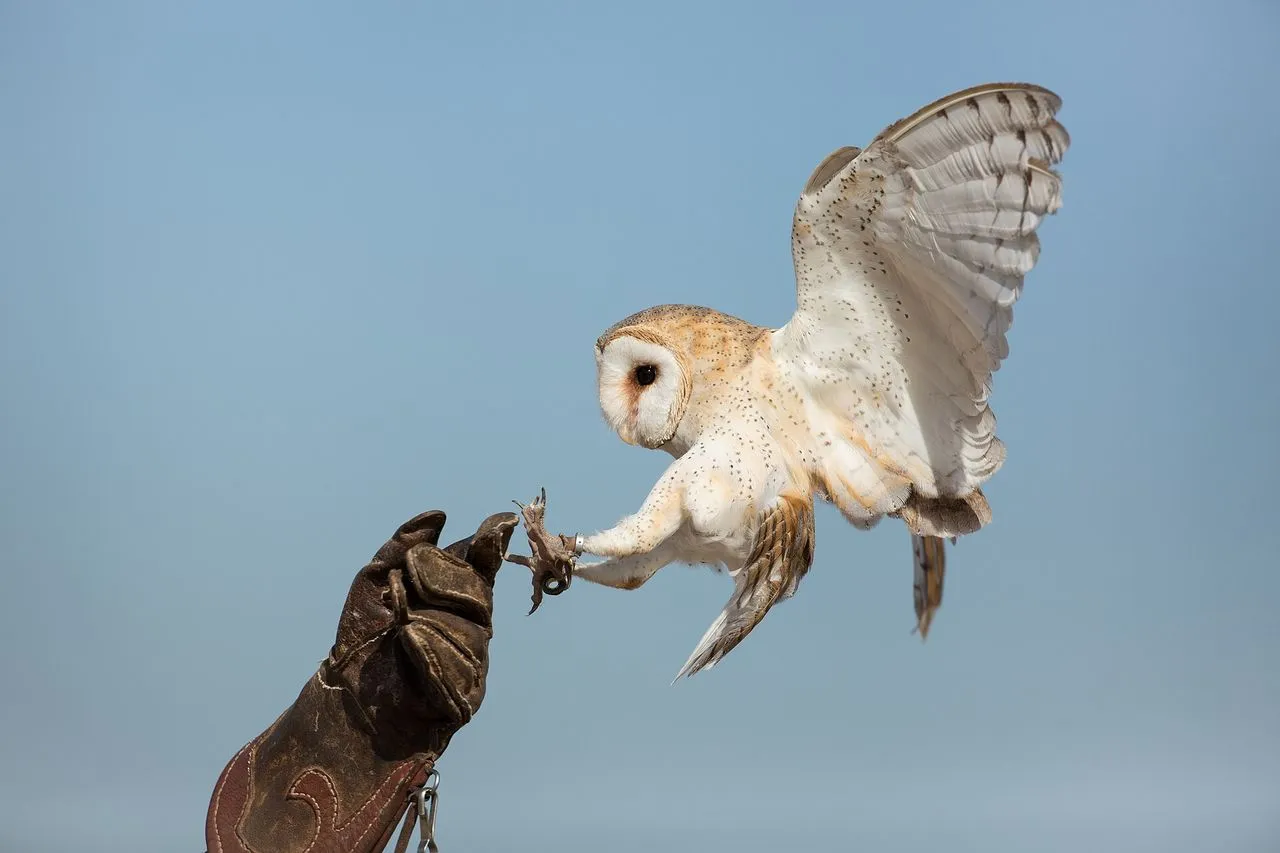
Tyto alba, the Barn Owl, holds the distinction of being the most widely distributed land bird in the world, occurring on every continent except Antarctica across a range that takes in open farmland, wetland fringes, semi-arid scrub, and the margins of cities. It was formally described by Giovanni Antonio Scopoli in 1769 from material collected in southern Austria, though the species had been part of European natural history since Aristotle noted its habit of hunting after dark.
Part of the Complete Owls Guide.
Identification
No other owl in western Europe or North America is likely to be confused with an adult Barn Owl in good light. The field characters are unambiguous:
| Character | Barn Owl (Tyto alba) | Tawny Owl (Strix aluco) |
|---|---|---|
| Length | 33-35 cm (13-14 in) | 37-43 cm (15-17 in) |
| Wingspan | 80-95 cm (31-37 in) | 81-96 cm (32-38 in) |
| Face | White to pale buff, heart-shaped | Rounded, mottled grey-brown to rufous |
| Main call | Harsh screech, 2-3 seconds | Male hoot plus female ke-wick |
| Hunting habitat | Rough grassland, ditches, field margins | Woodland, parks, old gardens |
- Facial disc. Heart-shaped, white to pale buff, edged by a continuous ruff of darker feathers. In the Tyto family this structure is the defining difference from the Strigidae, in which the disc is round.
- Upperparts. Golden-buff, intricately vermiculated with grey and white spots. The patterning appears complex at close range but reads as a single warm-buff tone at any distance.
- Underparts. White in males of the nominate subspecies; females and some subspecies show light buff speckling across the breast. The degree of spotting is used in some ageing and sexing protocols.
- In flight. Large, buoyant, with a slow wavering action on long wings over open ground. Appears entirely white from below in headlights or moonlight, one of the most reliable single-character cues for this species.
- Size. Body length 33 to 35 cm, wingspan 80 to 95 cm, weight 250 to 350 g. Noticeably smaller and more lightly built than a Tawny Owl.
Subspecies note. The IOC currently recognises 35 subspecies of Tyto alba, though the split into T. alba (white-breasted western form) and T. javanica (dark-breasted eastern form) is now accepted by many authorities as representing two distinct species. Observers in North America encounter the subspecies T. a. pratincola, which is field-identical to the nominate in all practical respects.
Voice
The Barn Owl does not hoot. Its advertising call is a prolonged, harsh screech lasting 2 to 3 seconds, given in flight and from a perch, most frequently in the two hours after sunset and again around midnight. At close range it is one of the more startling sounds a night-time garden observer will encounter: an abrupt, strangled scream from an apparently empty sky. It was, historically, the primary source of churchyard ghost legends in rural England.
Additional calls include a shorter hissing alarm screech when disturbed at the nest, a purring contact call exchanged between paired birds, and a persistent rasping or snoring call from chicks in the nest from about four weeks of age, audible at 50 to 100 metres from an active box.
Tyto alba does not produce the quavering territorial hoot or the sharp ke-wick contact call of the Tawny Owl. The classic "twit-twoo" is a duet between those two Tawny call types. If that is what you are hearing, it is not a Barn Owl.
Asymmetric Ears: The Acoustic Hunting Mechanism
The Barn Owl carries the most asymmetric skull of any bird yet measured. The left ear opening sits approximately 1.5 cm higher on the skull than the right, and the left half of the facial disc is correspondingly enlarged to match. This is not an incidental structural detail; it is the primary adaptation enabling accurate hunting in low or zero light.
Incoming sound from a prey item, typically a Field Vole (Microtus agrestis) moving through grass, reaches the two ear openings at slightly different times and with slightly different intensities. The brain extracts horizontal position from inter-ear timing differences in the same way that most predators with forward-facing eyes compute azimuth. The skull asymmetry adds vertical resolution: it shifts the angle at which sounds from above versus below arrive at each ear, allowing the bird to compute elevation as a separate channel. The result is a three-dimensional auditory map precise to approximately 1 degree in both axes.
Roger Payne's experiments at Cornell in the 1960s and 1970s demonstrated this definitively. Barn Owls striking at rustling sounds in a fully darkened room, under 0 lux, were accurate to within 1 degree of azimuth and 1 degree of elevation. No other vertebrate predator has been shown to match this acoustic accuracy under active hunting conditions.
The acoustic system is complemented by the silent-flight adaptation. The leading edge of each primary feather carries a comb-like fringe (fimbriae) that breaks up airflow turbulence; the trailing edge is soft-fringed rather than stiff. The resulting wing noise falls well below the sensitivity range of the owl's own hearing, allowing continuous listening through the final approach and strike.
Nest Box Design and Installation
Barn Owls are obligate cavity nesters. They do not build a nest structure; the female lays directly onto accumulated pellets in the cavity, which over several seasons builds up a substantial cushioned platform. Natural cavities, hollow trees, undisturbed barn lofts, ruined farm buildings, are increasingly scarce in intensively managed lowland landscapes, and nest box programmes have been central to population maintenance across the UK and lowland Europe.
A box that will attract and retain breeding birds requires the following minimum specifications:
Internal dimensions: 50 cm wide × 40 cm deep × 40 cm tall (all internal measurements). Smaller boxes are occasionally occupied but clutch size tends to be reduced. Larger boxes present no disadvantage.
Entrance aperture: 12 cm diameter circular hole. This dimension excludes most corvids while accommodating the Barn Owl's body diameter without difficulty during approaches at speed.
Mounting height: 4 to 6 metres above ground. Boxes mounted below 3.5 metres experience higher predation rates from ground predators such as mink and stoat, and suffer more frequent observer disturbance. Above 6 metres, access for annual monitoring and cleaning becomes impractical without specialist equipment.
Entrance orientation: North- or east-facing. A south- or west-facing entrance on a pole or barn wall can cause lethal overheating of eggs or small chicks on warm afternoons. The disc-shaped entrance funnels direct afternoon sun into the box interior with considerable efficiency; orient accordingly.
Mounting location. Inside a barn loft is the optimal position: weather protection, reduced predation risk, and typically close proximity to rough-grassland foraging habitat. External pole-mounted boxes work reliably but require the box face to be angled slightly downward, 5 degrees, to prevent rain ingress through the entrance hole.
Installation timing. Boxes installed before February are most likely to attract prospecting birds in the same calendar year. Barn Owls begin investigating potential nest cavities from late February and have usually committed to a site by late March. A box installed in April may not be investigated until the following winter.
A correctly positioned box, within 500 metres of rough grassland of at least 1 hectare, built to these specifications, should attract a prospecting bird within one to three seasons. If a box remains unused after three years, check first that it is dry, structurally sound, and free from nest material left by Stock Doves or jackdaws (both of which readily take owl boxes). If the box is clear and the problem persists, reconsider the location rather than the box design.
Habitat and Where to Watch
Barn Owls forage along habitat edges: rough grassland verges, field margins, drainage ditches, river banks, and railway embankments with long grass. Road-edge quartering is the most predictable behaviour for observation. On still evenings between October and March, driving slowly along a known route with a passenger watching from the front seat gives clear, extended views without significant disturbance; the bird commonly continues to quarter within 30 metres of a stationary vehicle.
Population trends across Britain are tracked through the BTO's Barn Owl Monitoring Programme, which uses nest box productivity data from thousands of recorded boxes to produce annual indices. The data show a strong correlation between vole availability and breeding success, with crash years visible as sharp productivity drops rather than range contractions.
For confirmed breeding sites, the Barn Owl Trust's field guidelines should be consulted before any close approach. The Trust also publishes a freely available nest box construction guide with detailed technical drawings if you prefer to build rather than buy.
See Also
Frequently Asked Questions
Do Barn Owls hoot?
No. Barn Owls produce a prolonged, harsh screech lasting 2-3 seconds rather than a hoot. The classic 'twit-twoo' call belongs to Tawny Owls, where it is actually a duet between the female's ke-wick and the male's hoot.
Why are Barn Owl ears asymmetric?
The left ear opening sits approximately 1.5 cm higher on the skull than the right, allowing the brain to compute vertical position from inter-ear timing differences. Combined with horizontal localisation, this produces a 3D auditory map accurate to within 1 degree, enabling hunting in zero light.
What are the dimensions for a Barn Owl nest box?
Internal dimensions of 50 cm wide x 40 cm deep x 40 cm tall, with a 12 cm circular entrance hole, mounted 4-6 metres above ground, facing north or east to prevent overheating. Install before February for best chance of occupation in the same calendar year.
Where is the best place to watch Barn Owls?
Along habitat edges such as rough grassland verges, field margins, drainage ditches, and railway embankments with long grass. Slow road-edge driving on still evenings between October and March gives extended views, as the bird typically continues quartering within 30 metres of a stationary vehicle.