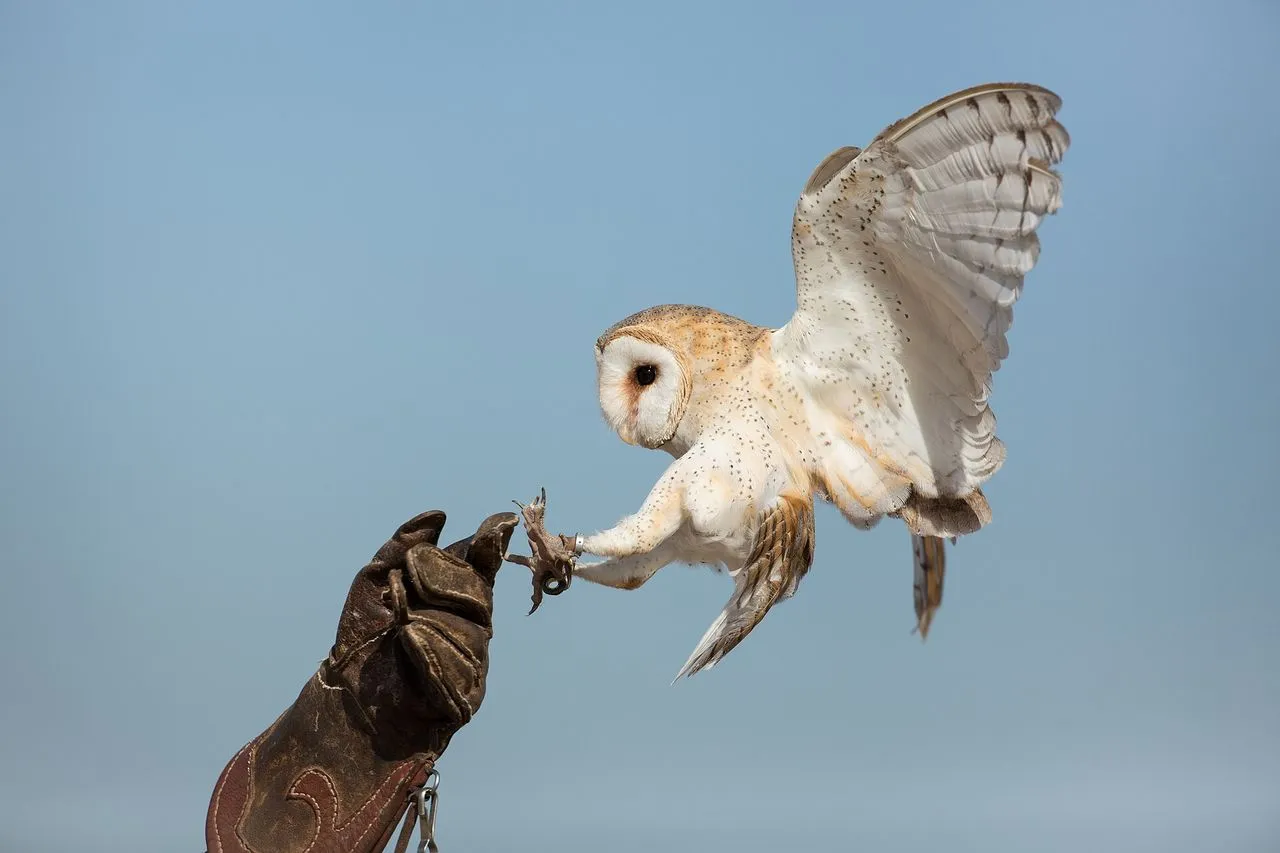
An owl in your yard is almost always a good sign. The most common explanation is a daytime roost site: a nocturnal owl such as a Great Horned or Barred has settled in a dense tree to sleep off the night's hunting, and it will leave at dusk. Some species, including the Burrowing Owl, are genuinely diurnal. Mid-summer sightings on or near the ground are often recently fledged juveniles, which look stranded but are not.
Best first step: watch from at least 15 m without approaching. Note the size, eye colour, and whether the bird has feather tufts above the crown. Look below the perch for whitewash droppings and pellets, which confirm a roost site used for more than a day or two.
Avoid: approaching the bird, making noise to move it on, or assuming injury because it is visible in daylight. Healthy roosting owls hold an upright posture, keep both eyes open, and will fly or climb away if approached closely.
An owl visible in your yard during daylight is, in the vast majority of cases, a completely healthy bird using your garden for a purpose of its own. The sighting is worth attention for identification, and it carries one practical conservation implication once you know the species. Beyond that, it needs no intervention from you.
Part of the Complete Owls Guide.
Quick answer: An owl in your yard during the day is almost always at a daytime roost site. Nocturnal species such as the Great Horned Owl and Barred Owl sleep through daylight in dense conifers or shaded canopy, then hunt at night. Some species, including the Burrowing Owl, are genuinely active during the day. Mid-summer sightings on or near the ground are usually recently fledged juveniles, which look stranded but are not.
Best first step: Stay at least 15 m away and observe without approaching. Note the size, eye colour, and whether the bird has feather tufts above the crown. Check the ground directly below the perch for whitewash droppings and pellets, which tell you whether the site has been used for more than a day or two.
Avoid: Walking toward the bird, making noise to move it on, or assuming it is injured because it is visible in daylight. A healthy roosting owl sits upright with both eyes open, tracks approaching movement, and will fly or climb away if you come too close.
Diagnosing the Sighting
| What you see | Time of day | Most likely explanation | What to do |
|---|---|---|---|
| Owl motionless in dense conifer or shaded canopy | Daytime | Nocturnal owl at its daytime roost | Watch from distance; it will leave at dusk |
| Owl on the ground, upright, wings folded, fully feathered | Day or night, June to August | Recently fledged juvenile | Observe from distance; adults are nearby |
| Small owl, round-headed, standing at a ground burrow | Daytime, open country | Burrowing Owl at nest or roost burrow | Normal behaviour; watch quietly |
| Crows or jays diving repeatedly at one fixed point in a tree | Daytime | Mobbing a concealed roosting owl | Scan canopy systematically; the owl is motionless inside it |
| Owl on the ground, drooping wing or unnatural head tilt | Any | Possible injury | Call a licensed wildlife rehabilitator |
| Large pale owl perching on fence posts or rooftops, winter | Daytime, northern locations | Snowy Owl (irruptive visitor) | Normal behaviour; observe from distance |
| Medium owl quartering low over open grass or marshland | Mid-afternoon to dusk | Short-eared Owl hunting | Normal; no action needed |
Why an Owl Is in Your Yard
Daytime roost site
The single most common explanation is a daytime roost. Most North American owls are nocturnal and spend daylight hours at a sheltered, camouflaged perch. Great Horned Owls press against the trunks of dense conifers, spruce and hemlock most often, relying on mottled plumage to break up the outline against bark. Eastern Screech-Owls roost in tree cavities and sometimes sit at the entrance in early morning light, head emerging with eyes half-closed. Barred Owls favour shaded mid-canopy, especially in mature woodland near water.
A suburban garden with mature conifers, old maples, or a dense hedgerow is entirely adequate roost habitat. The ground sign is the confirmation. Fresh whitewash droppings, white and watery, streaking bark or pooling on soil, indicate the bird has been returning to the same spot. Compressed pellets, roughly cylindrical and 3 to 8 cm long depending on species, accumulate below regularly used perches and are among the most reliable indicators of continued owl presence at a site.
Recently fledged juvenile
From June through August, young owls leave the nest well before they can fly reliably. They spend days to weeks climbing through branches, hopping between low perches, and occasionally coming to the ground. These birds are sometimes called "branchers." They look exactly as though they have fallen and need rescuing. They have not.
Parent owls continue to provision brancher owls for weeks after fledging, locating them by persistent food-begging calls. The juvenile's situation is normal and necessary: time on low branches and the ground builds coordination the bird will need for independent hunting. The only appropriate intervention is moving a brancher away from immediate danger, such as a busy road or a dog with access, to the nearest tree base, then stepping well away.
A genuinely diurnal species
Some owls are expected in full daylight. The Burrowing Owl of western North American grasslands stands at its burrow entrance through much of the day and hunts insects on foot in the morning. It is the only North American owl you should routinely expect to see standing in short grass under bright sun. The Short-eared Owl quarters open moorland, coastal marshes, and grasslands from mid-afternoon onward, long before dusk. Snowy Owls, irruptive winter visitors to northern yards, are frequently active in daylight, particularly younger birds from Arctic breeding grounds where continuous summer daylight is normal.
If you are in open-country habitat west of the Mississippi and the owl is small, upright, on the ground without ear tufts, and appears to be near a burrow entrance, it is almost certainly a Burrowing Owl. This species has declined sharply across much of its former range and warrants quiet, respectful observation.
Hunting during overcast or pre-storm conditions
Nocturnal owls sometimes extend hunting activity into daylight during sustained heavy overcast, when ambient light levels drop close to their usual active range. A Great Horned Owl crossing the yard at 3 pm on a dark November afternoon is hunting opportunistically, not lost or distressed. Pre-storm pressure changes also appear to trigger foraging behaviour in some individuals. The bird will return to its roost once conditions suit.
Crows mobbing the tree revealed it
Corvid mobbing is one of the most reliable ways to locate a roosting owl without actively searching for one. Crows, Blue Jays, American Robins, and chickadees mob owls vigorously in daylight, when the owl has no hunting advantage and can be harassed without real risk to the attackers. A group of three to ten crows diving repeatedly at a fixed point in a tree almost always has a roosting owl or raptor at its focus.
The owl will sit motionless through the harassment. It relies on camouflage and stillness rather than fleeing. Scan the canopy systematically before concluding there is nothing there. The mobbing resolves on its own within 30 to 60 minutes as the attackers tire.
Injured or disoriented bird
This is the least common explanation and the most straightforward to distinguish from normal roost behaviour. A healthy roosting owl holds the body upright, keeps both eyes open, tracks movement with deliberate head rotation, and flies or climbs away when you come within roughly 5 to 10 m. An injured bird may be on the ground at an inappropriate position, hold one wing noticeably lower than the other, tilt the head to one side, or fail to respond at all to a close approach.
Eyes closed in daylight while a person is within a few metres is a reliable warning sign. Call a licensed wildlife rehabilitator before doing anything else. Do not attempt to pick up the bird with bare hands. Even a small Eastern Screech-Owl has talons capable of puncturing skin, and a frightened owl grips with considerable force. The hazard is the feet, not the beak.
Identifying the Species
A few key features separate the most commonly encountered yard owls reliably.
| Feature | Great Horned Owl | Barred Owl | Eastern Screech-Owl | Burrowing Owl | Short-eared Owl |
|---|---|---|---|---|---|
| Length | 45-63 cm | 40-63 cm | 16-25 cm | 19-28 cm | 34-43 cm |
| Ear tufts | Yes, wide-set | No | Yes, smaller | No | Tiny, often invisible |
| Eye colour | Yellow | Dark brown | Yellow | Yellow | Yellow |
| Typical daytime position | Pressed against trunk in conifer | In shaded mid-canopy | At tree cavity entrance | Upright at burrow entrance | Quartering low in flight |
| When active | Nocturnal | Nocturnal | Nocturnal | Day and night | Often daylight or crepuscular |
Large owl, wide-set ear tufts, yellow eyes. Almost certainly a Great Horned Owl. The only confusion species is the Long-eared Owl, which has tufts positioned close together near the crown centre and is substantially smaller (around 250-435 g versus 900-2,500 g for Great Horned). Great Horned is by far the more commonly encountered of the two in suburban and rural yards across North America.
Large owl, round-headed, dark eyes, no ear tufts. Almost certainly a Barred Owl. The dark brown eyes separate it immediately from the Great Horned Owl and from every other large North American owl except the Barn Owl, which is distinctive in other respects: pale with a white heart-shaped face and long wings. Barred Owls are increasingly present in suburban woodland and often roost low enough to be plainly visible.
Small owl with ear tufts, bark-like streaked plumage, at or near a tree cavity. Likely an Eastern Screech-Owl, in grey or rufous morph depending on region. In the West, the visually similar Western Screech-Owl occupies the same niche.
Tiny owl, very round head, no ear tufts, faintly startled expression, roosting low in a conifer. Likely a Northern Saw-whet Owl at a day roost. This small owl sometimes roosts at nearly eye level and can be remarkably close-tolerant of observers who move quietly and slowly.
Is the Owl Injured?
The distinction is usually readable from a respectful distance.
Signs of a healthy owl at roost: Sitting upright at height. Both eyes open. Head turns to track your position. The bird climbs or flies when you come within roughly 5 to 10 m.
Signs that something may be wrong:
- On the ground at a location that is not appropriate for a fledgling or Burrowing Owl
- One wing held lower than the other, or dragging
- Head tilted unnaturally to one side
- Eyes closed in daylight while being closely approached
- No response to a close approach
If you observe any of these, call a licensed wildlife rehabilitator. The Owl Research Institute maintains a state-by-state directory. USFWS regional offices can also refer you. Do not offer food, water from a dropper, or shelter without veterinary guidance: incorrect handling does more harm than leaving the bird in place.
Risks to Pets and Songbirds
A Great Horned Owl routinely takes prey heavier than itself. The practical risk to pets is real but limited by size. Documented attacks focus on animals under approximately 2 kg and occur most often at dusk, at dawn, or at night rather than in full daylight. Keeping cats and very small dogs indoors after dark is a reasonable precaution. Medium and large dogs are not at risk from any North American owl.
Birds at feeders are also prey for owls, particularly during nocturnal hunting runs past roost sites. This is normal predation ecology, not a problem to be corrected. Any yard supporting a hunting owl is already part of a functional food web, which typically indicates healthy habitat structure.
For rodent control, the calculation runs clearly in favour of owls. A pair of Barn Owls provisioning a brood of four chicks may consume over 1,000 small rodents across a breeding season. Great Horned Owls sustain significant predation pressure on rats, mice, and voles throughout their territory year-round. A garden with resident owls will typically have substantially fewer rodents than one without.
Encouraging Owls: Nest Boxes and One Essential Precaution
Providing a species-appropriate nest box is the most practical step toward making a yard permanently attractive to owls. For Eastern Screech-Owls, the standard specification is an 8x8 inch interior floor with a 76 mm (3 inch) entrance hole, mounted 3 to 6 m up with a clear flight approach. Barred Owls need a substantially larger box. Barn Owls require a very large interior chamber, at least 60 x 30 cm, positioned in a barn, on a pole, or on a building with clear flight access to open hunting ground. For siting specifications across all species, see the complete attracting guide.
The most important single action for owls in any yard is stopping rodenticide use.
Second-generation anticoagulant rodenticides (SGARs), including brodifacoum, bromadiolone, difethialone, and difenacoum, persist in rodent liver tissue and bioaccumulate up the food chain. An owl consuming poisoned rodents absorbs these compounds with each meal. The mechanism is inhibition of vitamin K epoxide reductase: at sufficient concentrations the rodenticide prevents blood clotting, and the bird dies of internal haemorrhage following even minor injury.
The scale of this problem is well documented. Newton, Wyllie & Freestone (1990) found SGAR residues in 10% of Barn Owls tested in the UK, establishing the foundational baseline at a time when SGAR use was far below current levels. UK Centre for Ecology and Hydrology monitoring found detectable SGARs in 90% of British Barn Owls tested in 2017, 88% in 2020, and 79% in 2021. In California, CDFW's 2024 Wildlife Health Laboratory report recorded SGAR exposure in 72.7% of Great Horned Owls submitted for testing (8 of 11 birds), with 5 confirmed rodenticide toxicosis cases. Peer-reviewed studies in northern California found that 70% of Northern Spotted Owls and 62% of Barred Owls and hybrids carried detectable SGAR residues, with brodifacoum present in 97% of positive cases.
Replacing bait stations with snap traps, enclosed electric traps, or relying on owl predation itself eliminates the exposure route entirely. If rodenticide use is unavoidable, USFWS guidance recommends strict label compliance, post-application carcass searches, and burial of rodent bodies to interrupt the secondary poisoning pathway.
Legal Protection
All native owl species in the United States are protected under the Migratory Bird Treaty Act. It is illegal to harm, harass, capture, kill, relocate, or possess any native owl, or its feathers, eggs, or nest materials, without a federal permit. In the UK, owls are protected under Schedule 1 and Schedule 5 of the Wildlife and Countryside Act 1981. In Canada, most species fall under the Migratory Birds Convention Act.
These protections mean that moving a roosting owl, using audio playback to drive it off, or attempting to relocate an active nest are potentially prosecutable acts regardless of intent.
See Also
- The Complete Owls Guide: taxonomy, acoustic hunting mechanisms, pellets, and a full species overview.
- Great Horned Owl: identification, voice, prey range, and breeding timing for the most widespread large yard owl in North America.
- Eastern Screech-Owl: cavity use, colour morphs, calls, and nest-box specifications for the small suburban species most often found at tree holes.
- Burrowing Owl: the open-country species expected in full daylight, with habitat, diet, and decline context.
- Short-eared Owl: the open-habitat hunter most commonly seen quartering in daylight or at dusk.
- The Complete Attracting Guide: nest-box specifications and yard design for owl-friendly habitat.
Frequently Asked Questions
Is an owl in my yard dangerous to my pets?
A Great Horned Owl can take prey well above its own body weight, but documented attacks on domestic animals focus on very small individuals, typically cats and dogs under roughly 2 kg, and most often at dusk or at night. If you have very small pets, bring them indoors after dark as a standard precaution. Medium and large dogs are not meaningful prey for any North American owl species.
Should I try to move the owl along?
No. Roosting owls will leave of their own accord at dusk and are not a nuisance. All native owl species in the United States are protected under the Migratory Bird Treaty Act. Any deliberate disturbance, including shouting or clapping to move the bird, is illegal under that statute. If the roost is over a path and you are concerned about droppings, redirect foot traffic temporarily rather than disturbing the bird.
What does it mean when crows are mobbing a tree in my yard?
Corvid mobbing almost always means a roosting owl or raptor is concealed in the canopy. Crows, Blue Jays, and similar species mob owls to drive them out of the territory. The owl will be sitting motionless, pressed against a trunk or inside the denser part of the canopy. Scan systematically. The behaviour resolves on its own when the owl leaves.
What should I do if the owl seems injured?
Call a licensed wildlife rehabilitator before doing anything else. Do not attempt to pick up the bird with bare hands: even a small owl has talons capable of puncturing skin, and a frightened bird grips hard. If the owl is on the ground but upright, wings folded, and eyes open, wait several hours before concluding it is in trouble. It may be a recently fledged juvenile waiting for a parent. Act only if it cannot stand or has a clearly drooping wing.
Will the owl come back to the same spot?
Very likely. Owls return to the same roost sites across weeks, months, and often years. A Great Horned Owl that has chosen a particular conifer in your garden in February will commonly reuse the same roost the following winter. Pellet and whitewash accumulations under a branch confirm the site has been used repeatedly. Leave it undisturbed and you may have a resident owl for several seasons.
Sources & References
- Owl Research Institute
- Cornell Lab of Ornithology, Birds of the World
- U.S. Fish and Wildlife Service
- Newton, I., Wyllie, I. & Freestone, P. (1990). <em>Environmental Pollution</em>, 68(1-2), 101-117
- California Department of Fish and Wildlife, 2024 Wildlife Health Laboratory Annual Report
- UK Centre for Ecology and Hydrology, Predatory Bird Monitoring Scheme (2021)