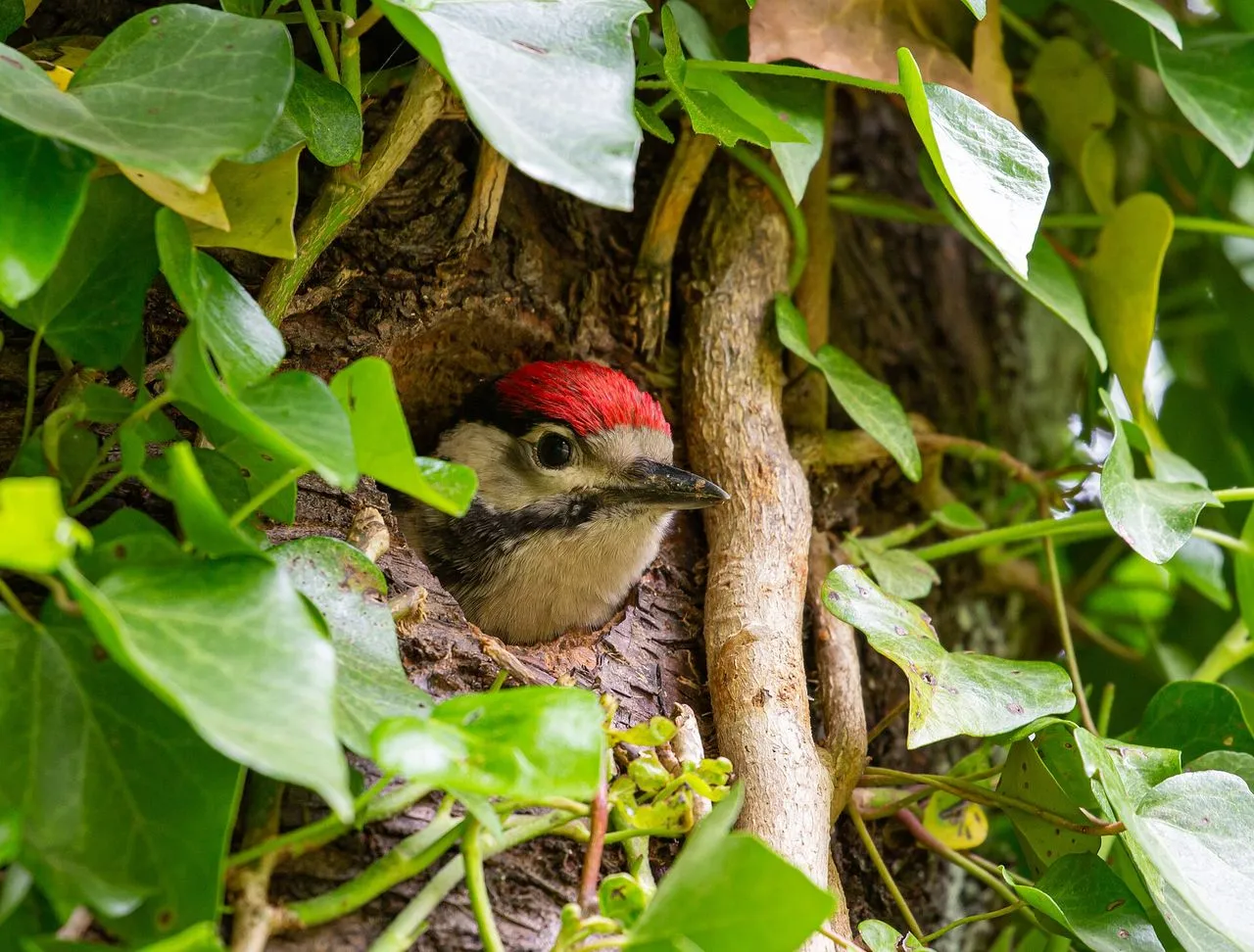
Woodpeckers (Picidae) use a hyoid cranial sling to absorb impact energy, allowing 20 strikes per second without concussion. They have zygodactyl feet (two toes forward, two back) for climbing. Drumming patterns identify species, Pileated uses a rolling roll, Downy a short burst. Suet is the primary feeder food. A cage-style feeder hung on a tree trunk attracts Downy, Hairy, and Red-bellied Woodpeckers.
The Picidae is a family of approximately 240 species of bark-foraging birds whose anatomy has been progressively refined for hammering hardwood, occupying every major landmass except Australia and Antarctica.
I'm Dr. James Whitfield, an ornithologist trained at Oxford and formerly a researcher with the British Trust for Ornithology. In more than 12,000 hours of field observation across temperate woodlands, woodpeckers have been consistent enough visitors to warrant a thorough reference. This guide covers structural mechanics, drumming behaviour, suet feeder selection, and the species most likely to appear in a garden with suitable habitat.
Taxonomy and Global Distribution
The order Piciformes contains roughly 450 species across ten families, of which Picidae is the most species-rich and ecologically dominant. The family divides into three subfamilies: the Jynginae (wrynecks, two species), the Picumninae (piculets, approximately 30 species), and the Picinae (true woodpeckers, approximately 200 species). The Jynginae sit at the base of the family tree and lack the heavy drumming behaviour of their relatives.
The true woodpeckers reach their greatest species richness in the Neotropics, but Melanerpes, Dryobates, Dryocopus, and Dendrocopos are the genera that define the woodpecker community in temperate North America and Eurasia. Most birders in eastern North America will encounter four or five species regularly; a garden with mature trees and at least one standing dead trunk can attract three without unusual effort.
The satellite articles in this series cover the two garden woodpeckers of greatest interest in temperate North America:
- Downy Woodpecker (Dryobates pubescens), the smallest North American woodpecker, and almost invariably the first woodpecker to locate a new suet feeder.
- Pileated Woodpecker (Dryocopus pileatus), the largest extant woodpecker in North America, with an expanding suburban presence as second-growth forest matures.
The Biomechanics of Striking Without Concussion
The defining characteristic of Picidae is not the call or the plumage but the capacity to strike hardwood at up to 20 strikes per second without neurological damage. The adaptations that make this possible are structural and operate as a system; no single component alone would be sufficient.
The hyoid apparatus. In most birds, the hyoid is a compact Y-shaped structure at the base of the tongue. In Picidae it is massively elongated: the two ceratobranchial horns extend far posterior to the skull, curve upward over the cranium, and in many species terminate near the nostril on one side. This converts the tongue-support structure into a cranial sling. Impact energy arriving at the bill tip is distributed along the full arc of the hyoid before reaching the braincase, a spatial distribution of force that reduces peak stress at any single anatomical point. The mechanism is functionally analogous to a crumple zone, though considerably more refined.
Skull microstructure. The frontal bone is unusually thick, and the diploe, the trabecular layer between the inner and outer cortical bone surfaces, consists of fine, densely packed bony struts rather than the hollow air spaces found in many other avian skulls. This architecture absorbs and distributes compressive force rather than transmitting it intact to the braincase.
Brain orientation and cerebrospinal fluid volume. The woodpecker brain is oriented in the skull with its longest axis perpendicular to the direction of impact, presenting maximum surface area to any deceleration force. The brain also fits tightly within the cranial cavity with minimal cerebrospinal fluid space. The mechanism of concussion in primates requires the brain to accelerate briefly relative to the skull after impact; that mechanism is structurally suppressed here because the geometry leaves no room for it.
The nictitating membrane. The third eyelid closes approximately one millisecond before each strike and reopens between them. The timing is neurologically fixed rather than learned. Without this, percussion transmitted through the base of the bill would risk displacing the globe on every strike.
Bill asymmetry. In several genera, the upper mandible extends fractionally beyond the lower. The lower mandible therefore contacts the substrate first on an upstroke, taking the initial compressive load and acting as a secondary damper before full force transfers through the skull.
Neck musculature. The splenius capitis and biventer cervicis groups are substantially hypertrophied relative to other birds of comparable body mass. These muscles provide both the strike force and, critically, the controlled deceleration on contact. This is a precision mechanism; the bird is not simply swinging its head into wood.
The combined result is tolerance for impact forces estimated at up to 1,200 g, repeated at rates that would produce subdural haematoma in any mammal within seconds.
The Zygodactyl Foot
Most passerine birds have an anisodactyl foot: three toes forward (digits II, III, and IV) and one back (digit I, the hallux). Woodpeckers have a zygodactyl arrangement, digits II and III forward, digits I and IV back, giving four-point contact with a vertical surface rather than the three-point grip of a perching bird.
The foot works in conjunction with the tail. Woodpecker rectrices are unusually rigid, with thick central shafts and stout barbules. During foraging, the bird braces its tail against the bark while the two pairs of opposing toes grip the surface to either side, producing a stable tripod: two foot contacts and one tail contact. The neck musculature can then drive the bill with full force without the bird needing to compensate for balance.
Drumming as Territorial Signalling
Drumming in Picidae is a territorial and mate-attraction signal, not a feeding behaviour and not a vocalisation. The sound is mechanical, produced by bill contact with a resonating surface rather than by the syrinx. Popular accounts conflate drumming with foraging; the distinction is audible to an attentive ear.
A woodpecker excavating a nest cavity or foraging for larvae makes irregular, purposeful contact with wood, pausing to investigate the substrate, reposition, and listen for the acoustic feedback of hollow chambers or larval galleries. A drumming woodpecker produces a rapid metronomic roll, consistent cadence, defined start and finish, from a specific resonant surface, then pauses and repeats it at intervals of several seconds to several minutes.
Both sexes drum. Frequency peaks in late winter and early spring, February to April across most of temperate North America, and drops sharply once pair bonds are established and incubation begins. Drumming posts are preferred resonating surfaces, often a dry dead branch or a hollow trunk, and individual birds return to the same post season after season. When a woodpecker adopts a metal downpipe or junction box as a drumming post, the explanation is acoustic rather than territorial to the structure: those surfaces are the most resonant substrates in the immediate vicinity.
Identification by Drum Pattern
Drum cadence, strikes per second, total roll duration, and whether the roll decelerates toward its end, can separate species in the field even when the bird is not visible.
| Species | Approx. strikes/sec | Roll duration | Pattern notes |
|---|---|---|---|
| Downy Woodpecker (D. pubescens) | ~17 | ~1 sec | Soft; relatively quiet for the family |
| Hairy Woodpecker (D. villosus) | ~25 | ~1 sec | Same duration as Downy; markedly louder and more resonant |
| Red-bellied Woodpecker (M. carolinus) | ~19 | ~1 sec | |
| Pileated Woodpecker (D. pileatus) | ~15 | 2–3 sec | Slow, very loud; may decelerate toward the end; resonates powerfully from large dead trunks |
| Northern Flicker (C. auratus) | ~25 | 1–1.5 sec | Rapid; structurally similar to Hairy |
| Yellow-bellied Sapsucker (S. varius) | irregular | variable | Non-metronomic: slow beats punctuated by acceleration, not a sustained roll |
The cadence table is a tool, not a definitive identifier. Resonating substrate alters perceived loudness and apparent pace significantly: a small Downy drumming on a large hollow oak can sound plausibly Hairy. Use drum cadence as a prompt for closer attention, and confirm with visual field marks when possible.
Suet Feeders
Rendered suet, kidney fat from beef, is the highest-calorie food available at most garden feeders, and the offering most reliably attractive to woodpeckers across the family. Commercial suet cakes are acceptable substitutes, but fat content varies; products with a high proportion of filler (seed fragments, starch binders) deliver substantially less energy per visit. Below approximately 50% fat by weight, the caloric value drops to a point where cold-weather birds, which visit feeders precisely for caloric density, may not find the stop worth making.
Two feeder designs dominate the market:
Cage feeders. A wire mesh cage, typically rectangular, holding a standard suet block, mounted vertically. Simple, durable, and effective. Starlings (Sturnus vulgaris) access cage feeders without difficulty, which is a meaningful limitation in gardens with heavy starling pressure; a flock can strip a block in hours and displace smaller woodpeckers in the process.
Upside-down feeders. The suet block is accessed from below, birds must hang inverted to reach it. Woodpeckers, nuthatches, and tits manage this without difficulty; it is not far removed from foraging on the underside of a branch. Starlings, which lack the toe grip and habit for inverted feeding, are largely excluded. If starlings are stripping feeders before woodpeckers arrive, this is the most direct solution. Note that the Pileated Woodpecker is large enough (40–49 cm, 250–350 g) that some upside-down feeder designs cannot accommodate it, check clearance specifications before purchasing.
Mount suet feeders at 1.5 m or more from the ground and within 3–5 m of cover; arrival frequency increases when escape cover is close.
Common Confusions
Downy vs Hairy Woodpecker. Covered in detail in the Downy Woodpecker satellite. The reliable separator is bill length relative to head depth: the Downy's bill is noticeably shorter than the depth of its own head; the Hairy Woodpecker's bill approaches the same length. The outer tail feather spot (present on Downy, absent on Hairy) is a useful confirming character in good light.
Juvenile plumage. First-autumn birds of most Picidae show blurred head markings, dull bill colour, and, in species with adult red head patches, a partial or diffuse red crown rather than a neat adult pattern. A juvenile Downy may show red across the centre of the crown rather than the neat nape spot of either adult sex, a pattern that matches nothing in the standard field guide plates. A juvenile Red-bellied Woodpecker (Melanerpes carolinus) with a smudged partial cap is regularly misidentified as a Red-headed Woodpecker by observers without direct experience of either species in comparable light conditions.
Sapsucker wells vs disease or pest damage. Yellow-bellied Sapsucker (Sphyrapicus varius) drill orderly horizontal rows of small wells into living bark, returning periodically to harvest sap and the insects attracted to it. The resulting sign, neat rows of small, closely spaced holes with amber staining, is regularly attributed to disease, borer damage, or unidentified environmental stress by observers who do not connect it to a bird. The neat geometry is diagnostic once seen.
Notable Species
- Downy Woodpecker (Dryobates pubescens), smallest in North America; usually the first woodpecker at any new suet feeder.
- Pileated Woodpecker (Dryocopus pileatus), largest extant in North America; leaves rectangular foraging cavities; a species in active range recovery.
- Hairy Woodpecker (Dryobates villosus), the Downy's larger lookalike; more dependent on mature forest interior.
- Red-bellied Woodpecker (Melanerpes carolinus), the standard medium-sized woodpecker of eastern North America; a common feeder visitor with a loud rolling call.
- Northern Flicker (Colaptes auratus), notable for feeding primarily on ants at ground level rather than on bark; the drumming rate is high and can be mistaken acoustically for a larger species.
- Yellow-bellied Sapsucker (Sphyrapicus varius), migratory; the sap wells it drills attract a disproportionate variety of other species to the same trees.
- Acorn Woodpecker (Melanerpes formicivorus), western North America; maintains communal granary trees with thousands of individually fitted acorn caches.
- Great Spotted Woodpecker (Dendrocopos major), the standard garden woodpecker across most of Europe; fills an ecological role broadly comparable to the Hairy in North America.
- Black Woodpecker (Dryocopus martius), the Eurasian counterpart of the Pileated; equally dramatic at close range, equally dependent on mature forest with large-diameter dead wood.
Snags and the Dead-Wood Requirement
A garden or woodland without standing dead wood cannot support breeding woodpeckers regardless of what feeders are on offer. Woodpeckers excavate fresh cavities each breeding season in soft, decayed heartwood, typically in snags (standing dead trees) or the dead portions of otherwise living trees. A single suitable snag can support one or more nesting pairs and remain a productive foraging resource for a decade or more as bark loosens and wood-boring beetle populations establish themselves in the interior.
Hard snags, recently killed trees with bark largely intact, are preferred for larval foraging; the beetle and ant colonies that are the primary prey concentrate here first. Softer, more advanced-decay snags are preferred for cavity excavation; the bird needs material the bill can work efficiently. A property with both decay stages present will attract more consistent woodpecker use than one with either extreme alone.
If a dead tree is structurally safe, leave it standing; a 3–4 m stub of a felled trunk provides a functional substitute. Clearing all dead wood from a property is the most direct way to exclude woodpeckers.
Where to See Woodpeckers
Mature deciduous or mixed woodland with some standing dead wood holds woodpeckers year-round across temperate North America. State and national forests, nature reserves with limited active management, and established suburban neighbourhoods with a mature tree canopy are consistently productive. The Downy Woodpecker is a permanent resident across almost the entire continent south of the subarctic tree line and is genuinely common wherever suet feeders exist near trees.
The Pileated demands more specific habitat, large-diameter trees, substantial dead wood, woodland blocks of meaningful extent, but has extended its range into suburban woodland edges over the past 30 years as second-growth forest has matured. If you live within 500 m of deciduous woodland with trees older than 50 years, it is worth checking more carefully.
- Why Is a Woodpecker Pecking My House?: four-behaviour diagnostic for siding damage with species-by-species treatment.
- Why Are Woodpeckers Drumming on My Gutter?: drumming is communication, not damage; species-by-species cadence and the wait-it-out timeline.
- Downy vs Hairy Woodpecker: the most common North American woodpecker ID problem solved with a 12-row table.
Frequently Asked Questions
How do woodpeckers avoid brain damage from drilling?
Woodpeckers have a hyoid apparatus, a bone structure that extends from the tongue, curves over the skull, and acts as a crash pad. It distributes impact energy across a wide area, preventing localized brain injury. This is functionally analogous to a crumple zone in a car.
What is the best suet feeder for a backyard?
A cage-style suet feeder hung on a tree trunk, ideally on a tree with deep bark for grip, attracts the most woodpecker species. Avoid mesh feeders that can trap tongues. Place near cover but not directly in dense foliage.
How can I identify a woodpecker by its drumming?
Pileated Woodpecker produces a slow, rolling 'r-r-r-r-r' that lasts 1–2 seconds. Downy Woodpecker gives a short, even burst of 5–12 strikes. Northern Flicker has an irregular, faltering pattern. The number of strikes, duration, and rhythm are diagnostic.
Do woodpeckers cause damage to trees?
Woodpecker damage is usually a sign of existing problems, not the cause. Healthy trees resist excavation. Most 'damage' is minor excavation for nesting or foraging in already-decaying wood. Pileated Woodpecker excavations can be extensive in soft, dead wood but rarely kill healthy trees.