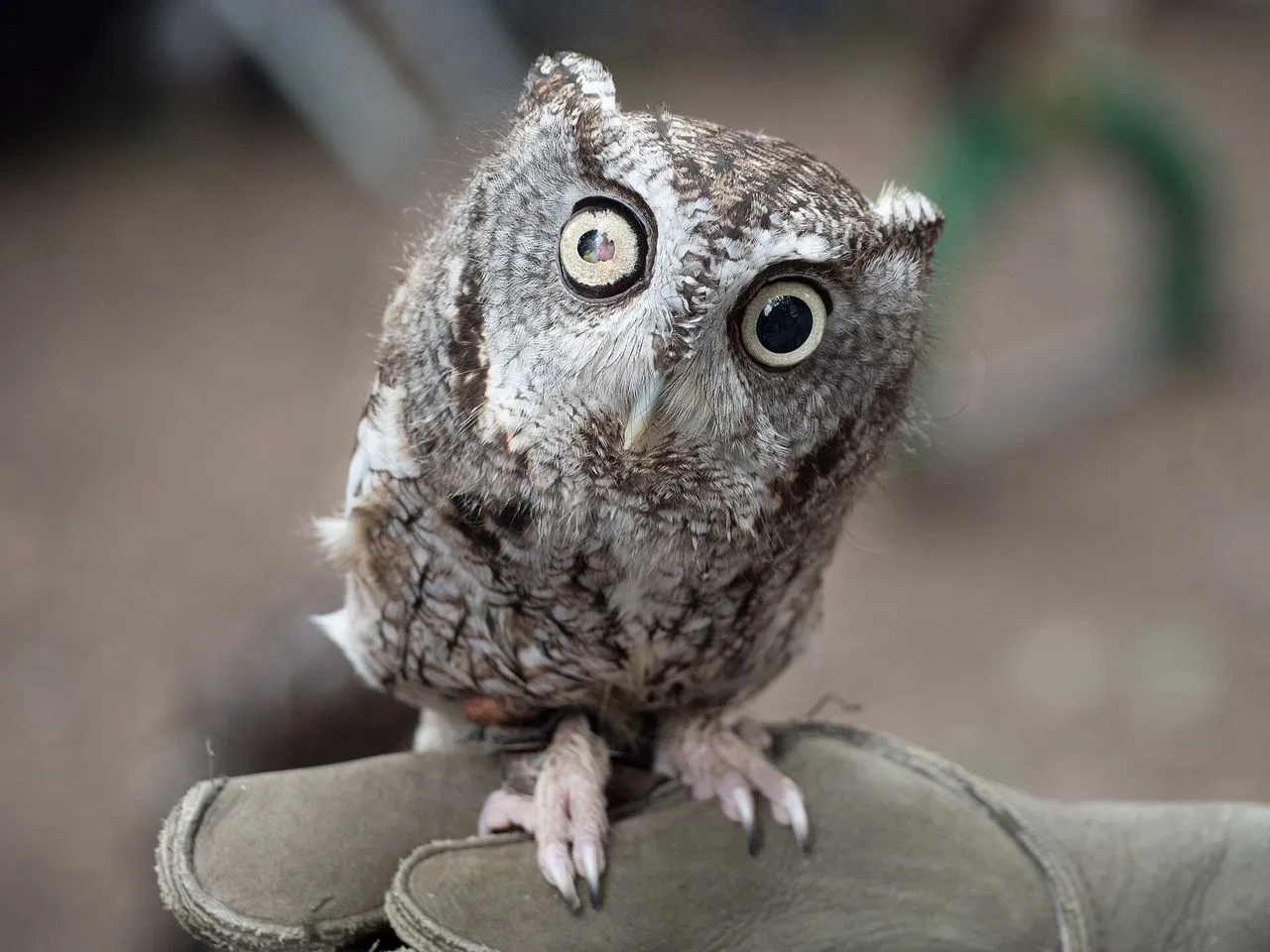
Megascops asio (Linnaeus, 1758), the Eastern Screech-Owl, is a 121-244 g cavity-nesting owl whose conspicuous ear tufts alter its head outline but have no auditory function; the actual ear openings are buried beneath the facial feathers.
Part of the Complete Owls Guide.
Identification
| Character | Eastern Screech-Owl (Megascops asio) | Western Screech-Owl (Megascops kennicottii) |
|---|---|---|
| Length | 16-25 cm (6-10 in) | 19-25 cm (7.5-10 in) |
| Mass | 121-244 g (4.3-8.6 oz) | 100-305 g (3.5-10.8 oz) |
| Range | Eastern North America | Western North America |
| Colour morphs | Grey and rufous common regionally | Usually colder grey; rufous less frequent |
| Primary call | Descending whinny or monotone trill | Bouncing-ball accelerating whistles |
| Field separator | Voice where ranges approach | Voice where ranges approach |
Visual
This is a small, compact owl, 16-25 cm long, with a short tail, rounded wings, heavy streaking below, and a bark-like dorsal pattern that works exceptionally well against oak, hickory, maple, and sycamore trunks. The bird often sits upright in the mouth of a cavity at dusk, eyes half-closed, relying on immobility rather than concealment by distance.
Two main colour morphs occur. Grey birds dominate much of the northern and western range, with cold grey upperparts crossed by fine black vermiculation. Red morph birds are rich rufous above and below, more frequent in the humid Southeast and lower Mississippi drainage. A brown intermediate occurs but is less common. Morph is not age or sex; it is genetically influenced polymorphism, and paired birds may be of different morphs.
The yellow iris, small size, ear tufts, and heavy vertical underpart streaking separate it from the Northern Saw-whet Owl, which lacks ear tufts and has a rounder, more surprised facial expression. Western Screech-Owl is visually close enough that range and voice are normally decisive. Where both are possible in western Texas, plumage alone should not be treated as conclusive.
Audio
Despite the name, the Eastern Screech-Owl does not usually screech. The primary territorial song is a descending whinny, a tremulous series falling in pitch over 2-3 seconds. A second common vocalisation is an even-pitched monotone trill, typically 3-6 seconds long, used in territorial and pair-contact contexts. In settled suburban territories the trill may be heard from the same tree cavities year after year.
Calls begin well before full darkness, especially in late winter and early spring. Juveniles produce rasping begging calls in late May through July, sometimes from low branches only 2-4 m above ground. These calls draw mobbing from robins, chickadees, titmice, and Blue Jays, which is often the most reliable daytime clue to a roosting adult.
Distribution
The species occupies eastern North America from southern Canada through the Great Lakes, New England, the Atlantic coastal plain, the Southeast, and west to the Great Plains edge. It is absent from most high-elevation Appalachian spruce-fir zones and from treeless intensive agricultural landscapes where cavities are scarce. Northern limits broadly follow the availability of mature deciduous trees and winter prey rather than latitude alone.
It is largely resident. Adults hold territories through winter, and banding recoveries show limited dispersal compared with migratory small owls. Young birds move farther after fledging, but the species is not a regular long-distance migrant.
Habitat
Eastern Screech-Owls are birds of edges and cavities: riparian woodland, old orchards, suburban streets with mature trees, wooded cemeteries, farm shelterbelts, and parks. They tolerate human proximity better than most owls provided cavity trees and prey remain available. A suburban block with old maples, unmown corners, and porch lights attracting insects may support a pair more reliably than a closed, even-aged forest stand.
The critical structural feature is not forest extent but cavity supply. Natural nest and roost sites include old woodpecker cavities, rot holes, broken limbs, and hollow trunks. The species also uses nest boxes readily when entrance diameter and placement exclude larger competitors.
Diet and Hunting
Diet is broad and seasonal. Invertebrates dominate many summer samples: moths, beetles, crickets, cicadas, katydids, and large spiders. In colder months the prey base shifts toward White-footed Mice (Peromyscus leucopus), Meadow Voles (Microtus pennsylvanicus), shrews, small rats, and roosting songbirds. Amphibians, small snakes, crayfish, and fish taken from shallow water are recorded often enough that they should not be treated as exceptional.
The usual method is perch-and-pounce hunting from 1-6 m above ground. The owl watches and listens from a fixed perch, drops almost vertically, then returns to cover. It also hawks insects around lights and woodland openings, a behaviour most visible in August and September when large moths are abundant.
Breeding Biology
Pair formation and territorial calling intensify from January through March. Eggs are laid in cavities from March into May depending on latitude. Clutch size is usually 3-5 eggs, sometimes 2 in poor prey conditions and up to 6 in favourable years. The female incubates for about 26 days while the male delivers prey to the cavity entrance or a nearby perch.
No nest is built. Eggs lie on wood chips, decayed cavity debris, old pellets, or material already present in the hollow. In nest boxes, a layer of coarse wood shavings is useful because bare plywood allows eggs to roll and cool. Young leave the cavity at roughly four weeks, before competent flight, and climb through nearby branches while adults continue provisioning.
Notes
This is one of the most accessible North American owls for careful garden observation, but accessibility does not justify playback at cavities. A bird calling naturally from a territory can be mapped by listening on three or four calm evenings in February. Its position will usually resolve to a cluster of old trees, one of which contains the day roost or nest cavity. That is enough. Close inspection of cavities during the breeding season risks flushing the incubating female and exposing eggs or small young to chilling and corvid predation.
See Also
- Western Screech-Owl
- Barred Owl
- Northern Saw-whet Owl
- American Kestrel
- The Complete Owls Guide
- Why Is an Owl in My Yard?: the species most likely to roost in suburban cavities and nest boxes, in context.
- Eastern vs Western Screech-Owl: yellow-green vs blackish bill plus voice differences; the contact-zone notes for southwestern readers.
Quick answer: how to identify an Eastern Screech-Owl
Eastern Screech-Owls are small, stocky owls with ear tufts, yellow eyes, and gray or reddish-brown color morphs. You are more likely to hear one than see one. Listen for a soft descending whinny or a steady tremolo from woods, suburbs, orchards, and older yards with tree cavities.
Calls are often the best clue
As an Amazon Associate, we earn from qualifying purchases, at no extra cost to you. The name is a little misleading: Eastern Screech-Owls do not usually give a harsh screech. Their whinny and tremolo carry well at dusk. Low light 8x42 birdwatching binoculars for owls can help if the bird is calling from a shadowed branch near a cavity or nest box.
Gray morph vs red morph
Both color morphs are the same species. Gray birds blend into bark, while red morph birds can look warmer and foxier in porch lights. Use size, ear tufts, call, and location instead of color alone.
Nesting box notes
Eastern Screech-Owls use natural cavities and sometimes nest boxes. If you put up a box, place it before breeding season, avoid checking it too often, and keep it away from heavy foot traffic.
Eastern Screech-Owl FAQ
Do Eastern Screech-Owls live in neighborhoods?
Yes. They can live in wooded suburbs if there are mature trees, cavities, cover, and enough insects or small prey.
Are Eastern Screech-Owls active during the day?
They mostly hunt at night. During the day they usually roost quietly against bark or inside a cavity.
Frequently Asked Questions
Do Eastern Screech-Owls actually screech?
Despite the name, no. The primary territorial song is a descending whinny, a tremulous series falling in pitch over 2-3 seconds. A second common call is an even-pitched monotone trill of 3-6 seconds used for territorial and pair-contact purposes.
What is the difference between red and grey Eastern Screech-Owls?
These are colour morphs, not age, sex, or subspecies differences. Grey morphs predominate in northern and western parts of the range; rufous morphs are commoner in the humid Southeast. Morph is genetically influenced polymorphism, and paired birds may be of different morphs.
Will Eastern Screech-Owls use nest boxes?
Yes, readily, when the entrance diameter and placement exclude larger competitors. They use cavities without building a nest; eggs lie on wood chips or cavity debris. A layer of coarse wood shavings in boxes prevents eggs from rolling and cooling on bare plywood.
What do Eastern Screech-Owls eat?
Diet is broad and seasonal. Summer samples are dominated by moths, beetles, crickets, cicadas, katydids, and large spiders. Winter prey shifts toward White-footed Mice, Meadow Voles, shrews, small rats, and roosting songbirds. Amphibians, small snakes, crayfish, and small fish are taken often enough to be regarded as routine.
Sources & References
- Cornell Lab of Ornithology. (2024). All About Birds: Eastern Screech-Owl. birds.cornell.edu
- Sibley, D.A. (2014). The Sibley Guide to Birds (2nd ed.). Knopf.
- Gehlbach, F.R. (1995). The Eastern Screech Owl: Life History, Ecology, and Behavior. Texas A&M University Press.
- Kaufman, K. (2000). Lives of North American Birds. Houghton Mifflin.