An owl calling at night is one of those sounds that stops people mid-sentence. The instinct to know what it is, and why it is doing it, is almost universal. The good news is that acoustic identification is learnable. Most of the owls calling across temperate North America and northern Europe produce phrases distinctive enough to identify from a single clear sequence.
Quick answer: Owls call to advertise territory, attract mates, or stay in contact with a partner. Juveniles beg for food from fledging through late summer. Peak calling season in temperate North America runs from January through March, when pairs are consolidating territories and selecting nest sites.
Best first step: Listen for the call pattern. Is it a series of deep hoots? A prolonged screech? A bouncing sequence of notes that accelerates in tempo? The pattern alone narrows the field to one or two species across most of North America. Use the diagnostic table below, then open the Merlin Bird ID app for real-time confirmation if any doubt remains.
Avoid: Using audio playback to attract an owl during breeding season, roughly December through June for most North American species. Playback provokes territorial responses that cost the bird real energy and can trigger nest abandonment near active nests.
Why Owls Call at Night
Four functions drive most owl vocalisation.
Territory advertisement is the dominant driver from late autumn through early spring. A calling owl is signalling to every rival within acoustic range where its territory boundary sits. The Great Horned Owl begins this process in earnest from December, earlier than almost any other North American bird. On a still, cold night its call carries 1 to 2 kilometres, which is precisely the point.
Mate attraction and pair bonding. Calling intensifies as breeding approaches. Paired Great Horned Owls often duet, the male calling at a noticeably lower pitch than the female. Their overlapping exchange, each bird answering the other within a second or two, signals to neighbouring pairs that a territory is jointly held. Barred Owl pairs extend this repertoire further, building into cackles, ascending caterwauls, and what sounds like a prolonged argument echoing across wet forest.
Pair communication. Once a territory is established, calls serve as contact signals between birds hunting separately across their range. The Barn Owl uses a purring contact call between paired birds, distinct from the advertising screech it produces from a perch or in flight. Many owl species also give quieter location calls that carry only a short distance and function as a check-in rather than a broadcast.
Juvenile begging. From late May through September, the most persistent and sometimes alarming night-time owl sounds are not from adults. Fledged Eastern Screech-Owl young produce rasping begging calls from low branches 2 to 4 metres above ground. Great Horned Owl juveniles, still dependent on their parents months after fledging, produce a persistent food-begging screech that bears no resemblance to the adult hoot. These birds are not in distress. The adults locate them by that call and provision them accordingly.
When to Expect Calling
Most owls concentrate calling in two windows: the first two hours after sunset and the hour or two before sunrise. Midnight calling exists but is less consistent than either of these peaks. On calm nights with dropping temperatures and low wind, sound carries furthest and calling frequency tends to be highest.
Seasonally, peak calling in temperate North America falls between January and March. Barn Owls and Short-eared Owls are less strictly seasonal and call year-round. Northern Saw-whet Owls, which migrate, are most vocal from October through March during their southward movement and winter residency at lower latitudes.
Wind above Beaufort scale 3 substantially reduces calling frequency and makes locating any calls that do occur much harder. A calm, cold, clear night consistently outperforms a warm breezy one. Position yourself downwind of a likely habitat patch, remain still, and wait at least 20 to 30 minutes after sunset before moving on.
Identifying the Caller: A Diagnostic Table
The table covers the eight North American species most likely to be heard after dark. Habitat and season provide supporting context; the call pattern is the primary key.
| Call pattern | Species | Habitat | Peak season | Next step |
|---|---|---|---|---|
| 4-7 deep resonant hoots, hoo, h'HOO, hoo, hoo | Great Horned Owl | Woodland edge, parks, suburbs | Dec-Mar | Note if pair is duetting; report to eBird |
| 8-9 notes, who cooks for you, who cooks for you-all | Barred Owl | Mature wet forest, swamp | Year-round, peak late winter | Record if possible; check swamp and stream margins |
| Descending whinny or monotone trill, 3-4 seconds | Eastern Screech-Owl | Suburban woodland, orchards, parks | Jan-Mar | Check old trees for cavities and roost holes |
| Bouncing-ball series of hoots, 5-15 accelerating notes | Western Screech-Owl | Western North America woodland | Jan-Mar | Confirm range; note habitat type |
| Long hissing screech, 2-3 seconds | Barn Owl | Open farmland, rough grassland, marsh edges | Year-round | Listen from road edges at dusk; watch for low quartering flight |
| Slow, even tooting whistle, roughly 2 notes per second | Northern Saw-whet Owl | Conifer forest, mixed woodland | Oct-Mar | Check dense conifers below for pellet accumulations |
| Single low hoo, repeated every 2-4 seconds | Long-eared Owl | Boreal and conifer forest; dense hedgerows in winter | Feb-Apr | Look for communal winter roosts in hawthorn thickets |
| Hoarse, dog-like barks in flight | Short-eared Owl | Open moorland, coastal marsh, rough grassland | Breeding season | Watch for quartering flight; often visible in afternoon light |
Species by Call: The Detail
Great Horned Owl
The most frequently heard owl across suburban and rural North America. Cornell Lab describes the song as a series of 3 to 8 deep, resonant hoots, typically patterned hoo, h'HOO, hoo, hoo, with the second note emphasised and the full phrase usually 4 to 7 notes long. It carries 1 to 2 kilometres on still nights. Once you have heard a settled pair calling from a neighbourhood stand of mature trees in January, this call is unlikely to be confused with anything else.
Males call at a lower pitch than females, which is the reverse of the relationship most people expect. A duetting pair, alternating calls in an overlapping exchange, makes this pitch difference audible as a clear drop in fundamental frequency between consecutive phrases. Young birds from the previous year's breeding attempt sometimes call from the territory margins through late summer, producing a persistent screech that sounds nothing like the adult hoot.
Barred Owl
The phrasing is consistent and memorable: who cooks for you, who cooks for you-all, 8 to 9 notes with a characteristic falling drawl on the final syllable. Cornell describes the ending as a "down-slurred hooooo" that separates it immediately from the Great Horned Owl's more even cadence. The Barred Owl favours mature, wet forest, and its calls carry particularly well across still water from swamp forest or bottomland hardwoods.
They respond to imitation, which is documented behaviour rather than something to be encouraged during the breeding season. Outside nesting season, a careful whistled approximation of the phrase sometimes draws a response within minutes, confirming presence without requiring any approach to the bird.
Eastern and Western Screech-Owls
Neither owl screech in the sense the name implies. The Eastern Screech-Owl's primary territorial song is a descending whinny, a tremulous series falling in pitch over 2 to 3 seconds, or an even-pitched monotone trill running 3 to 4 seconds. Cornell's All About Birds describes the whinny as falling in pitch like a horse's whinny; the trill as an evenly pitched, quavering series. The whinny is often described as horse-like by first-time hearers, and the trill is sometimes misidentified as a frog or insect.
The Western Screech-Owl produces an entirely different call: a series of 5 to 15 short hoots that begin slowly and accelerate to a rapid finish, like a bouncing ball slowing on a hard surface. Cornell renders it as a bouncing-ball series of toots on one pitch. Where both screech-owls are possible in western Texas, voice is the only reliable separator between the two species.
Barn Owl
What most people describe as a scream rather than a call. The advertising vocalisation is a prolonged, harsh screech lasting 2 to 3 seconds, produced from a perch or in full flight, most frequently in the two hours after sunset. At close range it is genuinely startling. It was historically the primary source of churchyard ghost stories in rural Britain, and for good reason: an abrupt, strangled scream from an apparently empty sky is not easily rationalised by someone who does not know what made it.
It bears no resemblance to any hoot. If you are in open country and heard something that sounded more like a scream than an owl call, the Barn Owl should be your first hypothesis.
Northern Saw-whet Owl
A monotonous tooting whistle repeated at an even rate of roughly two notes per second. Cornell describes it as a series of repeated single-note whistles with a mechanical, unchanging quality. The cadence has been compared to a truck reversing: regular, insistent, and unlikely to be confused with any other owl once learned. The phrase continues without variation, which is itself useful: other owls introduce cadence changes and emphasis; the Saw-whet does not.
Long-eared and Short-eared Owls
The Long-eared Owl gives a low, moaning single hoo repeated at 2 to 4 second intervals, often continuing for 20 or more repetitions during active territorial display. It carries poorly in wind and is easy to overlook. The Short-eared Owl is more often heard in daylight: hoarse, dog-like barks given in flight during territorial display over open ground. It is primarily a visual bird during its quartering flights but vocal enough during display to be detectable without optics.
UK Species
For observers in Britain and Ireland, the species set differs.
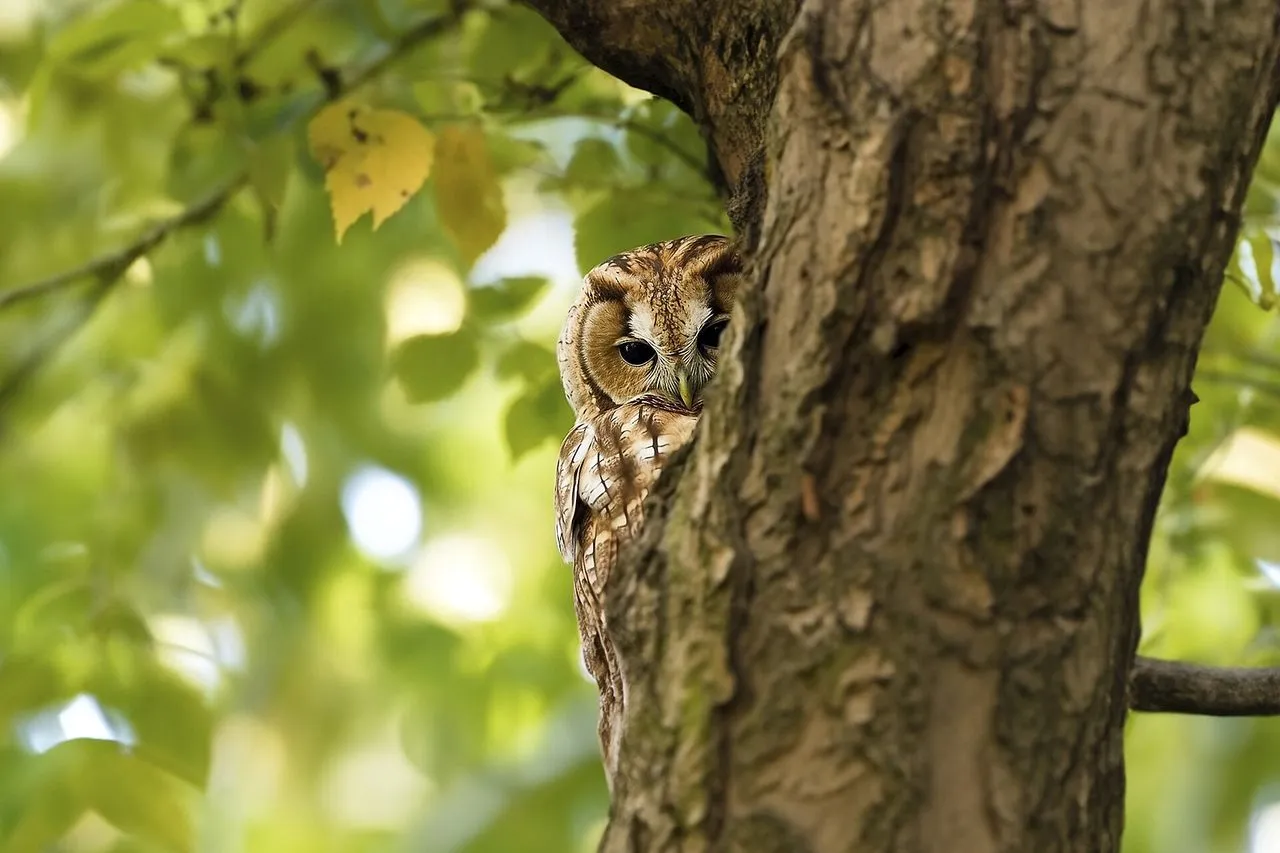
The Tawny Owl (Strix aluco) is the owl most people in Britain picture when they think of an owl calling at night. The classic "twit-twoo" is not a single bird: it is a duet. The female gives a sharp ke-wick contact call; the male answers with a quavering hoo-hoo-hoo-hooooo territorial hoot. Hearing both together in quick succession creates the impression of a single compound call.
The Barn Owl produces the same prolonged hissing screech across Europe as in North America. The Little Owl (Athene noctua) gives a rapid, upward-inflected yelping keeoo, surprisingly loud for a 170-gram bird, often heard at dusk from fence posts and rooftops. Long-eared and Short-eared Owls call much as described above.
The complete owls guide includes a UK species call summary table with seasonal notes.
Calls Misidentified as Owls
Three sounds in particular draw confident but incorrect owl identifications.
Mourning Dove. The Mourning Dove's three-note cooing phrase is frequently reported as a Great Horned Owl, particularly at dawn. The Dove's phrasing is softer, more musical, and lacks the deep resonance and slight hoarseness of the owl hoot. It also calls in full daylight, which Great Horned Owls rarely do.
Red fox vixen. The female red fox's call in January and February, a sharp, abrupt scream repeated at short intervals, is regularly attributed to a Barn Owl. The fox scream is higher-pitched, more clipped, and often more variable between repetitions than the Barn Owl's sustained rasp. Both animals call at night, in similar habitats, at the same time of year, which compounds the confusion.
Eastern Screech-Owl whinny. This is the reverse problem: the descending whinny is so unlike the expected hoot of an owl that it is regularly dismissed as a small horse, a coyote, or a large frog. If you hear something that sounds like a horse whinnying quietly in suburban woodland at night, reconsider the screech-owl before writing it off.
Recording and Reporting
The Merlin Bird ID app from Cornell Lab identifies owl calls in real time from a smartphone microphone, matching against the Macaulay Library archive of verified recordings. For any owl you cannot immediately name, Sound ID mode handles background noise reasonably well in calm conditions and correctly identifies common species reliably. Cornell's eBird platform accepts owl observations with location data, contributing those records to continent-scale monitoring without any disturbance to the bird.
If the same owl calls repeatedly from the same location over several nights, this usually indicates a territory boundary or roost, and often a nearby nest from January through April. Log the observation with a location pin. Do not attempt to find the nest by following the sound.
See Also
- The Complete Owls Guide: taxonomy, acoustic hunting mechanisms, and the full call reference table for UK and North American species.
- Great Horned Owl: call analysis, duetting behaviour, and breeding phenology for the most widespread large North American owl.
- Barred Owl: the who-cooks-for-you phrase, wet forest habitat, and the conservation issue in the Pacific Northwest.
- Eastern Screech-Owl: the descending whinny and monotone trill, cavity nesting, and suburban woodland use.
- Barn Owl: the hissing screech explained, open-country hunting, and nest box specifications.
- Long-eared Owl: communal winter roosts and the low moaning territorial hoot.
Quick answer: the main reasons owls call at night
Owls call at night mostly to claim territory, attract or stay in contact with a mate, and warn off rivals. In summer, much of the noise comes from hungry juveniles begging for food. Persistent loud calling near your house usually means your yard sits inside an active territory, not that anything is wrong.
Season changes what you hear
Late winter and early spring bring the most intense hooting, when pairs establish territories and court. By mid to late summer, raspy screeching from fledged young often replaces classic hoots. Autumn can bring another burst of calling as young birds disperse and look for territories of their own.
FAQ: should I worry about an owl calling every night?
No. Nightly calling is normal behavior and usually a good sign of healthy prey populations nearby. If the sound is disruptive, remember it is often seasonal and tapers off within weeks. Enjoy the chance to identify the species: each owl has a distinctive rhythm and tone to its call.
Quick answer: why owls call at night
Owls call at night to claim territory, contact a mate, warn rivals, beg for food, or keep track of family members. A repeated hoot from the same perch often points to territory. Harsh screeches or begging calls are more common around young owls.
How to listen without bothering the owl
Stay back, keep lights low, and listen from one spot instead of walking toward the call. If you are trying to identify the bird, Celestron Nature DX 8x42 binoculars are a useful daytime birding pair, especially for checking the same trees at dawn. As an Amazon Associate, we earn from qualifying purchases, at no extra cost to you.
Loud owl noises at night
A loud call does not automatically mean danger. Sound carries farther at night, and owls often call from open branches, roofs, or poles where their voice travels cleanly.
Why the owl sounds louder some nights
Cold, still air can carry an owl call farther than you expect. If you are trying to identify the bird from a porch or trail, 8x42 bird watching binoculars for low light can help at dusk without using playback or a flashlight on the bird. As an Amazon Associate, we earn from qualifying purchases, at no extra cost to you.
- A pair calling back and forth usually means contact or territory defense.
- Raspy food-begging from one spot in late spring or summer is often a juvenile.
- Sudden alarm calls may happen when crows, people, or another predator get too close.
FAQ: reasons for owls making loud noises at night
Does a loud owl mean something is wrong? Usually no. Loud calling is normal during territory defense, courtship, and juvenile begging. The best response is to listen from a distance. Avoid playback, nest searching, or shining bright lights toward the sound.
Frequently Asked Questions
Is it normal for an owl to call from the same tree every night?
Yes. Owls are highly territorial and routinely use the same calling perches night after night, sometimes for years. Repeated calling from a fixed location is a strong indicator of an established territory and, from January through April, of a nearby active nest. Listen from a distance and report the location to eBird rather than trying to close in.
Why does an owl call more at certain times of year?
Calling intensity tracks the breeding cycle. Territorial advertising peaks between December and March in temperate North America as pairs establish or re-confirm territories ahead of nesting. Calling drops once incubation begins, then rises again in late summer when juveniles beg loudly and adults re-establish winter territories.
What is the scream I keep hearing at night that does not sound like a hoot?
Most likely a Barn Owl. Its advertising call is a prolonged, harsh screech lasting 2 to 3 seconds, not a hoot of any kind. In rural North America and throughout Europe, the Barn Owl is responsible for most unexplained night-time screams. A female red fox can produce a similar sound in January and February; fox screams are sharper and more clipped than the Barn Owl's sustained rasp.
Should I use a playback app to get an owl to respond?
Not during the breeding season, which runs roughly from December through June for most North American species. Playback provokes territorial responses, drains energy that breeding birds cannot spare, and can cause nest abandonment near active nests. Passive listening on still nights gives reliable results without cost to the bird. Outside breeding season, the Merlin Bird ID app identifies a calling owl in real time from a smartphone microphone, which removes any reason to play recordings at all.