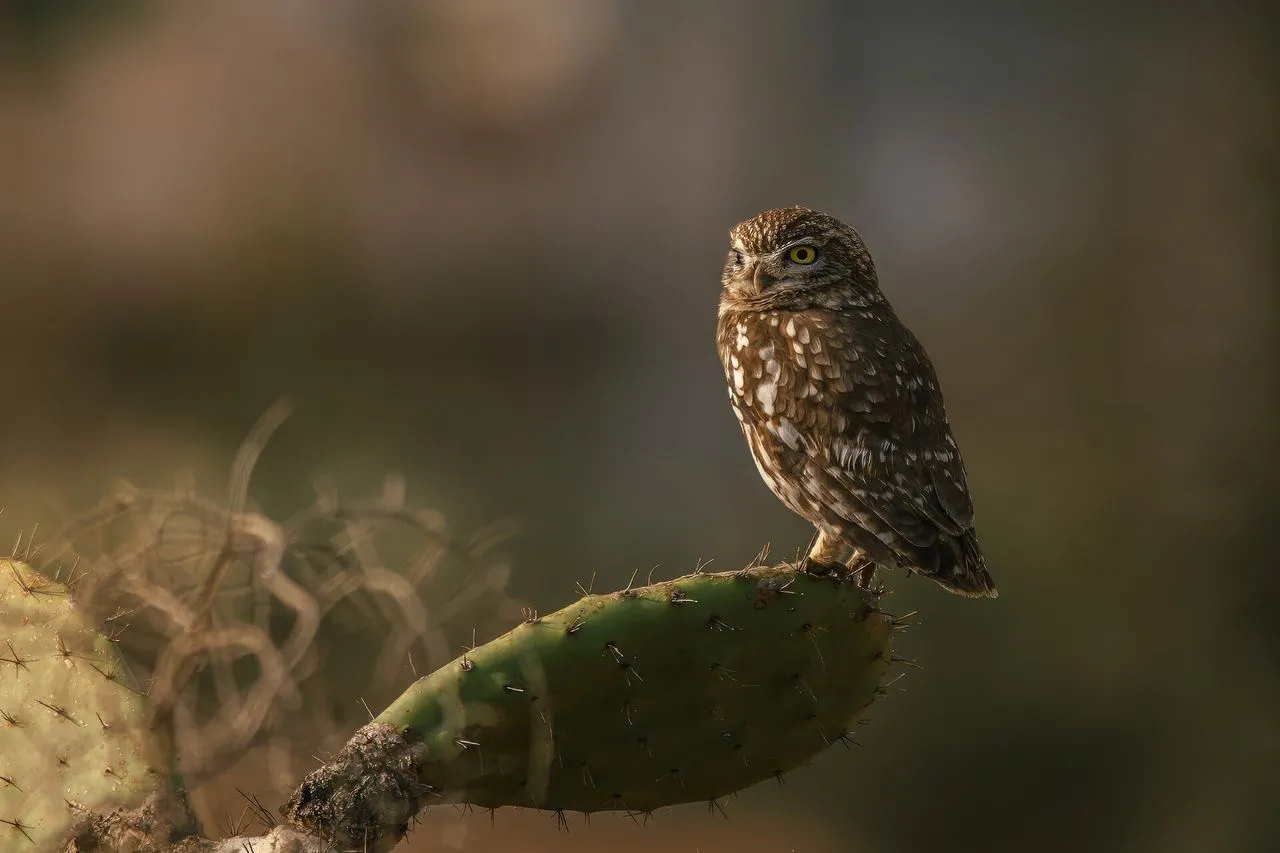
Athene noctua (Scopoli, 1769), the Little Owl, is a 140-220 g cavity owl introduced to Britain in the nineteenth century and now tied most strongly to grazed lowland farmland.
Part of the Complete Owls Guide.
Identification
| Character | Little Owl (Athene noctua) | Burrowing Owl (Athene cunicularia) |
|---|---|---|
| Length | 21-23 cm (8-9 in) | 19-28 cm (7.5-11 in) |
| Wingspan | 54-58 cm (21-23 in) | 50-61 cm (20-24 in) |
| Mass | 140-220 g (4.9-7.8 oz) | 140-240 g (4.9-8.5 oz) |
| Posture | Squat on low posts, walls, roofs | Upright on long legs at burrow mouth |
| Range context | Native Eurasia; introduced in Britain | Americas, including western North America and Florida |
| Nest site | Cavities, walls, barns, boxes | Mammal burrows or artificial burrows |
Visual
Little Owl is compact, short-tailed, and broad-headed, 21-23 cm long with a wingspan of 54-58 cm. It often perches in daylight on fence posts, pollarded willows, barn roofs, stone walls, and low branches. The posture is squat but alert, and the bird bobs when agitated.
Upperparts are brown with white spotting; underparts are whitish with brown streaking. The eyes are yellow under pale brows, giving a frowning expression. There are no ear tufts. In flight the species is low, fast, and bounding, with rounded wings and a direct path between perches.
It is smaller and more terrestrial than Tawny Owl, less leggy than Burrowing Owl, and much more likely than Barn Owl to be seen sitting in full daylight on a farm building. Juveniles are duller and fluffier-headed but retain the basic shape.
Audio
The common call is a plaintive, rising kee-ew or goooek, often given at dusk and dawn but also by day. Alarm calls include sharp yelps and chattering notes. The voice is surprisingly carrying for a bird of this size and is often the first sign of a territory in pasture with old trees.
Calling increases from late winter through spring. Pairs may answer each other from adjacent perches around a farmyard, orchard, or row of pollards.
Distribution
The native range extends across much of Europe, North Africa, the Middle East, and central Asia. In Britain the species was introduced deliberately, with releases in the 1870s and later, and became established mainly in England and parts of Wales. It remains scarce or absent from much of Scotland and Ireland.
British populations have declined from twentieth-century levels in many areas, probably through mixed pressures: loss of old orchards and pollards, agricultural intensification, fewer cavities, road mortality, and reduced invertebrate prey. It is established but not uniformly secure.
Habitat
The preferred landscape is low-intensity farmland with short grazed grass, old trees, cavities, hedgerows, barns, walls, and abundant invertebrates. Traditional orchards, horse pasture, sheep-grazed fields, parkland, and villages with old buildings can hold pairs. Tall dense crops are poor for hunting because prey becomes inaccessible.
Nest and roost sites include pollard cavities, hollow fruit trees, holes in barns, stone walls, rabbit burrows in some regions, and nest boxes. The bird benefits from structural untidiness: broken limbs, rough corners, dung-rich pasture, and old timber.
Diet and Hunting
Little Owl eats large invertebrates and small vertebrates. Beetles, earwigs, grasshoppers, moths, earthworms, and larvae are important, especially in spring and summer. Vertebrate prey includes mice, voles, shrews, small birds, frogs, and occasionally young rats.
Hunting is often from a low perch. The owl drops to the ground, runs briefly, seizes prey, and returns to a post or branch. It also hunts on foot, especially for beetles and earthworms after rain. Daylight and crepuscular hunting are normal; full nocturnal activity increases during chick provisioning.
Breeding Biology
Little Owls nest in cavities and enclosed holes. In Britain, eggs are usually laid from April into May. Clutch size is commonly 3-5 eggs. Incubation lasts about 27-28 days and is mainly by the female. The male provisions during incubation and early brood care.
No formal nest is built. Eggs rest on cavity debris, pellets, old nesting material, or the bare substrate. Young leave the cavity at about five weeks and remain close to cover while adults continue feeding them. Pairs may reuse the same cavity over multiple years if not disturbed and if the entrance remains clear.
Notes
The Little Owl's British status requires precision. It is introduced, not native, but it is also long established and culturally familiar in lowland farmland. Arguments about nativeness should not obscure the practical ecology: the species now marks a particular kind of agricultural structure that has itself declined. Where pollards are not renewed, orchards are grubbed out, and old barns are sealed, Little Owls disappear. Their decline often indicates loss of the same rough, insect-rich farmland used by bats, Swallows, Yellowhammers, and a long list of beetles.
Survey work should include daylight checks as well as dusk listening. A Little Owl may sit for long periods on the lee side of a pollard, a collapsed wall, or a barn roof, especially in weak winter sun. Whitewash below a favoured perch and small pellets containing beetle fragments are useful signs. The bird's low hunting height also makes road verges dangerous: beetle-rich short grass beside lanes can attract adults to exactly the zone where vehicle strikes are most likely.
Nest boxes can help where cavities have been lost, but they are not a substitute for pasture structure. Boxes placed beside tall silage fields often fail because prey is inaccessible. Boxes near grazed paddocks, orchard rows, and rough farm tracks are more logical. The entrance should face away from prevailing rain and strong afternoon sun, and the box must be safe from cats and rats, which are frequent around farm buildings.
See Also
Frequently Asked Questions
Is the Little Owl native to Britain?
No. It was introduced to Britain in the 1870s and later, becoming established mainly in England and parts of Wales. It is scarce or absent from much of Scotland and Ireland. Despite being non-native, it is long established and culturally familiar in lowland farmland.
Why are Little Owls active during the day?
They are crepuscular and partly diurnal, hunting from low perches in daylight. The species frequently sits on fence posts, pollarded willows, barn roofs, stone walls, and low branches in full daylight, especially in weak winter sun. Full nocturnal activity increases during chick provisioning.
What do Little Owls eat?
Diet combines large invertebrates and small vertebrates. Beetles, earwigs, grasshoppers, moths, earthworms, and larvae are important in spring and summer. Vertebrate prey includes mice, voles, shrews, small birds, frogs, and occasionally young rats. They also hunt on foot, especially for beetles and earthworms after rain.
Why are Little Owls declining in Britain?
Decline reflects mixed pressures: loss of old orchards and pollards, agricultural intensification, fewer cavities, road mortality, and reduced invertebrate prey. Their preferred landscape of grazed pasture with old trees, hedgerows, walls, and barns has shrunk markedly with modern farming.
Sources & References
- Mikkola, H. (1983). Owls of Europe. T & AD Poyser.
- Van Nieuwenhuyse, D., Genot, J.-C. & Johnson, D.H. (2008). The Little Owl: Conservation, Ecology and Behavior of Athene noctua. Cambridge University Press.
- Cramp, S. (ed.) (1985). The Birds of the Western Palearctic, Vol. 4. Oxford University Press.
- BTO. (2024). BirdFacts: Little Owl. British Trust for Ornithology.