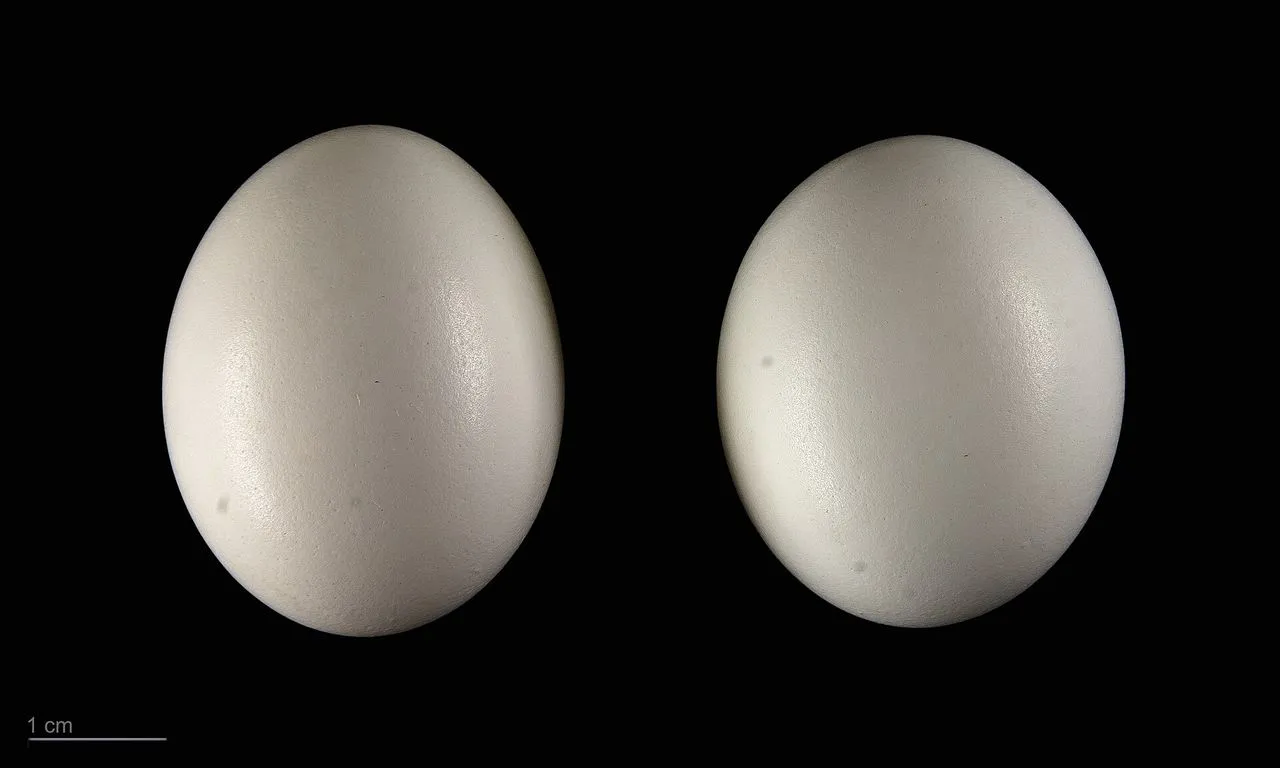
Aegolius funereus (Linnaeus, 1758), the Boreal Owl, is a 93-215 g spruce-belt owl with pronounced skull asymmetry that helps it locate small mammals beneath snow and litter.
Part of the Complete Owls Guide.
Identification
| Character | Boreal Owl (Aegolius funereus) | Northern Saw-whet Owl (Aegolius acadicus) |
|---|---|---|
| Length | 22-27 cm (9-11 in) | 18-21 cm (7-8 in) |
| Wingspan | 50-62 cm (20-24 in) | Compact; smaller than screech-owls |
| Mass | 93-215 g (3.3-7.6 oz) | 54-151 g (1.9-5.3 oz) |
| Face | Pale disc with strong dark border | Plainer face with white V between eyes |
| Song | Low hollow poo-poo-poo series | Clear steady toot-toot-toot |
| Habitat | Boreal spruce and mixed conifer | Conifer edges, cedar, hemlock, mixed woods |
Visual
Boreal Owl is small but larger-headed and more compact than Northern Saw-whet Owl, 22-27 cm long with a wingspan of 50-62 cm. The facial disc is pale and strongly outlined by a dark border, giving a framed expression. The eyes are yellow. Upperparts are dark brown with white spotting; underparts are whitish with brown streaks. The head can look flat-topped when the bird is alert.
Compared with Northern Saw-whet Owl, Boreal Owl is larger, colder in tone, and more heavily framed in the face. It lacks ear tufts. Daytime views are uncommon because the bird roosts quietly in dense spruce, fir, or mixed conifer cover. In many areas it is detected almost entirely by night listening.
Audio
The male song is a series of low, hollow notes, often described as poo-poo-poo-poo, accelerating slightly or delivered in steady runs. It is deeper and less metronomic than the Northern Saw-whet Owl's high tooting. Calling can begin in late winter, with males singing on cold calm nights when snow still covers the forest.
Females give harsher calls, and alarm notes are rarely heard unless near a nest. Wind through conifers masks the song easily; productive surveys require still nights, often between late February and April.
Distribution
The species is circumpolar, occurring across boreal North America and Eurasia. In North America it breeds from Alaska across Canada and south in the Rocky Mountains and some northern forest states. In Europe it is widely known as Tengmalm's Owl and occurs through Scandinavia, the Baltic region, montane central Europe, and eastward across Russia.
Movements are irregular. Some populations are resident, while others shift in response to vole cycles. Because the species is quiet outside the breeding season and occupies remote conifer forest, absence of records often means absence of observers rather than absence of birds.
Habitat
Boreal Owl uses mature and mixed-age conifer forest, especially spruce and fir with openings, bog edges, riparian strips, burns, and old woodpecker cavities. It is associated with boreal structure rather than continuous closed canopy. Hunting requires access to small mammals, so edges and small openings matter.
Nest sites are usually old Black Woodpecker cavities in Europe or Northern Flicker and Pileated Woodpecker holes in North America, depending on region. Nest boxes are used readily in parts of Fennoscandia, where long-running schemes have produced valuable data on vole-driven breeding.
Diet and Hunting
Small mammals dominate: voles, red-backed voles, deer mice, shrews, lemmings, and occasionally small squirrels. Birds are secondary but can be important in winter. The owl hunts from low perches inside forest openings, dropping onto prey detected by sound.
The asymmetrical ear structure is significant. Like several small nocturnal owls, Boreal Owl can locate prey under snow or vegetation with high precision. It does not equal the Barn Owl's experimentally famous acoustic specialisation in public literature, but the same principle applies: offset ear openings and a facial disc improve vertical and horizontal sound localisation.
Breeding Biology
Breeding is strongly linked to small-mammal abundance. In good vole years males sing vigorously and females occupy cavities early; in poor years territories may be silent or nesting may not occur. Egg laying usually begins from March to May depending on latitude and elevation. Clutch size is commonly 3-7 eggs, larger when prey is abundant.
The female incubates for about 26-32 days while the male provisions. Young remain in the cavity until about four to five weeks old, then disperse into nearby trees. Males may pair with more than one female in prey-rich years, and females may move between nesting attempts, a pattern also seen in related small owls.
Notes
Boreal Owl detection is a methodological problem. The species is small, nocturnal, quiet outside a narrow seasonal window, and concentrated in forests that few observers visit after midnight in March. Survey data therefore reflect weather, access, road networks, and observer tolerance as much as owl density. A serious search uses repeated listening stops on calm nights, avoids playback near suspected nests, and treats a single silent visit as no evidence at all. In the spruce belt, patience is not a virtue; it is the sampling method.
Nest-box studies in Scandinavia show why long data series are essential. Occupancy can rise sharply in vole peak years and collapse soon after, even when the forest itself has not changed. Females may skip breeding, move long distances, or switch mates between attempts. A one-year survey therefore measures the vole cycle as much as the owl population. Interpreting Boreal Owl status requires pairing owl records with small-mammal indices, snow conditions, and cavity availability.
The bird's secrecy should not be mistaken for fragility in every context. It can use managed forests where cavities or boxes remain and where clearings support prey. The damaging management is the combination of short rotations, snag removal, and loss of old woodpecker holes. Retaining cavity trees and dead-topped spruce is a direct intervention, not a decorative gesture.
See Also
Frequently Asked Questions
How does the Boreal Owl differ from the Northern Saw-whet Owl?
Boreal Owl is larger, colder in tone, and has a strongly framed pale facial disc with a dark border, giving it a more severe expression. Saw-whet is smaller, plainer-faced, and rounder-headed. Both lack ear tufts. The two are rarely seen together except in northern forests.
What is the difference between Boreal Owl and Tengmalm's Owl?
They are the same species (Aegolius funereus). 'Boreal Owl' is the standard North American name; 'Tengmalm's Owl' is the European name. The species is circumpolar, occurring across boreal forests of both continents.
Why is Boreal Owl hard to detect?
It is small, nocturnal, occurs in remote conifer forest, and is vocal only during a narrow late-winter window. Wind through conifers easily masks the song. Productive surveys require still nights between late February and April, with repeated listening stops, since a single silent visit provides no evidence.
How do vole cycles affect Boreal Owl breeding?
Breeding is strongly tied to small-mammal abundance. In good vole years males sing vigorously, females occupy cavities early, and clutches can reach 7 eggs. In poor years, territories may be silent and nesting may not occur. Females may move between attempts and males may pair with multiple females in prey-rich years.
Sources & References
- Cornell Lab of Ornithology. (2024). All About Birds: Boreal Owl. birds.cornell.edu
- Mikkola, H. (1983). Owls of Europe. T & AD Poyser.
- Korpimaki, E. & Hakkarainen, H. (2012). The Boreal Owl: Ecology, Behaviour and Conservation. Cambridge University Press.
- Sibley, D.A. (2014). The Sibley Guide to Birds (2nd ed.). Knopf.