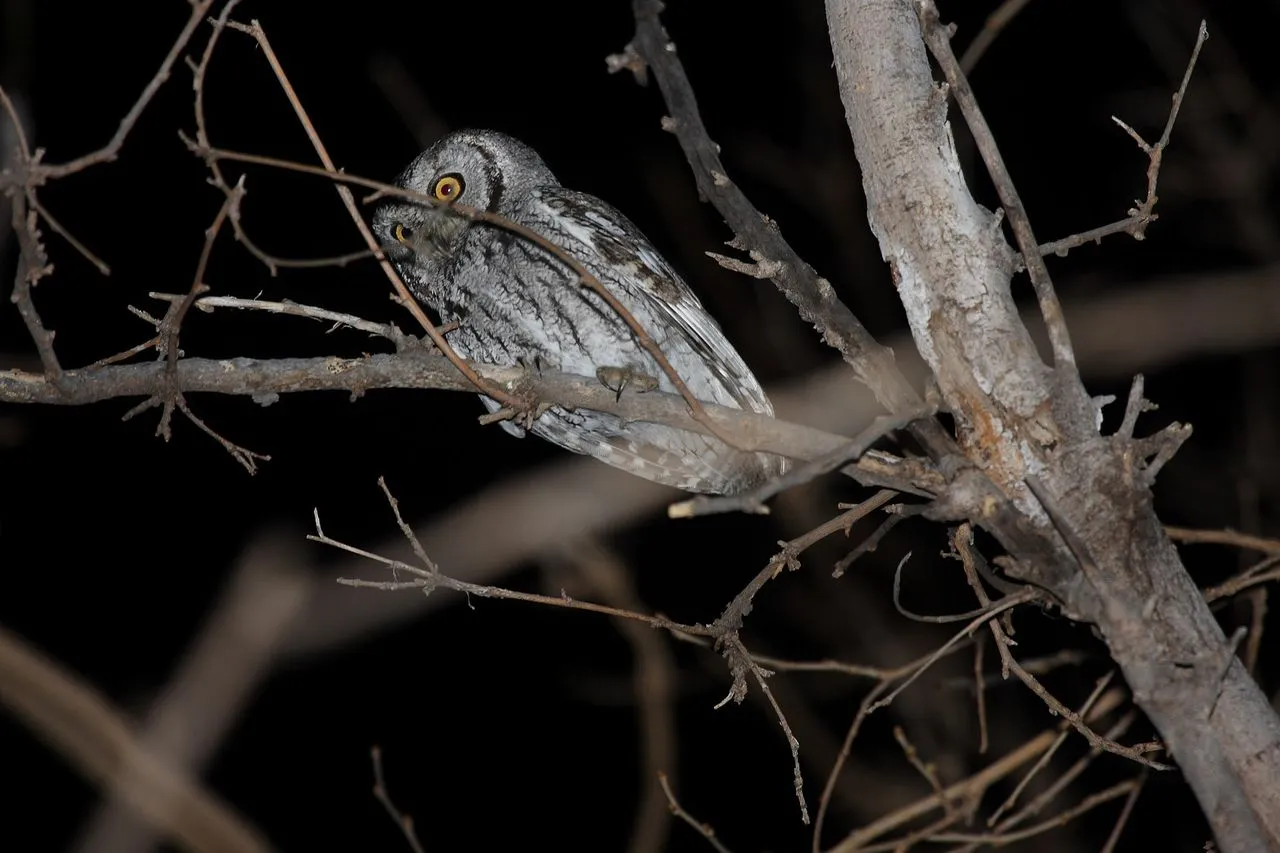
Megascops kennicottii (Elliot, 1867), the Western Screech-Owl, is a 100-305 g cavity owl whose grey-brown cryptic plumage is less useful for field identification than its accelerating series of hollow notes.
Part of the Complete Owls Guide.
Identification
| Character | Western Screech-Owl (Megascops kennicottii) | Eastern Screech-Owl (Megascops asio) |
|---|---|---|
| Length | 19-25 cm (7.5-10 in) | 16-25 cm (6-10 in) |
| Wingspan | 55-62 cm (22-24 in) | Compact; similar small screech-owl build |
| Mass | 100-305 g (3.5-10.8 oz) | 121-244 g (4.3-8.6 oz) |
| Range | Western North America | Eastern North America |
| Primary call | Bouncing-ball accelerating whistles | Descending whinny or monotone trill |
| Plumage use | Overlaps; voice is safest in contact areas | Overlaps; voice is safest in contact areas |
Visual
Western Screech-Owl is small, broad-headed, and short-tailed, with raised ear tufts that produce a squared-off crown when alert. Length is usually 19-25 cm and wingspan 55-62 cm. Females average larger than males, but size overlap is considerable and not useful in the field without direct comparison.
Upperparts are grey-brown, finely mottled and streaked; underparts are paler with dark shaft streaks and crossbars. The facial disc is grey with a darker rim, the bill is yellowish to horn-coloured, and the iris is yellow. Compared with Eastern Screech-Owl it is usually colder and greyer, with less frequent rufous morphs, but the overlap is substantial. In areas near the eastern edge of its range, identification by plumage alone is poor practice.
It is larger and more ear-tufted than Northern Saw-whet Owl, smaller and more compact than Long-eared Owl, and much less open-country in behaviour than Burrowing Owl. Roosting birds often press tightly against trunks or sit in cavities, becoming visible only when mobbed by songbirds.
Audio
The typical song is a bouncing-ball series: evenly spaced hollow whistles that accelerate slightly toward the end, often transcribed as poo-poo-poo-poopopopopop. It lacks the descending whinny of Eastern Screech-Owl. A second call is a short double trill or bark used in contact and agitation.
Vocal activity increases from January through April, especially in calm weather within two hours after sunset. In arid country the call carries surprisingly far along washes, because the bird often sings from cottonwood, sycamore, or mesquite perches over open ground. Young give harsh begging notes after fledging, usually from dense cover close to the nest cavity.
Distribution
The range covers western North America from southeastern Alaska and coastal British Columbia through the Pacific states, the Great Basin, the Rocky Mountain region, the Southwest, and parts of Mexico. It is absent from high alpine zones, extensive treeless basins, and dense closed conifer forest lacking cavity-bearing deciduous trees.
Several subspecies are described, with darker birds along the wet Pacific coast and paler birds in dry interior regions. Taxonomy within the screech-owl complex has changed repeatedly because voice, genetics, and contact-zone behaviour do not always align neatly with plumage variation. For field purposes, voice remains the most reliable separator from similar Megascops species.
Habitat
This is not a bird of uniform forest. The best habitat has cavities, edges, and small-prey abundance: riparian cottonwood belts, oak-juniper canyons, old orchards, suburban neighbourhoods with mature trees, desert washes, and wooded foothill drainages. In coastal regions it uses mixed woodland and parks; in the interior Southwest it may be concentrated in ribbons of green habitat along otherwise dry terrain.
Nest boxes are accepted where natural cavities are limited, but placement matters. Boxes set near riparian trees or mature oak cover are more likely to be occupied than boxes placed in open desert scrub. European Starlings and squirrels can exclude owls from cavities in suburban areas, so entrance size and maintenance affect occupancy.
Diet and Hunting
Western Screech-Owl is a generalist. Summer diet includes large moths, beetles, Jerusalem crickets, grasshoppers, cicadas, scorpions, and spiders. Vertebrate prey includes deer mice (Peromyscus maniculatus), voles, pocket mice, small rats, shrews, lizards, small snakes, tree frogs, and roosting birds. In riparian corridors it also takes crayfish and small fish from shallow margins.
Hunting is mostly perch-and-pounce from low to mid-level branches. The owl makes short flights to the ground, foliage, or trunk surfaces, then returns to cover. Around streetlights and porch lights it may sally for insects, which partly explains its success in older suburbs. It is primarily nocturnal but may become active before sunset when feeding large young.
Breeding Biology
The species nests in natural cavities, old woodpecker holes, hollow limbs, and nest boxes. It does not excavate. Courtship begins in late winter; egg-laying usually runs from March through May, later at higher elevations and northern latitudes. Clutch size is generally 3-5 eggs. Incubation is by the female and lasts about 26 days.
The male supplies prey during incubation and early brooding. Prey remains and pellets accumulate in the cavity, but there is no constructed nest. Young leave the cavity at about 4-5 weeks and spend several days as weak-flying branchers, during which adults may call and scold vigorously if approached.
Notes
The Western Screech-Owl is often missed because observers look for it in large wilderness blocks rather than in structurally suitable edges. A narrow cottonwood drainage behind houses may be better habitat than extensive conifer slope. Its dependence on cavity-bearing trees also makes it vulnerable to tidy land management: removal of dead limbs, old orchard trees, and riparian snags can eliminate territories without changing the general appearance of the landscape. Retaining safe standing deadwood, where it does not threaten buildings or paths, is a practical conservation measure for this species.
Surveying this species by playback alone can give a distorted impression of abundance because territorial males answer readily early in the season and poorly after incubation begins. A better local assessment combines dusk listening, cavity-tree mapping, and repeated checks for pellets below likely roost trees. In arid western valleys, watercourse continuity is often the limiting feature: remove the cottonwood line and the owl may vanish even if the surrounding acreage appears unchanged on a map.
See Also
- Eastern Screech-Owl
- Barred Owl
- Northern Pygmy-Owl
- American Kestrel
- The Complete Owls Guide
- Eastern vs Western Screech-Owl: the bill-colour and bouncing-ball-vs-trill voice diagnostic side by side.
Frequently Asked Questions
How do I tell Western from Eastern Screech-Owl?
Voice is decisive: Western has a bouncing-ball song that accelerates evenly, while Eastern has a descending whinny. Plumage overlaps substantially in their narrow contact zone, so identification by appearance alone is poor practice where both occur. Western is usually colder grey with less frequent rufous morphs.
Where do Western Screech-Owls nest?
In natural cavities, old woodpecker holes, hollow limbs, and nest boxes. They do not excavate. Best occupancy is in cottonwood belts, oak-juniper canyons, old orchards, and suburban neighbourhoods with mature trees. Egg laying runs from March through May, with clutches of 3-5 eggs.
What do Western Screech-Owls eat?
Generalist diet. Summer includes large moths, beetles, Jerusalem crickets, grasshoppers, scorpions, and spiders. Vertebrate prey includes deer mice, voles, pocket mice, small rats, shrews, lizards, small snakes, tree frogs, and roosting birds. In riparian corridors they also take crayfish and small fish from shallow margins.
Why are Western Screech-Owls often missed by observers?
Observers look for them in large wilderness blocks rather than in structurally suitable edges. A narrow cottonwood drainage behind houses may be better habitat than an extensive conifer slope. The species depends on cavity-bearing trees, and removal of dead limbs, old orchard trees, and riparian snags can eliminate territories without changing the general appearance of the landscape.
Sources & References
- Cornell Lab of Ornithology. (2024). All About Birds: Western Screech-Owl. birds.cornell.edu
- Sibley, D.A. (2014). The Sibley Guide to Birds (2nd ed.). Knopf.
- Cannings, R.J. & Angell, T. (2020). Western Screech-Owl. Birds of the World. Cornell Lab of Ornithology.
- Kaufman, K. (2000). Lives of North American Birds. Houghton Mifflin.