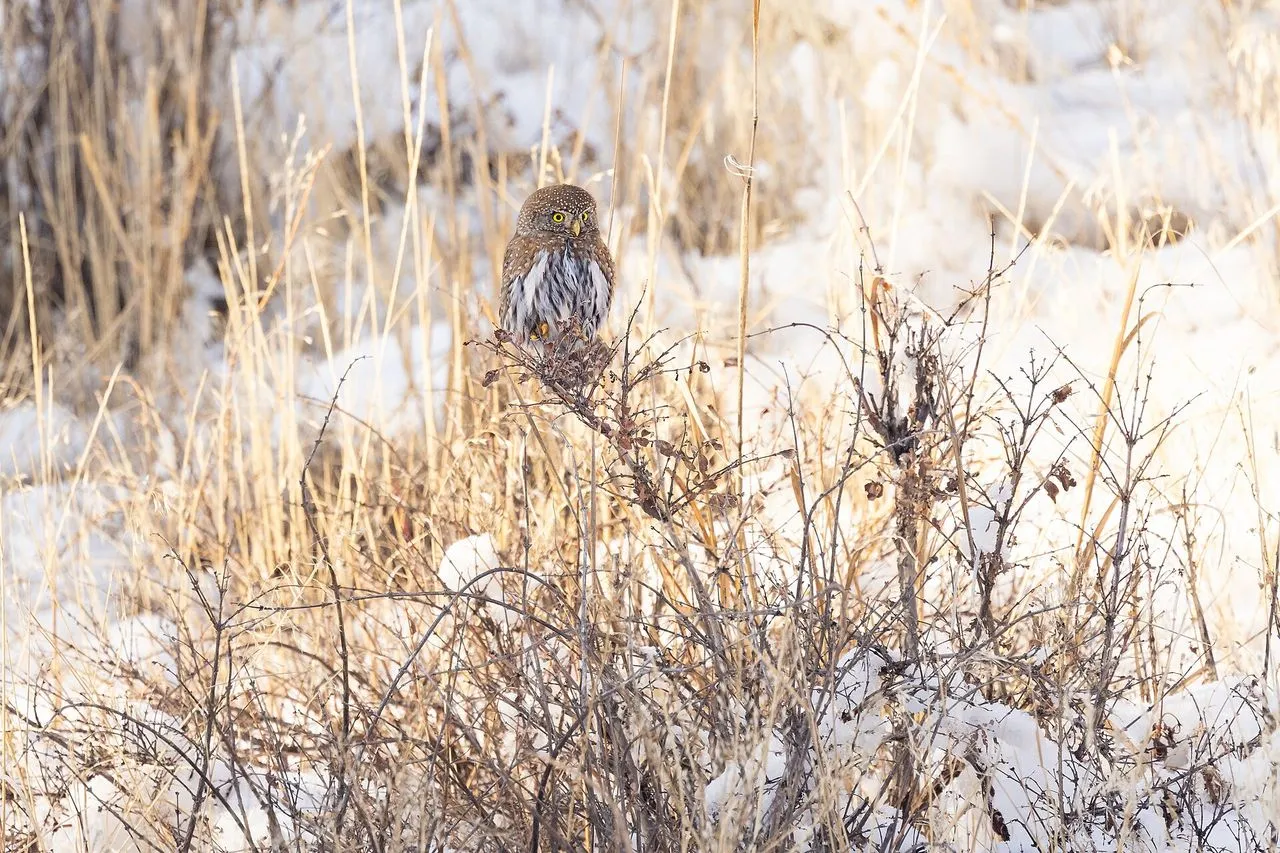
Glaucidium gnoma (Wagler, 1832), the Northern Pygmy-Owl, is a 53-76 g diurnal owl that routinely kills birds near its own mass and advertises with a simple, spaced whistled toot.
Part of the Complete Owls Guide.
Identification
| Character | Northern Pygmy-Owl (Glaucidium gnoma) | Northern Saw-whet Owl (Aegolius acadicus) |
|---|---|---|
| Length | 16-18 cm (6-7 in) | 18-21 cm (7-8 in) |
| Mass | 53-76 g (1.9-2.7 oz) | 54-151 g (1.9-5.3 oz) |
| Tail | Long, barred, often flicked | Shorter, rounder owl profile |
| Active period | Diurnal | Strictly nocturnal in normal activity |
| Nape | False eye-spots present | No false eye-spots |
| Main song | Single spaced toot every 1-2 seconds | Steady toot-toot-toot series |
Visual
Northern Pygmy-Owl is tiny but not delicate in behaviour. Length is 16-18 cm, with a long tail for its size, a small rounded head, no ear tufts, yellow eyes, and a compact predatory posture. Upperparts are brown to grey-brown with white spotting; underparts are white with dark vertical streaks. The tail is dark with narrow pale bars and is often flicked or cocked.
The nape bears two dark false eye-spots bordered by pale marks. These ocelli are conspicuous when the bird faces away and may reduce attacks from behind by small birds or confuse predators about head orientation. They are not unique among pygmy-owls but are especially useful in field views.
Unlike Northern Saw-whet Owl, this species is often active by day, perches in exposed treetops, and has a longer tail. Saw-whet is rounder, more nocturnal, and lacks the strongly barred long-tail impression.
Audio
The song is a series of evenly spaced, hollow whistles, usually a single toot repeated every 1-2 seconds. It may continue for several minutes from a high perch. The simplicity of the song makes distance estimation difficult; in mountain air a calling bird may be farther away than it sounds.
Calling is most frequent from late winter through spring. Agitated birds give faster notes and chatter. Because the species is diurnal, mobbing by chickadees, nuthatches, jays, warblers, and sparrows is a major detection cue. A tight ball of small birds scolding a fixed treetop often contains a pygmy-owl at the centre.
Distribution
The species occurs in western North America from southeastern Alaska and western Canada through the Rocky Mountains, Pacific ranges, Great Basin mountains, and into Mexico. Taxonomic limits within the pygmy-owl complex are debated, and some authorities split or rearrange forms formerly included under broader concepts. In practical North American field use, G. gnoma refers to the northern and western montane bird.
Movements are mostly local and elevational rather than long-distance migration. In winter, birds may appear at lower elevations, foothill woodlands, orchards, and wooded suburbs, especially when snow reduces access to prey higher in the mountains.
Habitat
Northern Pygmy-Owl uses coniferous and mixed forest, especially edges, openings, burns with snags, riparian strips, and montane slopes with scattered perches. It is not a deep closed-canopy specialist. Productive sites often have old woodpecker cavities for nesting, dense cover for prey, and open sightlines for hunting.
Snags are important. The owl nests in old woodpecker holes, especially those made by flickers and small woodpeckers, and hunts from exposed dead tops. Removal of dead trees for aesthetic or fuel reasons reduces both nest sites and hunting perches.
Diet and Hunting
This is a visually oriented daytime predator. Birds are central in the diet: chickadees, nuthatches, warblers, sparrows, kinglets, finches, and occasionally birds as large as quail or small thrushes. Mammals include voles, mice, shrews, and chipmunks. Lizards and large insects are taken in warmer regions and seasons.
The owl hunts from a perch, launching fast, direct attacks into shrubs, trees, or ground cover. It may pursue birds through branches in short bursts. Prey is often carried to a plucking perch, where feathers accumulate. Caching is regular; prey may be stored in cavities, branch forks, or dense foliage, especially during cold weather.
Breeding Biology
Nesting is in cavities, not open nests. The bird uses old woodpecker holes in aspen, pine, fir, cottonwood, or other trees, often several metres above ground. Egg laying varies with elevation but commonly occurs from April through June. Clutch size is usually 3-7 eggs.
The female incubates while the male delivers prey. After hatching, prey deliveries increase sharply, and caches near the nest may be used. Fledglings remain near the cavity initially and are fed for several weeks. Adults can be conspicuous during this period because they hunt in daylight and respond strongly to small birds near the nest.
Notes
The Northern Pygmy-Owl is a reminder that owl does not mean nocturnal, soft, or slow. Its morphology is closer to a small forest hawk in function than to an acoustic Barn Owl: long tail, direct flight, exposed perches, and a diet rich in birds. Playback should be avoided not only because it disturbs the owl but because it can pull dozens of small birds into mobbing behaviour, increasing their exposure to the predator being summoned.
Field observers should also treat mobbing flocks as data rather than background noise. Chickadees, nuthatches, and jays often detect the owl before a human does, and their calls can fix its position to a single snag or conifer top. The bird may then remain still for several minutes, turning only the head. A patient scan of the highest exposed perches is more effective than walking directly toward the sound, which usually pushes both the mobbing birds and the owl deeper into cover.
Fresh plucking remains beneath a lookout, especially small feathers concentrated below a snag, can indicate repeated use. The bird may hunt from the same exposed perch for several mornings when weather is settled.
See Also
Frequently Asked Questions
Are Northern Pygmy-Owls active during the day?
Yes. They are diurnal predators that hunt visually, perch in exposed treetops, and have a long tail and direct flight more like a small forest hawk than a typical nocturnal owl. Calling and prey attacks frequently occur in full daylight.
What are the false eye-spots on the back of the head?
Two dark patches bordered by pale marks on the nape, visible when the bird faces away. These ocelli may reduce attacks from behind by small birds or confuse predators about head orientation. They are particularly useful as a field identification feature.
How do you find a Northern Pygmy-Owl?
Mobbing flocks are the most reliable detection cue. A tight ball of chickadees, nuthatches, jays, warblers, and sparrows scolding a fixed treetop often contains a pygmy-owl at the centre. Patient scanning of the highest exposed perches works better than approaching the sound directly.
What do Northern Pygmy-Owls eat?
Birds are central in the diet: chickadees, nuthatches, warblers, sparrows, kinglets, finches, and occasionally birds as large as quail. Mammals include voles, mice, shrews, and chipmunks. Lizards and large insects are taken in warmer regions. Prey is often carried to a plucking perch and surplus is cached.
Sources & References
- Cornell Lab of Ornithology. (2024). All About Birds: Northern Pygmy-Owl. birds.cornell.edu
- Sibley, D.A. (2014). The Sibley Guide to Birds (2nd ed.). Knopf.
- Holt, D.W. & Petersen, J.L. (2020). Northern Pygmy-Owl. Birds of the World. Cornell Lab of Ornithology.
- Kaufman, K. (2000). Lives of North American Birds. Houghton Mifflin.