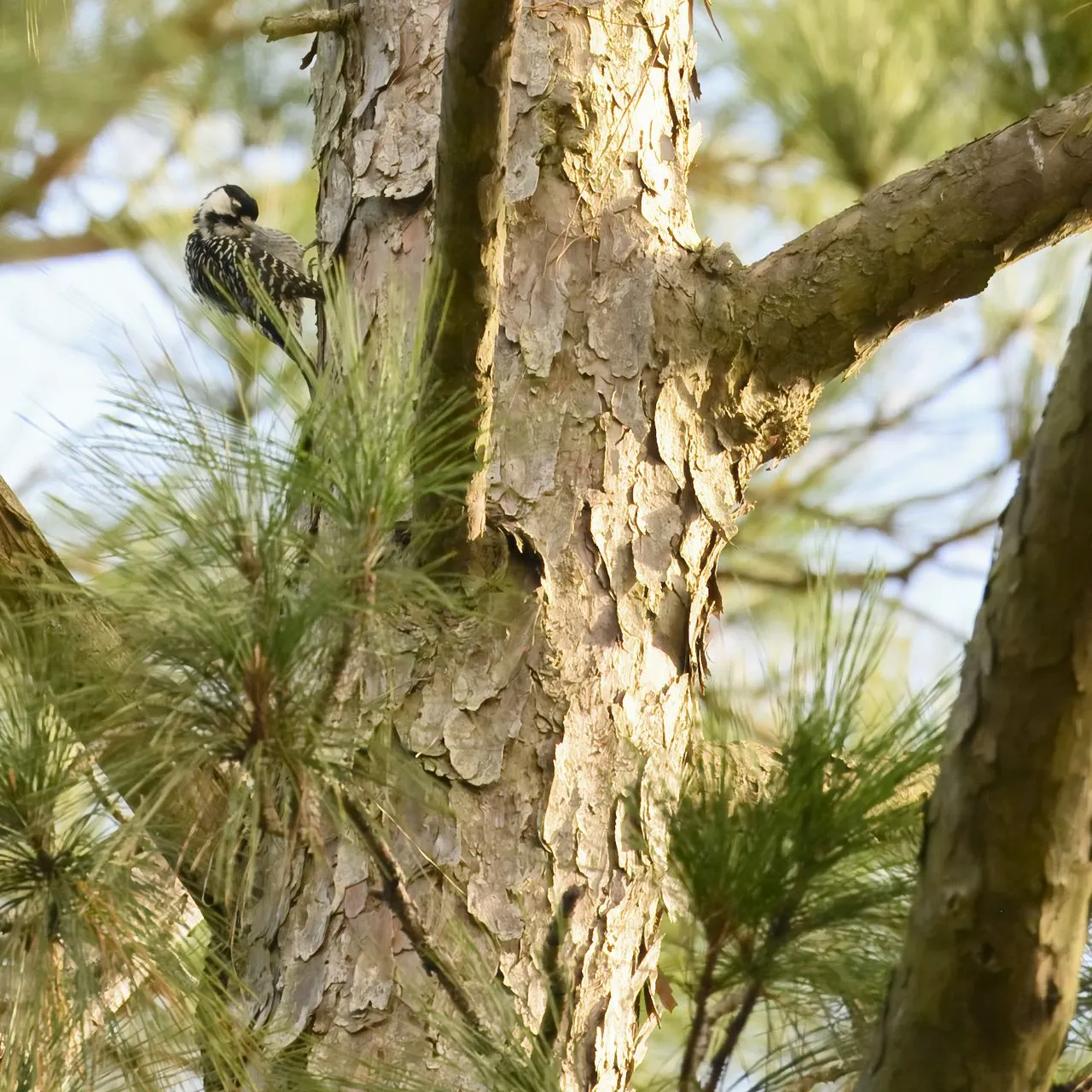
Leuconotopicus borealis (Vieillot, 1809), the Red-cockaded Woodpecker, is the longleaf pine specialist whose nest cavities are excavated in living pines rather than dead wood. A cavity may take one to seven years to complete, often around old pines infected with red heart fungus; the bird's small red male cockade is usually invisible in the field, while the resin wells around active cavities are unmistakable.
Part of the Complete Woodpeckers Guide.
Identification at a glance
| Character | Red-cockaded Woodpecker (L. borealis) | Field use |
|---|---|---|
| Body length | 20–23 cm (7.9–9.1 in) | Small to medium black-and-white picid |
| Body mass | 40–55 g (1.4–1.9 oz) | Lighter than Hairy in similar regions |
| Head pattern | White cheek, black cap, black malar stripe | Practical visual mark in open pine |
| Male red | Tiny cockade behind eye | Usually hidden; do not require it |
| Cavity sign | Living pine with resin wells | Strongest field evidence at colonies |
Identification
Visual
This is a small to medium black-and-white woodpecker, about 20–23 cm long and 40–55 g, with barred back, white cheek patch, black cap, and black malar stripe. Adult males possess a tiny red streak, the cockade, behind the eye on each side, but it is normally concealed and should not be expected in routine observation. Females lack the red. Juveniles are duller; young males may show red on the crown before acquiring the adult pattern.
The white cheek patch bordered by black, combined with open mature pine habitat, is the practical field mark. Downy and Hairy Woodpeckers may occur in the same region, but they do not maintain living-pine cavity clusters with flowing resin. Red-cockaded Woodpeckers often move in family groups through pine trunks and limbs, giving soft calls as they forage.
Drumming is a short roll, not usually the primary detection cue. At known colonies, cavity trees marked by resin are more reliable than sound.
Audio
Calls include sharp sklit or churt notes exchanged among group members. Vocal contact is important because birds forage as a social unit through open pine stands. The sound is not loud compared with Pileated or Red-bellied Woodpecker.
Distribution
The species is resident in the southeastern United States, historically across the longleaf pine belt from eastern Texas through the Gulf states and north into the Carolinas and Virginia. Its range contracted severely with the loss of old longleaf pine savanna. Remaining populations are concentrated on military bases, national forests, state lands, and managed private forests where prescribed fire and cavity management are maintained. It has been listed under the U.S. Endangered Species Act, and intensive management has been central to recovery.
Habitat
Red-cockaded Woodpeckers require mature open pine woodland, especially longleaf pine, maintained by frequent low-intensity fire. The ideal stand has old living pines, sparse midstory hardwoods, open grassy ground layer, and multiple cavity trees grouped in a cluster. Fire suppression allows hardwood midstory to develop, which reduces habitat quality and can lead to colony abandonment.
Living-pine excavation is the defining constraint. The birds select older pines, often 60–100 years or more, softened internally by red heart fungus. They drill resin wells around the entrance, causing sap to flow down the trunk. The resin barrier helps deter rat snakes, a major nest predator.
Diet and Foraging
The diet consists mainly of ants, beetles, cockroaches, spiders, caterpillars, and other arthropods taken from pine bark, branches, and needles. Birds forage by scaling bark, probing crevices, and gleaning along trunks and limbs. They also take small fruits and seeds. Group members spread through a stand, maintaining vocal contact while working different trees.
Unlike sapsuckers, the resin wells are not food wells. They are defensive architecture associated with cavity trees. Confusing the two misses the species' central adaptation.
Breeding Biology
The breeding system is cooperative. A typical group contains a breeding pair and one or more helpers, often male offspring from previous years. Helpers assist with incubation, brooding, feeding nestlings, territory defence, and cavity maintenance. Clutch size is usually three to four eggs. Incubation lasts about 10–12 days, and young fledge after roughly 26–29 days. One brood is typical.
Because natural cavity excavation can take years, managers install artificial cavity inserts and restrict midstory growth with prescribed burning. These interventions are not cosmetic; they address the biological bottleneck that limits territory formation.
Notes
This species cannot be conserved by leaving a few pines in a closed woodland. It requires an old, open, fire-maintained pine system with living cavity trees and social group continuity. The cavity timeline, often measured in years rather than days, makes population recovery slow. A lost cavity cluster is not replaced in a season.
The visible resin flow is one of the most useful signs in the southeastern pine woods. Active cavity trees show fresh, pale resin streaking below the entrance and multiple small resin wells around the cavity face. Inactive trees darken as flow declines. Managers often mark cavity trees and restrict disturbance around clusters because each tree represents years of work. Artificial cavities can accelerate territory formation, but they do not remove the need for prescribed fire, midstory control, and recruitment of future old pines.
The bird's social system also means that counting individuals alone is not enough. A population needs functioning groups with breeders, helpers, and usable cavity clusters. Three birds without cavities are not equivalent to three birds in a stable cluster.
For visitors to managed sites, disturbance discipline matters. Active clusters may be monitored closely by biologists, and approaching cavity trees outside permitted viewing areas can disrupt behaviour or damage sensitive ground-layer vegetation. The correct field method is to watch from roads, trails, or designated points in early morning when birds leave roost cavities. The white cheek patch, group movement, and resin-streaked pines can be studied without walking into the cluster.
See Also
Frequently Asked Questions
How do I identify a Red-cockaded Woodpecker?
Look for a small black-and-white woodpecker with barred back, white cheek patch, black cap, and black malar stripe. The tiny red male cockade behind the eye is usually concealed. The white cheek in open pine habitat is the practical field mark. They often move in family groups with soft calls.
Why is the Red-cockaded Woodpecker endangered?
It has declined severely due to loss of old longleaf pine savanna from logging, fire suppression, and habitat fragmentation. It requires mature open pine woodland maintained by frequent low-intensity fire. Cavity excavation in living pines takes 1-7 years, making population recovery slow.
What are resin wells?
Resin wells are small holes drilled around cavity entrances that cause sap to flow down the tree trunk. This is not a food source but a defensive adaptation - the resin barrier helps deter rat snakes, a major nest predator. Active cavity trees show fresh pale resin streaking below the entrance.
Do Red-cockaded Woodpeckers have cooperative breeding?
Yes, they have cooperative breeding. Groups typically contain a breeding pair and one or more helpers (often male offspring from previous years). Helpers assist with incubation, brooding, feeding nestlings, territory defence, and cavity maintenance.
Sources & References
- Ehrlich, P.R., Dobkin, D.S. & Wheye, D. (1988). The Birders Handbook. Simon & Schuster.
- Cornell Lab of Ornithology. (2024). All About Birds: Red-cockaded Woodpecker. birds.cornell.edu
- Sibley, D.A. (2014). The Sibley Guide to Birds (2nd ed.). Knopf.
- Winkler, H., Christie, D.A. & Nurney, D. (1995). Woodpeckers: A Guide to the Woodpeckers of the World. Houghton Mifflin.