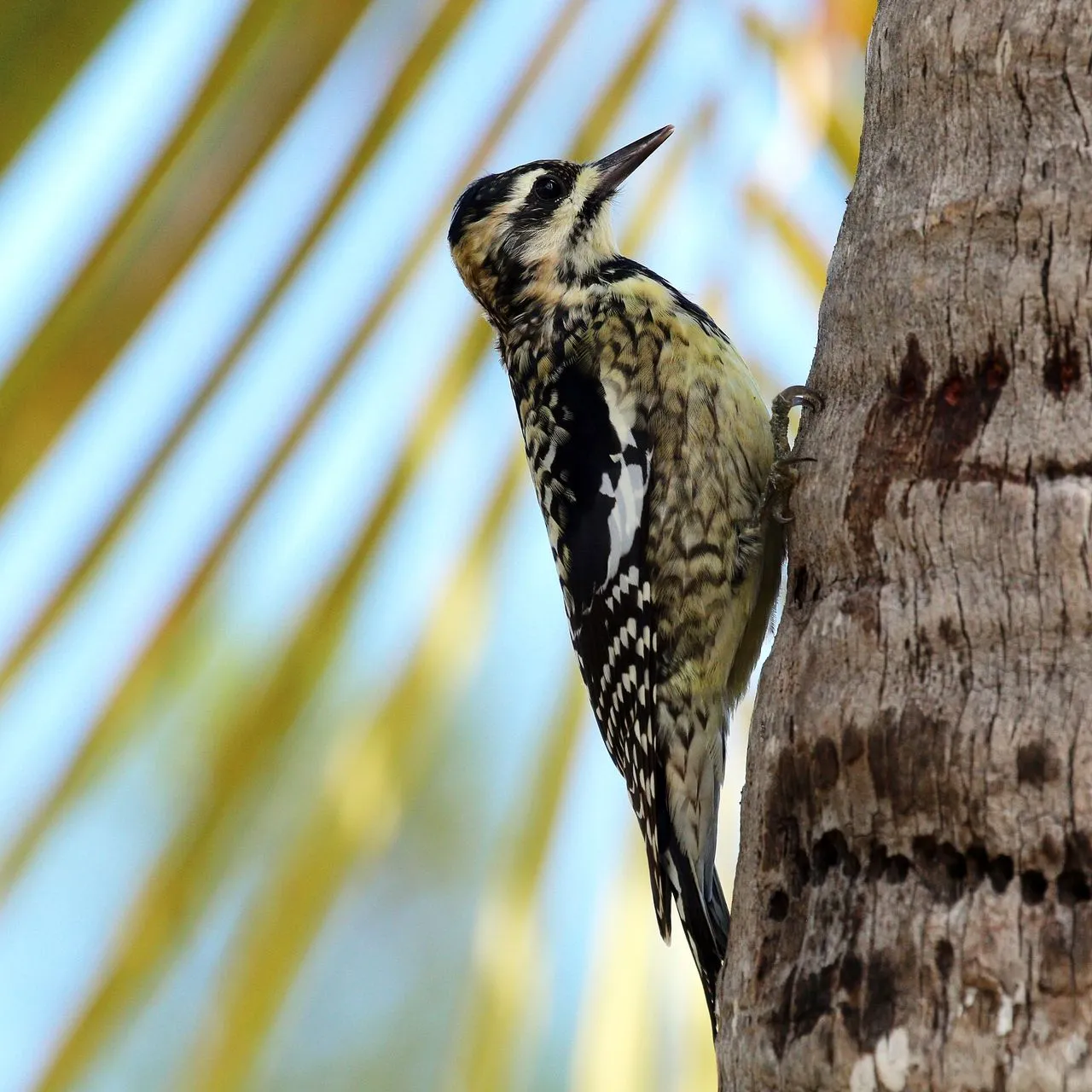
Sphyrapicus varius (Linnaeus, 1766), the Yellow-bellied Sapsucker, is the migratory picid whose orderly rows of sap wells are more often noticed than the bird itself. Its drum is not a metronomic roll: it begins with several slow, separated taps, accelerates briefly, then trails or pauses, a syncopated pattern that separates it from Hairy, Downy, and Red-bellied Woodpeckers.
Part of the Complete Woodpeckers Guide.
Identification at a glance
| Character | Yellow-bellied (S. varius) | Red-naped (S. nuchalis) | Red-breasted (S. ruber) |
|---|---|---|---|
| Body length | 18–22 cm (7.1–8.7 in) | 19–21 cm (7.5–8.3 in) | 20–22 cm (7.9–8.7 in) |
| Body mass | 35–63 g (1.2–2.2 oz) | About 32–66 g (1.1–2.3 oz) | About 53–64 g (1.9–2.3 oz) |
| Head pattern | Red crown; male red throat, female white throat | Red crown, throat, and nape patch | Red head and breast |
| Main range | Eastern breeding range; winters south | Interior western North America | Pacific coast forests |
| Drum | Irregular, syncopated taps | Irregular sapsucker pattern | Irregular sapsucker pattern |
Identification
Visual
The Yellow-bellied Sapsucker is 18–22 cm long and roughly 35–63 g, with a vertical white wing stripe, black-and-white back, pale yellowish wash on the belly, and a strongly patterned head. Adult males show a red crown and red throat bordered in black. Adult females show a red crown but a white throat. Juveniles are brownish, scaly, and much less crisp, which causes repeated autumn confusion.
The long white wing patch is a major field mark, visible on a perched bird as a clean vertical stripe along the folded wing. The face pattern is more complex than Downy or Hairy, with a bold black breast patch and contrasting throat. The belly colour is often subtle; as with Red-bellied Woodpecker, the common name is not the most useful field cue.
Drumming is diagnostic when heard well. It sounds like an uneven code: tap, tap, pause, rapid notes, then scattered taps. No other regular eastern backyard woodpecker uses this broken rhythm so consistently.
Audio
Calls include a nasal, catlike mew and sharp quee-ah notes. Migrants in autumn may be quiet, detected instead by fresh sap wells or brief views on ornamental birch, maple, or fruit trees. In spring breeding habitat, the irregular drum carries well from resonant dead limbs.
Distribution
The species breeds in boreal and northern hardwood forests across Canada and the northeastern United States, extending into the Appalachian highlands. It migrates south and winters in the southeastern United States, Gulf Coast, parts of the Caribbean, Mexico, and Central America. In much of the eastern United States, it is therefore a passage or winter bird rather than a summer resident. Spring and autumn movements bring it into suburbs, orchards, parks, and isolated trees that would not support breeding.
Habitat
Breeding habitat includes young to mature deciduous and mixed forest, especially aspen, birch, maple, and conifer-hardwood edges with suitable dead wood for nesting. Winter habitat is broader: woodlots, orchards, bottomland forest, shade trees, and gardens with sap-producing species. Individual birds often maintain well trees and return repeatedly, sometimes daily, to keep sap flowing.
Diet and Foraging
Sap wells define the genus. The bird drills small holes in horizontal rows through bark into cambium and phloem, then returns to drink sap and collect insects trapped or attracted by it. Wells are maintained actively; abandoned wells dry or callus over. Tree species used include birch, maple, hickory, apple, pine, and many ornamentals, though individual birds show preferences.
The diet includes sap, cambial tissue, ants, beetles, flies, wasps, caterpillars, and fruit. Insects attracted to sap may be as important as the sap itself during parts of the year. The wells also support other species. Ruby-throated Hummingbirds, warblers, kinglets, butterflies, bees, and flies visit active wells, and early-arriving hummingbirds may use sapsucker wells before flowers are abundant.
The damage to trees is usually localised, but repeated girdling of small branches or heavy use of stressed ornamental trees can cause dieback. The neat rows of holes are avian foraging sign, not random borer damage.
Breeding Biology
Nest cavities are excavated in dead or decaying trees, often aspen, birch, or other soft hardwoods infected with heart rot. Entrance diameter is roughly 3.5–4.5 cm, with cavity depth about 20–30 cm. Excavation usually takes one to three weeks. Clutches commonly contain four to six eggs. Incubation lasts about 12–13 days, shared by both adults. Young fledge after roughly 25–30 days. One brood is typical.
Pairs often nest near productive sap trees. The male drums irregularly to establish territory, and both sexes participate in maintaining wells. Because sap resources are spatially fixed, territories may be defended around both nest and feeding sites.
Notes
Sapsucker ecology is disproportionate to the bird's size. A 50 g woodpecker drilling a few rows of wells can create a seasonal feeding station used by hummingbirds and insects, alter sap flow on individual trees, and leave field sign that persists for years as scars. The important identification point is geometry: evenly spaced rows of holes, often rectangular or round, in living bark. That pattern is a signature.
Host choice changes through the year. Early spring birds often use trees with strong sap flow, especially maples and birches. Later in the season, wells that attract insects may matter as much as sugar concentration. Wintering birds in the South may maintain wells in pines, sweetgum, magnolia, orchards, and ornamental trees. The same individual can work a small circuit of trees, visiting each in sequence. When assessing damage, distinguish light well use from repeated girdling on a stressed tree. The first is normal bird sign; the second can justify protecting a valued ornamental with temporary wrap or deterrence outside the active nesting period.
Migration timing is also useful. In the northeastern United States, spring birds often appear in April and breeding areas fill shortly after leaf-out. Autumn passage is broader and quieter, with juveniles turning up on isolated trees, garden maples, and orchards from September into October. A winter sapsucker in the same region is usually absent unless mild coastal conditions or local food permit survival.
See Also
Frequently Asked Questions
How do I identify a Yellow-bellied Sapsucker?
Look for the diagnostic vertical white wing stripe, black-and-white barred back, and pale yellowish belly. Adult males have a red crown and red throat bordered in black; females have red crown but white throat. The irregular, syncopated drumming pattern is also distinctive.
What are sap wells and why do sapsuckers create them?
Sap wells are rows of small holes drilled through bark into the cambium layer to access tree sap. The bird drinks sap and eats insects attracted to it. Wells are maintained actively - the bird returns repeatedly to keep sap flowing. This is the sapsucker's primary foraging method.
Do Yellow-bellied Sapsuckers migrate?
Yes, they are migratory. They breed in boreal and northern hardwood forests across Canada and the northeastern US, then migrate south to winter in the southeastern US, Gulf Coast, Caribbean, Mexico, and Central America.
Do sapsuckers damage trees?
Light sap well use is normal and causes minimal damage. However, repeated girdling of small branches or heavy use of stressed ornamental trees can cause dieback. Most healthy trees tolerate moderate sapsucker activity without serious harm.
Sources & References
- Ehrlich, P.R., Dobkin, D.S. & Wheye, D. (1988). The Birders Handbook. Simon & Schuster.
- Cornell Lab of Ornithology. (2024). All About Birds: Yellow-bellied Sapsucker. birds.cornell.edu
- Sibley, D.A. (2014). The Sibley Guide to Birds (2nd ed.). Knopf.
- Winkler, H., Christie, D.A. & Nurney, D. (1995). Woodpeckers: A Guide to the Woodpeckers of the World. Houghton Mifflin.