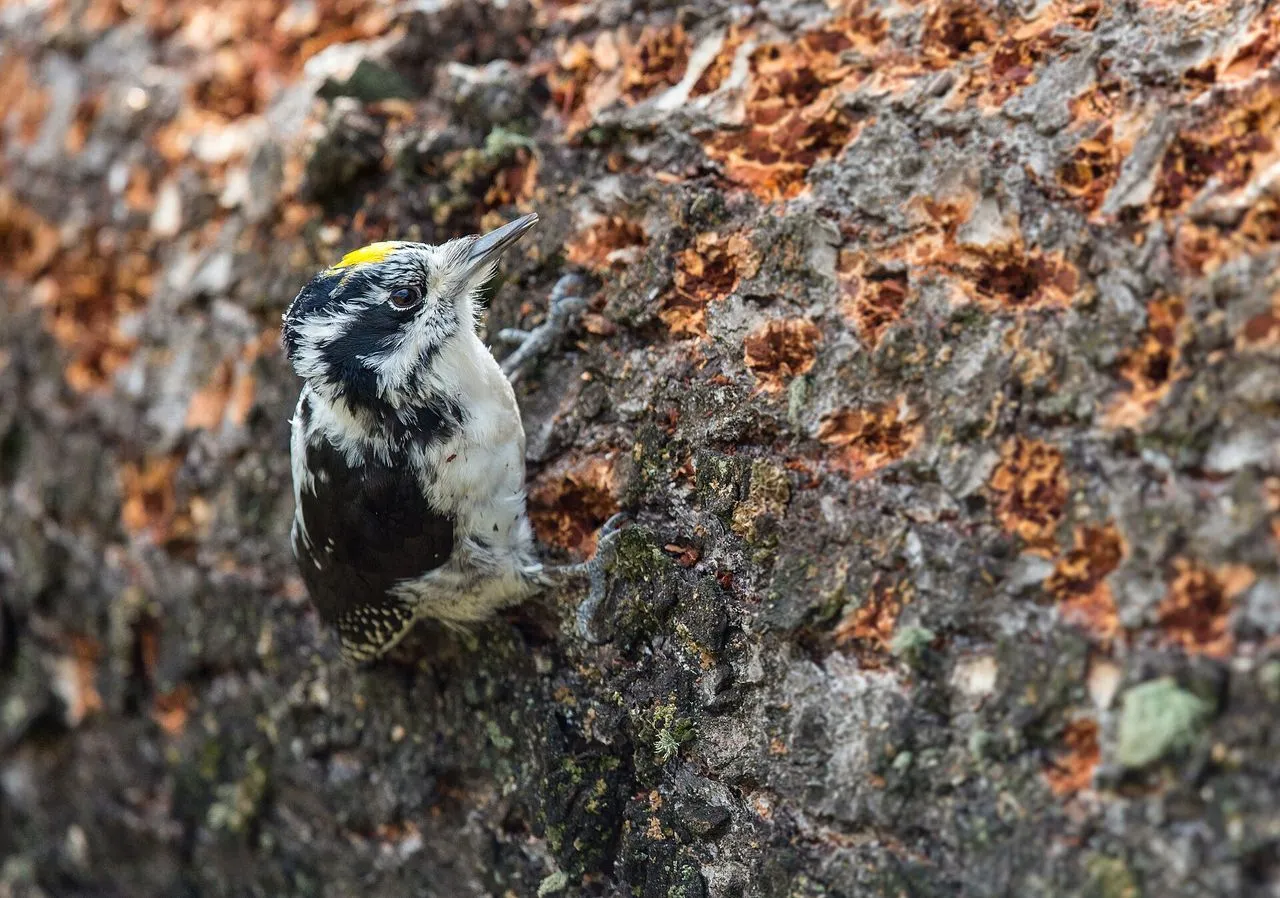
Picoides dorsalis (Baird, 1858), the American Three-toed Woodpecker, is a boreal and montane bark specialist built for flaking spruce and fir. Its drum is variable but often a brief, uneven roll near 15 strikes per second, less emphatic than Hairy Woodpecker; the better field sign is scaled bark on dead or dying conifers in cold forest.
Part of the Complete Woodpeckers Guide.
Identification at a glance
| Character | American Three-toed (P. dorsalis) | Black-backed (P. arcticus) |
|---|---|---|
| Body length | 21–23 cm (8.3–9.1 in) | About 23 cm (9.1 in) |
| Body mass | 45–70 g (1.6–2.5 oz) | 60–90 g (2.1–3.2 oz) |
| Back pattern | Barred or laddered black and white | Solid black |
| Male crown | Yellow patch | Yellow patch |
| Main habitat | Spruce-fir and beetle-killed conifers | Recent burns and dead conifer stands |
Identification
Visual
This is a medium-small woodpecker, about 21–23 cm long and 45–70 g. It has black upperparts barred or speckled with white, white underparts marked with barring on the flanks, and a dark head with a white moustachial stripe. Adult males have a yellow crown patch; females do not. Unlike Hairy Woodpecker, it lacks a broad white central back stripe and has no red on the head. Unlike Black-backed Woodpecker, the back is barred rather than solid black.
The three-toed foot is taxonomically important but seldom visible. The absence of the hallux changes leverage and is associated with powerful bark scaling rather than the delicate probing of smaller four-toed species. In the field, posture is often close to the trunk, with slow upward movement and repeated prying at bark plates.
Drumming is not as tidy a separator as plumage and habitat. Listen for a short, somewhat irregular roll from spruce or fir forest, then look for a dark-backed bird working quietly on a dead stem.
Audio
Calls are sharp pik or kik notes, generally thin and not far-carrying. The species can be unobtrusive even in breeding season. Bark flaking, small chips falling, and the sight of fresh pale patches on conifer trunks may be more useful than voice.
Distribution
American Three-toed Woodpeckers occur across boreal Canada, Alaska, and the northern United States, with montane populations south through the Rocky Mountains and other western ranges. They are resident but locally irruptive or nomadic when bark beetle outbreaks or forest disturbances create temporary food concentrations. In the lower forty-eight states, they are most reliably sought in high-elevation spruce-fir, lodgepole pine, and burned or beetle-killed conifer stands.
Habitat
The species is tied to cold conifer forest: spruce, fir, tamarack, lodgepole pine, and mixed boreal stands. It uses recent burns, beetle-killed forest, windthrow, and old stands with abundant dead wood. Compared with Black-backed Woodpecker, it is somewhat less exclusively tied to severe burns and more often encountered in unburned spruce forest with chronic bark beetle activity or decaying trees.
Diet and Foraging
The diet consists largely of bark beetle larvae, wood-boring beetle larvae, ants, spiders, and other bark arthropods. The bird flakes bark rather than drilling many neat holes. Productive trees show irregular patches where outer bark has been removed to expose galleries beneath. During beetle outbreaks, American Three-toed Woodpeckers can concentrate in affected stands and help reduce local larval numbers, though they do not control outbreaks alone.
Foraging is methodical. The bird hitches up a trunk, braces with its tail, pries bark, probes, and moves again. It is much less likely than Red-headed or Lewis's Woodpecker to sally into open air. Its world is the vertical surface of cold conifers.
Breeding Biology
Nest cavities are excavated in dead conifers, decayed live trees, or burned snags, usually in softer wood where excavation is efficient. Entrance diameter is about 4 cm, and cavity depth often 20–30 cm. Excavation takes one to three weeks depending on decay. Clutch size is usually three to four eggs. Incubation lasts about 12–14 days, and young fledge around 22–26 days after hatching. One brood is typical.
Pairs often nest in areas with active prey concentrations. Because suitable habitat is patchy and temporary, local abundance may change sharply over a decade as beetle-killed trees age, bark falls, and prey declines.
Notes
The species is often missed by observers expecting colour or noise. It is a quiet, dark, boreal woodpecker doing specialised work on conifer bark. The most practical search method is to locate fresh scaling in spruce or fir forest, then wait. The bird may be only a few trunks away, largely silent, using the same dead timber that marks its presence.
Separation from Black-backed Woodpecker should be made conservatively in poor light. Both are three-toed, both may show a yellow crown in males, and both use burned or beetle-affected conifers. The back pattern is central: barred or laddered in American Three-toed, plain black in Black-backed. American Three-toed also often appears slightly smaller and more finely patterned on the flanks, but size is a weak mark without direct comparison. In mountain forests where both are possible, record substrate, burn age, back pattern, flank barring, and vocalisations rather than relying on a single distant view.
Its dependence on beetle-affected forest means that some tree mortality is habitat, not merely forest damage. Complete sanitation cutting simplifies the food web the bird uses.
The species can be surprisingly tame when feeding, not because it is oblivious but because its attention is fixed on bark acoustics and prey extraction. A quiet observer may watch prolonged scaling at close range if movement is limited. This creates a risk of overestimating abundance: one cooperative bird can generate many minutes of observation. Use mapped locations and individual plumage marks where possible rather than assuming several detections represent several birds.
See Also
Frequently Asked Questions
How do I identify an American Three-toed Woodpecker?
Look for a dark-backed woodpecker with barred (not solid black) upperparts, white underparts with barring on flanks, and a yellow crown in adult males. The back pattern separates it from Black-backed Woodpecker (solid black). Often works quietly on dead conifers, scaling bark rather than drilling holes.
What is unusual about this woodpecker's feet?
It has only three toes (two forward, one back) instead of the typical four-toed zygodactyl arrangement. The absence of the hallux changes leverage and is associated with powerful bark scaling rather than delicate probing.
Where can I find American Three-toed Woodpeckers?
They inhabit boreal conifer forest across Canada, Alaska, and the northern US, with montane populations south through the Rocky Mountains. They prefer spruce, fir, tamarack, and lodgepole pine, especially in areas with bark beetle activity, dead trees, or recent burns.
What do American Three-toed Woodpeckers eat?
Their diet consists largely of bark beetle larvae, wood-boring beetle larvae, ants, spiders, and other bark arthropods. They flake bark rather than drilling many holes, leaving irregular patches where outer bark has been removed to expose galleries beneath.
Sources & References
- Ehrlich, P.R., Dobkin, D.S. & Wheye, D. (1988). The Birders Handbook. Simon & Schuster.
- Cornell Lab of Ornithology. (2024). All About Birds: American Three-toed Woodpecker. birds.cornell.edu
- Sibley, D.A. (2014). The Sibley Guide to Birds (2nd ed.). Knopf.
- Winkler, H., Christie, D.A. & Nurney, D. (1995). Woodpeckers: A Guide to the Woodpeckers of the World. Houghton Mifflin.