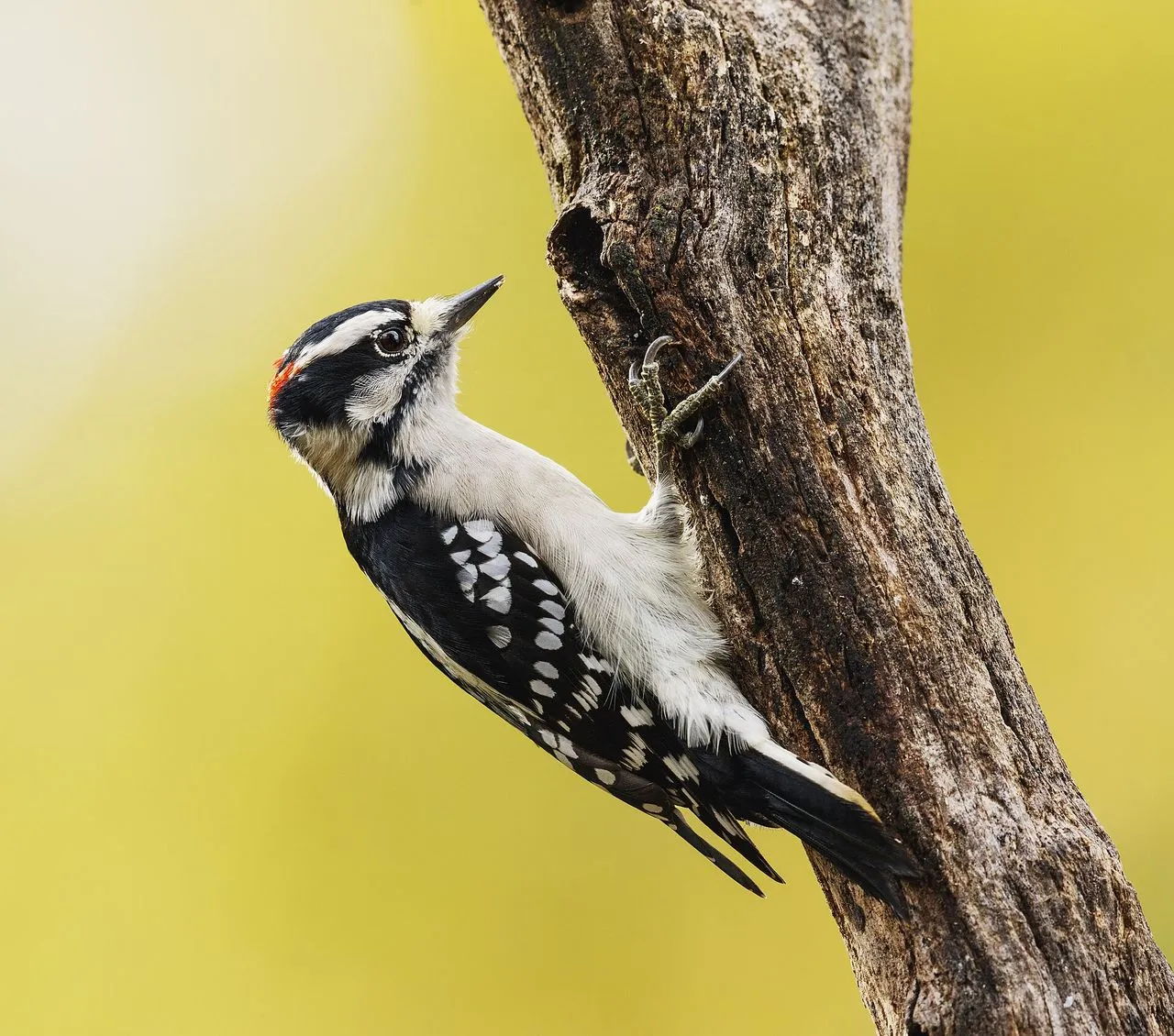
Dryobates pubescens, the Downy Woodpecker, is the smallest member of Picidae in North America, measuring 14–17 cm from bill tip to tail and weighing 20–33 g. It is also, almost without exception, the first woodpecker to locate a new suet feeder, an observation consistent enough across a range of garden types and regions to function as a useful rule of thumb.
Part of the Complete Woodpeckers Guide.
Identification
The Downy is a bird of high-contrast black and white: white underparts, black upperparts broken by a broad white central back patch, heavily barred outer wing feathers, and a bold head pattern dominated by a white supercilium running from bill to nape. Males carry a small red patch on the rear crown; females do not. In the hand, size is diagnostic. In the field, a lone Downy on a feeder offers no easy reference point for scale, and this is where the identification problem begins.
The Hairy Woodpecker (Dryobates villosus) shares virtually the same plumage pattern and occupies many of the same habitats. The two are not close relatives despite appearances; the resemblance is convergent rather than phylogenetic. The reliable separating character is bill length relative to head size:
| Character | Downy (D. pubescens) | Hairy (D. villosus) |
|---|---|---|
| Body length | 14–17 cm | 19–26 cm |
| Body mass | 20–33 g | 40–95 g |
| Bill length | Noticeably shorter than head depth | Approaches head depth |
| Bill profile | Thin, fine-tipped | Heavy, chisel-shaped |
| Outer tail feathers | Small black spots present | Plain white, unspotted |
| Overall impression | Small, delicate | Solid, substantially larger |
The outer tail feather mark, black spots on the Downy, plain white on the Hairy, is visible on a perched bird in reasonable light and is arguably more reliable than estimating bill-to-head ratio in the field. The size difference, though substantial in absolute terms (a Hairy is close to three times the mass of a Downy), is only obvious when both species appear at the same feeder simultaneously, which does occasionally happen.
Juvenile Downy Woodpeckers add a further complication. Both sexes in their first autumn plumage may show a red or orange-tinged crown patch diffused across the forecrown rather than the neat rear-crown spot of an adult male. A bird showing red on the front of the crown and none on the nape is almost certainly a juvenile Downy rather than any other species; it simply does not match the adult plate in most field guides and so generates unnecessary uncertainty.
Feeder Behaviour
The Downy's tendency to be first at new feeders has a direct explanation: it is the most widespread and habitat-tolerant woodpecker in North America, and a generalist forager with a low threshold for investigating novel food sources. The Hairy is warier and more interior-forest dependent. The Red-bellied and Pileated both prefer larger, more established food resources. The Downy fills the gap, visiting suburban feeders, small woodland patches, hedgerow trees, and garden bird stations with equal readiness.
At a suet feeder, the typical approach is from a nearby tree, the bird descends the trunk in short hops, pauses briefly at the feeder, then feeds in bursts of 10–30 seconds before retreating to cover. It is not a dominant feeder: it will yield the station to larger woodpeckers, aggressive nuthatches, and even persistent chickadees, returning when the feeder clears. Individual Downy Woodpeckers maintain winter territories of roughly 6–12 hectares and will visit several feeders within that range in a single day.
Suet is the primary offering, rendered fat or commercial suet cakes with embedded peanuts or sunflower pieces. Cage-style and upside-down feeders both work; the Downy feeds in almost any orientation.
Drumming and Calls
The Downy drums at approximately 17 strikes per second with a roll lasting about one second, evenly spaced and ending abruptly. The drum is noticeably softer than the Hairy's, a direct consequence of smaller body mass driving a smaller resonating surface. The two species' cadences are close enough that loudness and resonance are more useful separating characters than rate alone.
The most diagnostic call is a flat pik note, often given as a descending whinny series when the bird is flushed or alarmed. The whinny falls in pitch through the series, a character that separates it from the Hairy's equivalent, which holds a more even pitch throughout.
Habitat and Breeding
The Downy nests in cavities excavated in decayed wood, small snags, dead branches of living trees, and occasionally fence posts or utility poles where the wood has softened sufficiently. Entrance hole diameter is approximately 3 cm; cavity depth runs 15–30 cm. The species shows a preference for moderately decayed, soft wood that the relatively fine bill can excavate efficiently, which partly explains how the Downy and the heavier-billed Hairy coexist across most of their shared range without obvious competitive exclusion: they are working different material.
Clutch size is four to five eggs, incubated by both sexes for approximately 12 days. The male takes the night shift. Young are altricial and fledge at 20–25 days. One brood per year across most of the range, occasionally two in the southern portion.
The species is a permanent resident across most of North America south of the subarctic tree line, absent only from treeless grassland and desert, one of the most frequently recorded species in both the Christmas Bird Count and the Great Backyard Bird Count.
See Also
- Hairy Woodpecker
- Northern Flicker
- Pileated Woodpecker
- Red-bellied Woodpecker
- The Complete Woodpeckers Guide
- Why Is a Woodpecker Pecking My House?: if a small woodpecker is the culprit, the four-cause diagnostic and species-specific treatment.
- Downy vs Hairy Woodpecker: the bill-length and outer-tail-feather diagnostic, with juvenile considerations and convergent-evolution context.
Frequently Asked Questions
How do I distinguish a Downy Woodpecker from a Hairy Woodpecker?
The most reliable field marks are bill length (Downy's bill is noticeably shorter than head depth) and outer tail feathers (Downy has small black spots; Hairy is plain white). Downy is also substantially smaller at 14-17 cm versus Hairy's 19-26 cm.
Do Downy Woodpeckers migrate?
Downy Woodpeckers are year-round residents across most of their range. They do not migrate but may shift slightly south or to lower elevations in harsh winters.
What do Downy Woodpeckers eat at feeders?
Suet is the primary attractant, rendered fat, suet cakes, or suet blends with peanuts and sunflower. They also eat sunflower seeds, peanuts, and will occasionally visit hummingbird feeders.
How can I attract Downy Woodpeckers to my yard?
Provide suet feeders (cage or upside-down style), maintain dead trees or snags for natural foraging, and plant native trees that support insect populations. They are more tolerant of suburban settings than other woodpeckers.
Sources & References
- Ehrlich, P.R., Dobkin, D.S. & Wheye, D. (1988). The Birders Handbook. Simon & Schuster.
- Cornell Lab of Ornithology. (2024). All About Birds: Downy Woodpecker. birds.cornell.edu
- Sibley, D.A. (2014). The Sibley Guide to Birds (2nd ed.). Knopf.
- Winkler, H., Christie, D.A. & Nurney, D. (1995). Woodpeckers: A Guide to the Woodpeckers of the World. Houghton Mifflin.