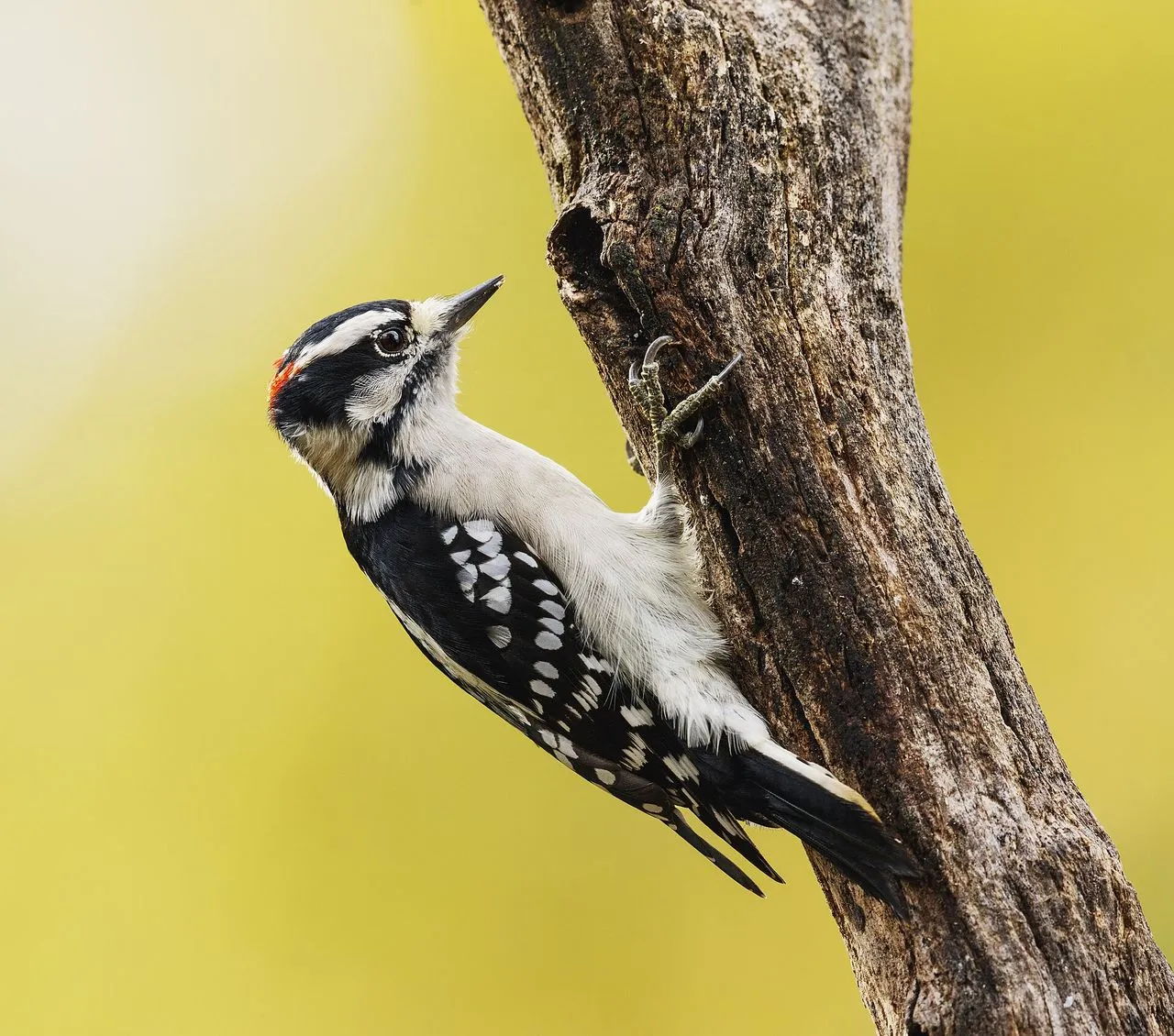
First step: View the bird side-on and compare bill length with head depth before judging body size.
Avoid: Do not identify a lone bird by size alone. Without a nearby bird or feeder scale, size can mislead you.
The Downy Woodpecker and the Hairy Woodpecker are the most frequently confused pair of birds in North America. They share the same bold black-and-white plumage pattern, the same chisel-bill silhouette, many of the same habitats, and regularly appear at the same suet feeders. New and experienced birders alike record one species for the other. The confusion is understandable: the resemblance is striking and, as molecular work has established, it is not an accident of shared ancestry but the product of convergent evolution operating independently on two distantly related woodpeckers. Separating them reliably requires attention to two structural marks, of which both can be assessed on a perched bird in reasonable light.
Part of the Complete Woodpeckers Guide.
Quick answer: Two field marks separate the species dependably. Bill length: on a Downy, the bill is noticeably shorter than head depth and looks stubby or delicate; on a Hairy, the bill approaches or equals head depth and projects as a full chisel. Outer tail feathers: Downy has small black spots on its outer rectrices; Hairy's outer tail feathers are plain white. Size differs substantially (Downy 14-17 cm; Hairy 19-26 cm) but is only useful when both species appear at the same feeder simultaneously.
Best first step: Look at the bill in profile. A bill that appears too short for the bird's head points strongly to Downy. A bill that looks proportional or long, projecting from the face as a robust tool, points to Hairy. Make this assessment before checking anything else, because it resolves quickly and does not depend on lighting or angle as much as plumage details do.
Avoid: Relying on size impression alone. A lone bird on a feeder offers no scale reference. A large Downy and a small Hairy can look nearly identical in isolation. Use structural ratios, not perceived body size.
The Big Comparison Table
| Character | Downy Woodpecker | Hairy Woodpecker |
|---|---|---|
| Scientific name | Dryobates pubescens | Leuconotopicus villosus |
| Body length | 14-17 cm (5.5-6.7 in) | 19-26 cm (7.5-10.2 in) |
| Body mass | 20-33 g (0.7-1.2 oz) | 40-95 g (1.4-3.4 oz) |
| Bill length | Noticeably shorter than head depth | Approaches or equals head depth |
| Bill profile | Thin, fine-tipped | Heavy, robust chisel |
| Outer tail feathers | Small black spots present | Plain white, unspotted |
| Drum cadence | About 17 strikes per second; soft, one-second roll | About 25 strikes per second; louder, harder, more resonant |
| Call note | Flat pik; whinny descends in pitch | Sharp peek; whinny holds even pitch |
| Habitat | Woodlands, suburbs, orchards, hedgerows | Mature forest with standing dead timber |
| Foraging substrate | Small branches, twigs, weed stems | Large trunks, major limbs; bark-scaling common |
| Feeder occurrence | Frequent; typically first at new suet feeders | Occasional; less tolerant of small suburban settings |
| Juvenile distinction | Red or orange wash across forecrown in both sexes; not rear-crown only | Similar forecrown wash in juveniles; larger bill proportion still holds |
The Two Reliable Marks
Bill length
The bill-to-head ratio is the most stable single field mark across all lighting conditions, angles, and individual variation. Look at a perched bird in profile. On a Downy Woodpecker, the bill looks almost abbreviated, as if shortened relative to the face. At 20-33 g, the Downy's bill is correspondingly fine and stubby. On a Hairy Woodpecker, the bill projects clearly from the face, approaching the full depth of the skull from crown to chin. It looks like a tool built for heavy work, because it is: Hairy Woodpeckers excavate deeper into bark and sapwood and spend more time on larger-diameter trunks where the force of a proportionally longer bill matters.
A practical internal check: compare bill length to head depth (crown to chin, assessed visually at the face plane). On Downy, this ratio is well under 1:1, and the impression is of a blunt, short projection. On Hairy, the ratio approaches or reaches 1:1. You do not need to measure; the visual impression resolves quickly once you have trained your eye on a confirmed individual of each species.
Outer tail feathers
When a bird is perched against bark with its tail braced against the surface, the outer rectrices may be partially visible. On a Downy, these feathers carry small but clear black spots, visible as dark marks against the otherwise white feather. On a Hairy, the outer tail feathers are clean white with no spotting. The mark is not always visible (angle and feather wear affect it), but when it is visible it is unambiguous.
In good light on a cooperative bird, use both marks together. Bill ratio gives you a probability; outer tail feathers confirm it. A bird with a stubby bill and spotted outer tail feathers is a Downy. A bird with a long chisel bill and plain white outer tail feathers is a Hairy. If only one mark is available, bill proportion carries the most weight.
Why They Look Alike: Convergent Evolution
Despite sharing virtually identical plumage patterns, Downy and Hairy Woodpeckers are not close relatives. Molecular phylogenetic analysis by Weibel and Moore (2005, The Condor, 107:797-809) placed the two species in separate clades within Picidae, ruling out the close kinship that their appearance implies. The resemblance is the product of convergent evolution: independent arrival at similar solutions under similar selection pressures, not descent from a recent common ancestor.
The selective forces driving convergence in this case are not fully resolved, but leading hypotheses involve shared habitat-based selection favouring the same high-contrast black-and-white pattern as a communication signal in closed-canopy woodland, or mimicry dynamics between species occupying overlapping ecological space. What the molecular evidence establishes firmly is that the similarity is not evidence of kinship. Two species can look nearly identical while being only distantly related, and Downy versus Hairy is one of the clearest examples in North American ornithology.
Juvenile and First-year Considerations
Adult plumage in Picoides-group woodpeckers is not what newly fledged birds show, and this generates identification problems when a juvenile Downy or Hairy appears at a feeder in late summer or early autumn.
Both species show red on the forecrown in juvenile plumage. In adult birds, only males carry red, and it is restricted to the rear crown as a neat patch. In juveniles of both sexes, the red is diffused across the forecrown as a vague orange-red wash on the front of the skull rather than a defined patch at the back. A bird showing red on the forehead with no red on the nape is almost certainly a juvenile; field guides typically illustrate only adult plates, so this pattern can generate unnecessary uncertainty for birders relying on those images.
The key point for identification: the structural marks remain fully valid on juveniles. A juvenile Downy still has a shorter bill and spotted outer tail feathers. A juvenile Hairy still has a long bill and plain white outer tail feathers. Age does not compromise either reliable mark, so apply the same protocol regardless of plumage stage.
Drumming and Calls
Drum cadence can support identification but should be treated as corroborating evidence rather than a primary mark. A Downy on a thin, resonant branch can produce a surprisingly loud roll; a Hairy on a dense substrate can sound quieter than expected. Substrate and position confound raw rate comparisons enough that ears alone should not close the case.
With that caveat noted: the Downy drums at approximately 17 strikes per second, with a roll lasting roughly one second, ending abruptly. The sound is softer and has less penetrating crack than the Hairy's. The Hairy drums at approximately 25 strikes per second with a harder, drier impact that carries well through open woodland. On a good resonating snag, the Hairy's drum is noticeably more powerful and percussive than anything a Downy typically produces.
Call notes differ clearly. The Downy gives a flat pik note; when alarmed or flushed it strings these into a whinny series that falls in pitch through the sequence, a descending quality that is consistent and recognisable. The Hairy gives a sharper peek, higher and more forceful. Its whinny equivalent holds a more even pitch rather than falling, giving the series a more level, urgent quality compared to the Downy's descending run.
Suet feeders offer a practical listening and viewing opportunity. Suet feeders and rendered fat covers setup and fat types in detail. A well-stocked cage feeder near mature trees will draw both species during winter months across most of eastern and central North America, providing direct comparison opportunities under controlled conditions. Both species will share a feeder with Red-bellied Woodpecker, which is substantially larger than either and provides a useful size anchor when all three appear together. Northern Flicker, though less frequent at suet, occasionally joins winter feeder gatherings and rounds out the comparison set for birders building familiarity with the woodpecker family.
See Also
- Downy Woodpecker: full species account including feeder behaviour, habitat, breeding biology, and drumming.
- Hairy Woodpecker: full species account covering mature forest habitat, foraging strategy, and cavity supply role.
- The Complete Woodpeckers Guide: full family reference covering all North American picid species and their relationships.
- Red-bellied Woodpecker: a larger woodpecker frequently sharing the same suet feeders, useful as a size reference.
- Northern Flicker: a distinctively patterned woodpecker that occasionally appears alongside Downy and Hairy at winter feeders.
- Suet feeders and rendered fat: feeder setup and fat types that reliably attract both Downy and Hairy Woodpeckers.
Quick answer: the bill check beats size
If the bird is alone, ignore your first size impression and look at the bill in profile. A Downy's bill looks short, neat, and almost stubby against the face. A Hairy's bill projects farther and feels like a full woodworking tool. After that, check the outer tail feathers: Downy often shows small dark bars or spots; Hairy usually looks cleaner white there.
Use optics before you use guesswork
At feeder distance, the field marks are small enough that poor optics cause many wrong calls. Compact close-focus binoculars such as the Celestron Nature DX 8x42 make it easier to compare bill length, tail edges, and posture without walking closer and flushing the bird.
As an Amazon Associate, we earn from qualifying purchases, at no extra cost to you.
Frequently Asked Questions
What is the single most reliable field mark?
Bill length is the most reliable single mark. On a Downy, the bill is noticeably shorter than head depth and looks stubby in profile. On a Hairy, the bill approaches or equals head depth and projects as a substantial chisel. The outer tail feather mark (spotted black on Downy, plain white on Hairy) is a reliable second mark when the bird is perched against bark with tail visible.
Do they hybridise?
No confirmed hybrids exist. Downy and Hairy are not closely related despite their similar appearance. Molecular phylogenetic work by Weibel and Moore (2005) placed them in separate clades within Picidae. Their resemblance is the product of convergent evolution, not shared recent ancestry, which removes the kinship context that typically drives interspecific hybridisation.
How can I tell juvenile Downy from adult?
Juvenile Downy Woodpeckers of both sexes may show red or orange-tinged feathers diffused across the forecrown, not restricted to the rear crown as in adult males. A small black-and-white woodpecker with red on the front of the crown and none on the nape is almost certainly a juvenile Downy. The reliable structural marks, bill length and outer tail feather spotting, remain valid on juveniles.
Which is more likely at my feeder?
Downy Woodpecker is substantially more likely at suburban and garden feeders across North America. It is the most widespread woodpecker on the continent and a low-threshold investigator of new suet feeders. Hairy Woodpecker visits suet feeders but prefers mature forest and is less common in small suburban gardens. In most backyards, a black-and-white woodpecker at the suet is a Downy until the bill length shows otherwise.
What is the easiest way to tell a Downy from a Hairy Woodpecker?
Use the bill. A Downy Woodpecker has a short bill that looks smaller than the depth of its head. A Hairy Woodpecker has a longer, heavier bill that looks close to head depth. Tail spots and voice help, but the bill is the quickest first check.