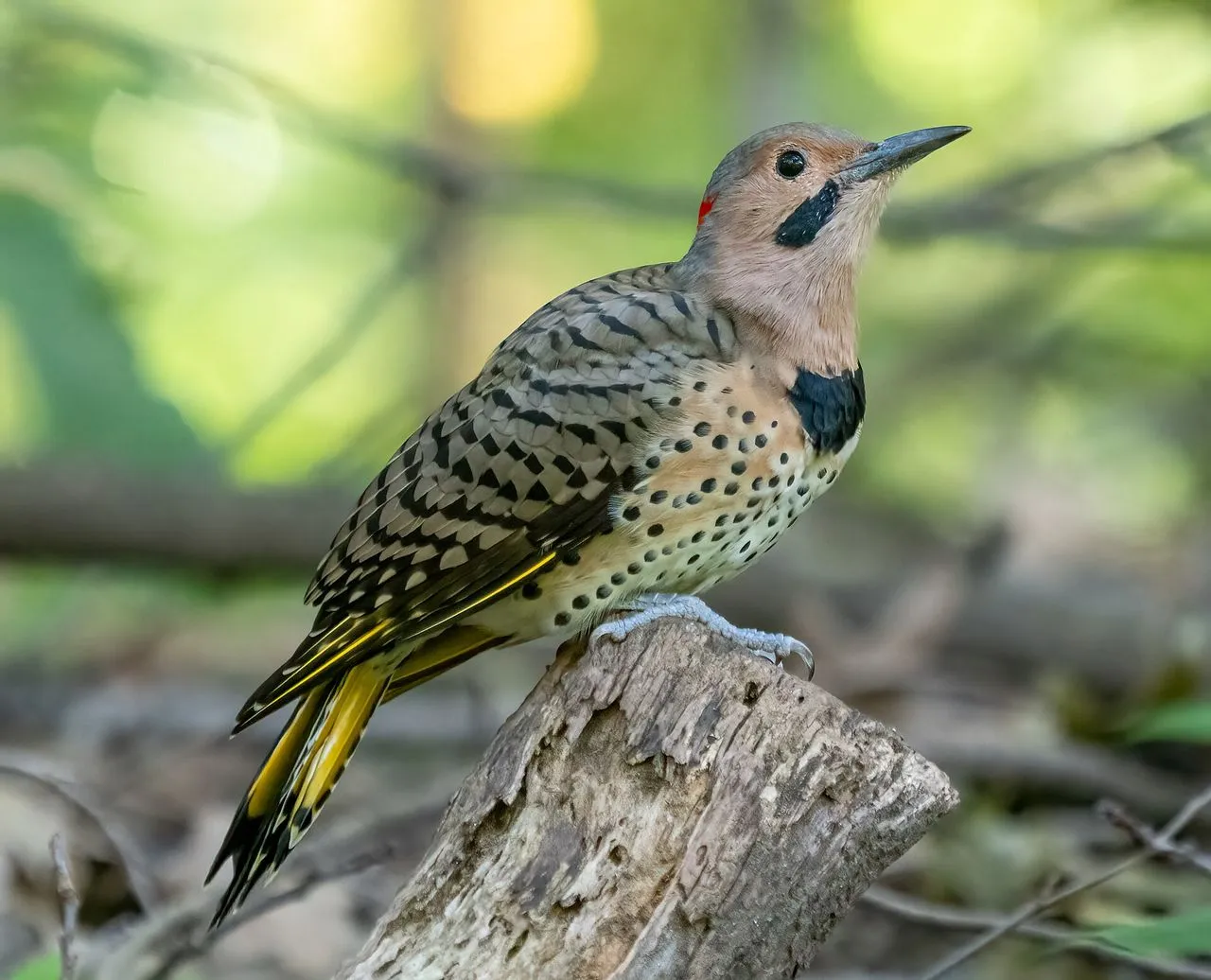
Colaptes auratus (Linnaeus, 1758), the Northern Flicker, is the North American woodpecker most likely to be seen feeding on a lawn. Its drum is a rapid, even roll of roughly 25 strikes per second lasting one to one and a half seconds, yet its foraging life is built less around bark percussion than around ants taken from soil, turf, and rotting wood.
Part of the Complete Woodpeckers Guide.
Identification at a glance
| Character | Yellow-shafted (C. auratus) | Red-shafted (C. auratus) |
|---|---|---|
| Body length | 28–36 cm (11–14 in) | 28–36 cm (11–14 in) |
| Body mass | 110–160 g (3.9–5.6 oz) | 110–160 g (3.9–5.6 oz) |
| Underwing shafts | Yellow | Salmon-red |
| Male malar stripe | Black | Red |
| Nape mark | Red crescent | Usually absent |
Identification
Visual
Northern Flickers are large woodpeckers, 28–36 cm long and commonly 110–160 g, with a brown barred back, spotted underparts, a black crescent on the upper breast, and a conspicuous white rump patch visible in flight. The flight is strongly undulating: several wingbeats, wings closed, a dip, then another burst. On the ground, flickers often stand upright, probe with the bill, and shuffle among anthills or short grass.
Two major colour forms dominate. The Yellow-shafted Flicker of the east shows yellow underwing and undertail shafts, a grey crown, brown face, red nape crescent, and black malar stripe in males. The Red-shafted Flicker of the west shows salmon-red underwing and undertail shafts, a brown crown, grey face, no red nape crescent, and red malar stripe in males. Intergrades occur broadly where the forms meet, especially across the Great Plains and western Canada. Gilded Flicker complicates identification in desert regions, but the Northern's barred back, spotted belly, and rump flash remain central.
The drum is fast and strong, close in rate to Hairy Woodpecker, but habitat and call usually separate them. A large brown woodpecker drumming from a dead limb near open ground in April is often a flicker.
Audio
The common call is a loud repeated wicka-wicka-wicka, ringing and emphatic. Single kyeer notes are also frequent in flight or alarm. During courtship, birds perform bill-pointing displays with repeated calls and head-swinging movements around trunks or posts.
Distribution
The species breeds across most of North America from Alaska and Canada south through the United States into parts of Mexico and Central America. Northern populations are migratory, with substantial southward movement in autumn. Southern and coastal populations are more resident. Flickers appear regularly in suburban parks, golf courses, cemeteries, farms, woodland edges, burned areas, and open forest, provided nest trees or soft snags remain available.
Habitat
Northern Flickers require a mixture of open feeding ground and cavity-bearing trees. Dense closed forest is less suitable than woodland edge, savanna, open pine, riparian groves, orchards, and parkland. Short turf with ant colonies can be excellent foraging habitat, but only if there are nearby trunks or poles for nesting and roosting. They also use burned forests and beaver-created openings where dead trees stand over open ground.
Diet and Foraging
Ants are the central prey. In some studies they account for nearly half or more of the annual diet, and in summer they can dominate stomach contents. Flickers probe anthills and soil with a long, extensible tongue coated in sticky saliva, taking adult ants, larvae, and pupae. They also eat beetles, termites, caterpillars, flies, berries, seeds, and fruit. Poisoned lawns and aggressive ant control can remove the very resource that draws the bird.
Foraging signs differ from those of trunk specialists. Look for small probes in turf, disturbed anthills, and birds feeding upright on the ground rather than rectangular holes in trunks. Flickers do excavate wood, but much daily feeding occurs below knee height.
Breeding Biology
Nest cavities are excavated in dead trunks, dead limbs, softwood trees, utility poles, nest boxes, or occasionally earthen banks. Entrance diameter is commonly 6–7 cm, with cavity depth around 30–40 cm. Excavation usually takes one to three weeks. Clutch size is large for a woodpecker, often five to eight eggs and sometimes more. Incubation lasts about 11–12 days, shared by both adults; nestlings fledge after roughly 24–28 days. One brood is typical, though replacement clutches are common after failure.
The species is vulnerable to cavity competition from European Starlings, which favour the same open landscapes. Flickers can excavate new cavities, but repeated usurpation reduces productivity where starling density is high.
Notes
The Northern Flicker is the corrective to the assumption that woodpeckers are mainly trunk birds. Its anatomy remains picid: zygodactyl feet, stiff tail, elongated tongue, and drumming behaviour. Its ecological emphasis, however, is terrestrial. A flicker feeding on a lawn is not behaving oddly; it is doing exactly what its lineage has specialised to do. Retain dead trees, tolerate some ant colonies, and the species has reason to visit.
Hybrid zones are worth treating carefully in records. Yellow-shafted and Red-shafted birds intergrade extensively, producing individuals with mixed malar colour, intermediate shaft colour, or partial nape crescents. These are not necessarily escaped cage birds or separate species. They are expected products of contact between long-recognised geographic forms. Note the visible characters rather than forcing every bird into a pure category: underwing shaft colour, malar stripe colour, nape mark, face tone, and location are the useful details.
Flickers also have a well-known habit of drumming on buildings. Metal chimney caps, roof vents, and siding can amplify the territorial signal far beyond a dead branch. The bird is not searching for food in metal. It is exploiting resonance.
See Also
- Red-bellied Woodpecker
- Pileated Woodpecker
- Downy Woodpecker
- Yellow-bellied Sapsucker
- The Complete Woodpeckers Guide
- Why Is a Woodpecker Pecking My House?: the species most often blamed for cedar-siding damage gets a dedicated symptom guide.
- Why Are Woodpeckers Drumming on My Gutter?: if you hear the long even roll on metal, it is almost always this species.
Frequently Asked Questions
How do I distinguish Yellow-shafted from Red-shafted Flickers?
Yellow-shafted Flickers (eastern) show yellow underwing and undertail shafts, grey crown, red nape crescent, and black malar stripe in males. Red-shafted Flickers (western) have salmon-red shafts, brown crown, no red nape, and red malar stripe. Intergrades occur where ranges meet.
Why do Northern Flickers feed on the ground?
Northern Flickers specialize in eating ants, which they probe from soil, turf, and rotting wood using their long, sticky tongue. About 50% of their diet is ants, they are the most ant-specialized woodpecker in North America.
Do Northern Flickers migrate?
Northern populations are migratory, moving south in autumn. Southern and coastal populations are more resident. They appear in a wide variety of open habitats including suburban parks, golf courses, and woodland edges.
What habitat do Northern Flickers need?
They need a mix of open feeding areas (lawns, grass, anthills) and cavity-bearing trees for nesting. They prefer woodland edge, savanna, open pine, riparian areas, parks, and orchards rather than dense forest.
Sources & References
- Ehrlich, P.R., Dobkin, D.S. & Wheye, D. (1988). The Birders Handbook. Simon & Schuster.
- Cornell Lab of Ornithology. (2024). All About Birds: Northern Flicker. birds.cornell.edu
- Sibley, D.A. (2014). The Sibley Guide to Birds (2nd ed.). Knopf.
- Winkler, H., Christie, D.A. & Nurney, D. (1995). Woodpeckers: A Guide to the Woodpeckers of the World. Houghton Mifflin.