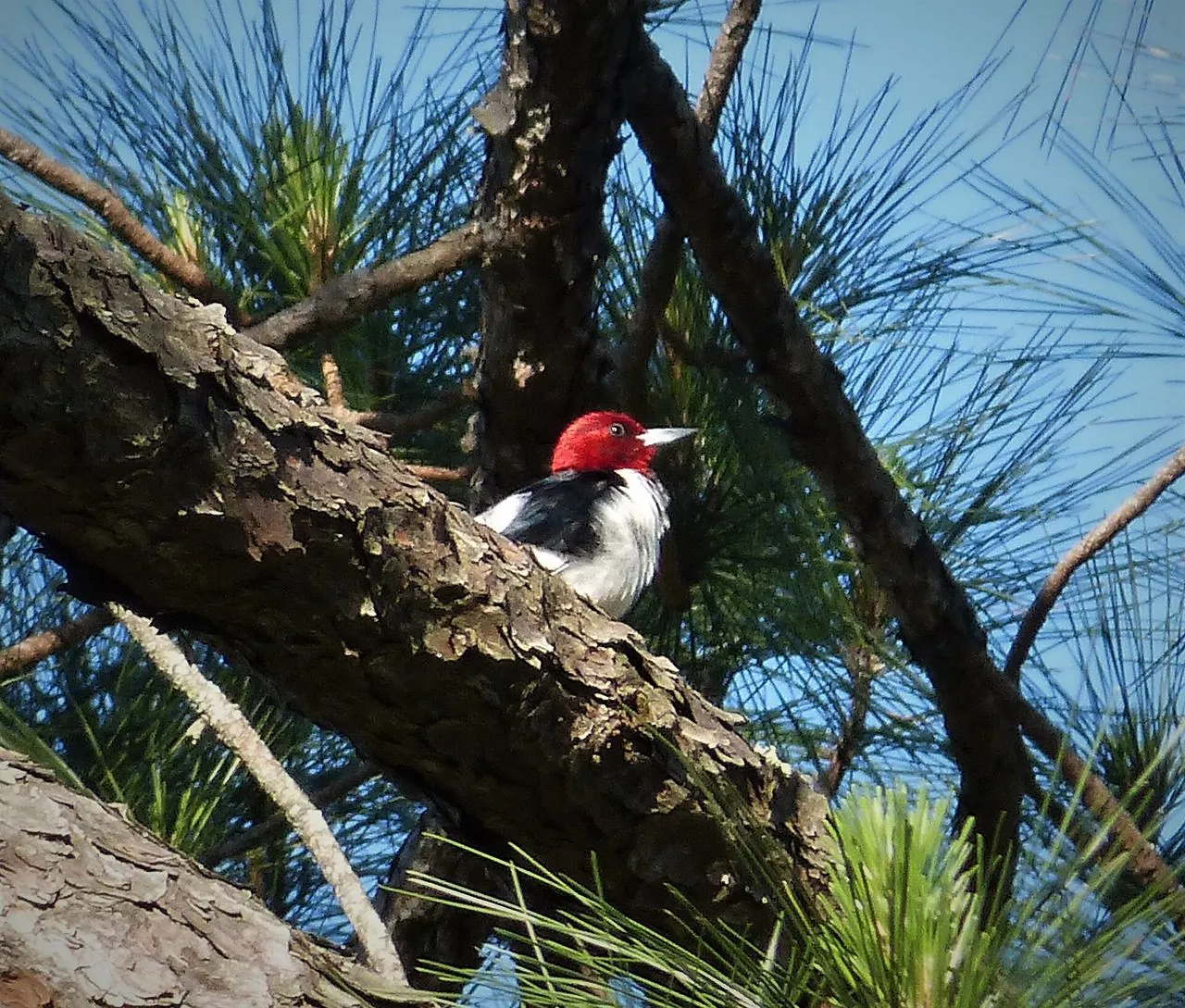
Melanerpes erythrocephalus (Linnaeus, 1758), the Red-headed Woodpecker, is a 21–25 cm open-country picid with one of the cleanest plumage patterns in North America: crimson head, white underparts, black back, and large white wing panels. Its drum is a short, even roll, usually near 20 strikes per second, but the species is as likely to be found by watching exposed flycatching perches in oak savanna as by listening for percussion.
Part of the Complete Woodpeckers Guide.
Identification at a glance
| Character | Red-headed (M. erythrocephalus) | Red-bellied (M. carolinus) |
|---|---|---|
| Body length | 21–25 cm (8.3–9.8 in) | 23–27 cm (9.1–10.6 in) |
| Body mass | Not the primary field cue | 55–90 g (1.9–3.2 oz) |
| Adult head | Entire head and throat red | Pale face, red crown or nape |
| Back and wing | Black back, large white wing panels | Barred black-and-white back |
| Main habitat | Open woodland, savanna, snags | Mature deciduous woods and suburbs |
Identification
Visual
Adult Red-headed Woodpeckers are not subtly marked. The entire head, throat, and upper breast are deep red. The back, tail, and outer wings are black. The belly and rump are white, and the inner wing forms a large white panel visible both perched and in flight. There is no barred back, no pale face, and no partial crown patch. The body is compact, with a stout pale bill and a squared-off posture on exposed trunks, fence posts, and dead limbs.
Juveniles are the difficulty. They replace the red head with a grey-brown head and streaked or mottled brown upperparts. The white wing panels remain large, and this is the field mark to trust. A juvenile Red-bellied Woodpecker may have a dull head and ambiguous red, but it shows the barred back of M. carolinus rather than the broad white wing blocks and cleaner body division of M. erythrocephalus.
Drumming is short and moderately rapid, usually a simple territorial roll rather than the irregular sign of a sapsucker. It is less diagnostically useful than plumage and habitat.
Audio
The common call is a harsh tchur or queer, sharper and less rolling than Red-bellied Woodpecker. Birds also give rattling notes during territorial disputes. In open habitat the call may carry from a dead snag on a pasture edge or burned woodland margin before the bird is seen.
Distribution
The breeding range extends across the eastern and central United States and locally into southern Canada, with strongest associations in the Midwest, Great Plains edges, and open oak systems. Northern birds are migratory or partially migratory; southern birds may remain resident. The species has declined substantially from historical abundance because of loss of open woodland, removal of dead trees, collision mortality, and competition for cavities from European Starlings. It remains locally common where the right structure persists, but absence from superficially wooded landscapes is now routine.
Habitat
This is not a closed-forest woodpecker. It uses oak savanna, pasture with dead trees, orchards, beaver meadows, burned woodland, forest edges, golf courses with retained snags, and open riparian groves. The ideal site has scattered mature trees, abundant dead limbs or snags, short ground vegetation, and open airspace for sallying after insects. Dense second-growth forest may contain many trees yet be poor habitat because it lacks exposed perches and open flight lanes.
Diet and Foraging
The Red-headed Woodpecker is one of the most aerial members of the North American woodpecker assemblage. It captures flying insects from exposed perches, drops to the ground for beetles and grasshoppers, gleans bark, and takes acorns, beechnuts, berries, fruit, and occasionally eggs or nestlings. Food caching is conspicuous. Acorns, insects, and other items are wedged into bark cracks, fence posts, roof shingles, and cavities, sometimes with careful placement that prevents loss to competitors.
Seasonal diet shifts are pronounced. In summer, large insects may dominate. In autumn and winter, mast crops influence local abundance and winter persistence. A productive oak year can hold birds well into cold weather; a mast failure can prompt movement.
Breeding Biology
Pairs excavate or reuse cavities in dead trees, dead limbs, utility poles, or fence posts. Entrance diameter is usually around 5 cm, with cavity depth roughly 20–45 cm. Excavation may take one to two weeks in suitably soft wood. Clutches usually contain four to seven eggs, incubated for about 12–14 days by both sexes. Young fledge at roughly 24–31 days. One brood is typical in northern parts of the range, while two broods are possible farther south.
Competition with European Starlings can be severe because both species use similar cavity dimensions in open habitat. Retaining multiple snags in a territory reduces but does not eliminate the pressure. Nest boxes can help locally when designed with appropriate entrance size and starling management, but standing dead wood remains the primary resource.
Notes
The conservation issue is structural. Many landscapes still have trees, but fewer have open-grown trees with dead limbs, standing snags, and short vegetation beneath. A tidy pasture or park where every dead limb is removed is not Red-headed Woodpecker habitat; it is a visually green but biologically simplified space. The bird's tricolour plumage makes it easy to recognise. The harder task is recognising why it is no longer present.
Management that benefits the species is correspondingly concrete. Retain dead trees where they do not present a genuine safety hazard, preserve open-grown oaks, prevent complete canopy closure in savanna remnants, and avoid converting rough pasture into uniformly mown turf. Where starlings are abundant, nest-site competition should be expected rather than treated as an anomaly. The Red-headed Woodpecker is often described as declining, but that word can flatten the mechanism. It is declining where the open, dead-wood-rich woodland structure has been removed.
See Also
Frequently Asked Questions
How do I identify a Red-headed Woodpecker?
Adults are unmistakable: entire head and throat are deep red, back is black, underparts are white, and inner wings show large white panels. No other North American woodpecker combines these marks. Juveniles are brown/grey-headed but retain the diagnostic white wing panels.
What habitat does the Red-headed Woodpecker prefer?
They use open woodland, oak savanna, pasture with dead trees, orchard, burned areas, forest edges, and golf courses with retained snags. They need scattered mature trees, dead limbs or snags, short ground vegetation, and open airspace for flycatching.
Why is the Red-headed Woodpecker declining?
Major threats include loss of open woodland habitat, removal of dead trees, European Starling competition for cavities, vehicle collisions, and canopy closure in formerly open savanna. The species needs standing dead wood in open settings.
What does the Red-headed Woodpecker eat?
Their diet is varied: flying insects caught on the wing, beetles, grasshoppers, acorns, beechnuts, berries, and fruit. They are notable food cachers, storing acorns and insects in bark cracks, fence posts, and cavities for later retrieval.
Sources & References
- Ehrlich, P.R., Dobkin, D.S. & Wheye, D. (1988). The Birders Handbook. Simon & Schuster.
- Cornell Lab of Ornithology. (2024). All About Birds: Red-headed Woodpecker. birds.cornell.edu
- Sibley, D.A. (2014). The Sibley Guide to Birds (2nd ed.). Knopf.
- Winkler, H., Christie, D.A. & Nurney, D. (1995). Woodpeckers: A Guide to the Woodpeckers of the World. Houghton Mifflin.