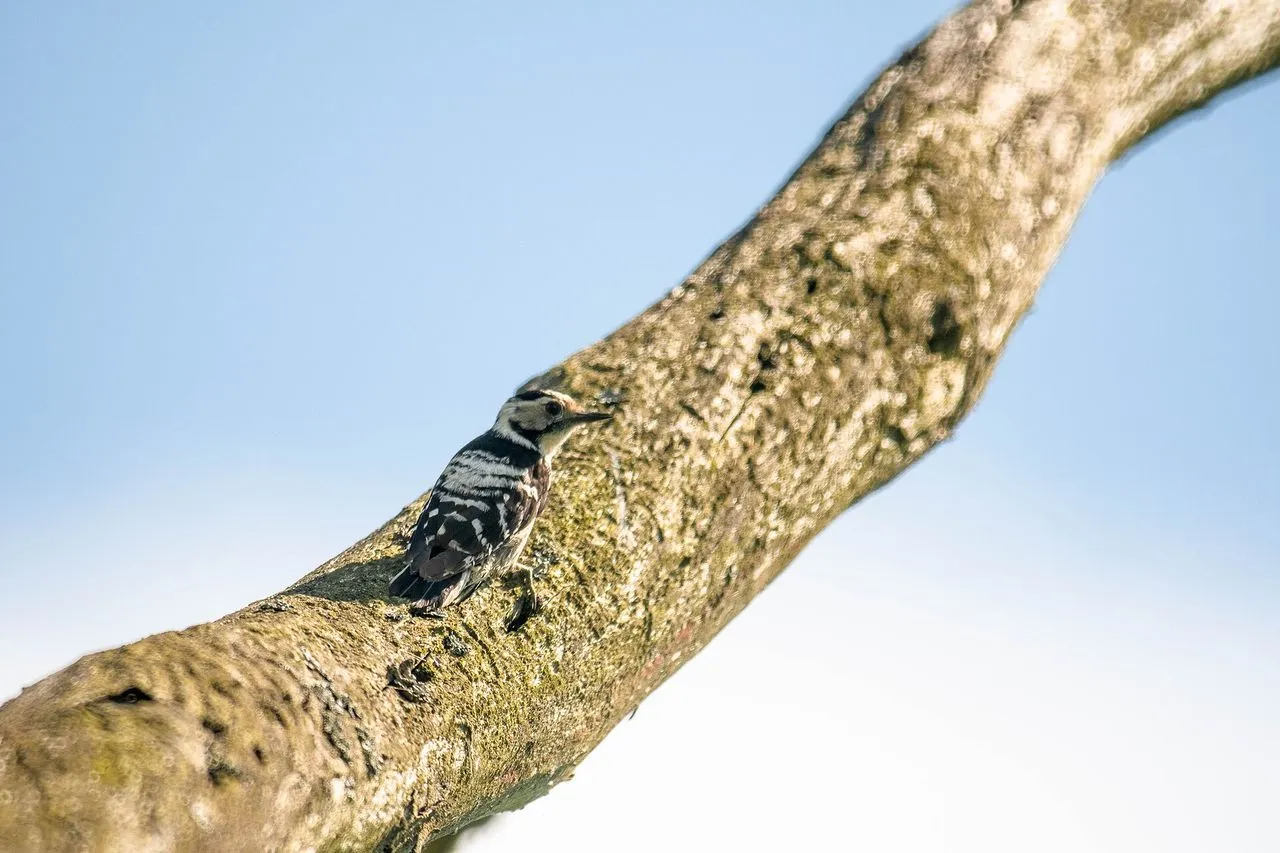
Dryobates minor (Linnaeus, 1758), the Lesser Spotted Woodpecker, is Britain's smallest woodpecker at only 14–16 cm and roughly 17–25 g. Its drum is a weak, high, extended roll, often lasting one to two seconds and repeated from thin dead branches; the sound is less forceful than Great Spotted Woodpecker and can be lost easily in wind through spring canopy.
Part of the Complete Woodpeckers Guide.
Identification at a glance
| Character | Lesser Spotted (D. minor) | Great Spotted (D. major) |
|---|---|---|
| Body length | 14–16 cm (5.5–6.3 in) | 22–23 cm (8.7–9.1 in) |
| Body mass | 17–25 g (0.6–0.9 oz) | 70–95 g (2.5–3.4 oz) |
| Back pattern | Barred black and white | Large white shoulder patches |
| Red under tail | Absent | Present |
| Main foraging level | High canopy, fine dead branches | Trunks, larger limbs, feeders |
Identification
Visual
This is a small, delicate pied woodpecker, closer to a sparrow than a starling in bulk. The back is barred black and white rather than marked with the large white shoulder patch of Great Spotted Woodpecker. The underparts are pale with fine streaking, and there is no red undertail patch. Adult males have a red crown; females have a pale or whitish crown without red. The bill is short and fine compared with Great Spotted.
The bird spends much time high in the canopy on small dead branches, often moving horizontally along fine limbs rather than hammering large trunks. This behaviour makes scale difficult. A brief view high in an alder crown can look like a small pied movement rather than a woodpecker. The barred back and absence of red vent are essential.
Drumming is proportionately long and weak. It may sound like a miniature roll from a thin twig, not the hard burst of Great Spotted. Because the bird is small, direction-finding by sound can be difficult.
Audio
Calls include a sharp repeated kee-kee-kee series, sometimes reminiscent of a small falcon in rhythm but thinner. Vocal activity peaks in late winter and early spring. After leaf-out, detection becomes much harder, and many territories go unnoticed unless surveyed early.
Distribution
The species occurs across much of Europe and temperate Asia, but in Britain it has declined severely and is now scarce, local, and absent from many formerly occupied districts. It is most often associated with southern and central England, parts of Wales, and scattered suitable sites elsewhere. It is largely resident, with local dispersal. The low density of territories makes casual encounters uncommon.
Habitat
Lesser Spotted Woodpeckers use mature broadleaved woodland, wet woodland, old orchards, parkland, riverine alder and willow, and wooded farmland with abundant dead branches. They require small-diameter dead wood in the canopy as much as trunks. Tidy woodland management that removes dead limbs and simplifies understorey can reduce feeding and nesting opportunities even when large trees remain.
Wet woods with alder, willow, birch, and poplar are often productive because small decaying branches provide invertebrate prey and excavation sites. The species is not well served by young plantation blocks lacking dead branch structure.
Diet and Foraging
The diet consists of small insects and larvae, including beetles, moth larvae, aphids, ants, spiders, and other arthropods gleaned or probed from bark and dead twigs. Unlike Great Spotted Woodpecker, it is less associated with large excavations, garden feeders, or predation of nestlings. It works fine branches, often upside down or sideways, with quick movements.
In winter it may join mixed feeding flocks loosely, though it remains unobtrusive. Its small bill restricts it to softer and smaller substrates, which partly explains its dependence on dead twigs and thin branches.
Breeding Biology
Nest cavities are excavated in dead or decaying branches and small trunks, often in willow, alder, birch, apple, or poplar. Entrance diameter is about 3 cm, and cavity depth commonly 10–20 cm, smaller than Great Spotted. Excavation may take one to three weeks. Clutches usually contain four to six eggs. Incubation lasts about 11–12 days. Young fledge after roughly 18–21 days. One brood is typical.
The nest is often high and difficult to observe without disturbing the birds. Productivity may be affected by food availability during cool springs, predation, and shortage of suitable dead branch sites.
Notes
Lesser Spotted Woodpecker is hard to find because it is genuinely scarce, small, high-feeding, and seasonally quiet. The best method is early spring listening in mature wet woodland before leaves obscure the canopy. Do not expect it at a peanut feeder. The field problem is less separating it from Great Spotted when seen well than detecting it at all.
Its decline in Britain is probably not reducible to a single cause. Loss of old orchards, simplification of wet woodland, removal of dead branches, changes in invertebrate abundance, and cool spring weather affecting nestling food have all been implicated. Great Spotted Woodpecker predation may affect individual nests, but it does not explain every regional pattern. The habitat lesson is precise: conserve dead and dying small-diameter wood throughout the canopy, not just large fallen logs on the ground.
Survey effort should also be precise. Visits in March and early April, calm weather, and attention to weak drumming from the upper canopy are far more productive than casual summer walks. Once the pair is feeding young, the birds can become quiet again and extremely difficult to track.
Garden claims should be checked carefully. Lesser Spotted Woodpecker only rarely visits feeders, and most small pied woodpecker reports in Britain prove to be Great Spotted juveniles, distant nuthatches, or brief views without scale. A credible record should include size relative to nearby birds or branches, barred back, absence of red undertail coverts, fine bill, and preferably the longer weak drum or repeated thin call. Scarcity does not make the species impossible, but it raises the evidential standard.
See Also
Frequently Asked Questions
How do I identify a Lesser Spotted Woodpecker?
Look for a tiny sparrow-sized pied woodpecker with a barred black-and-white back (not the large white shoulder patch of Great Spotted). No red undertail coverts. Adult males have a red crown; females have pale/whitish crown. The bill is short and fine.
Why is the Lesser Spotted Woodpecker so hard to find?
It is scarce, very small, feeds high in the canopy on thin dead branches, and becomes very quiet after spring. Detection is best done by listening for its weak, extended drum (1-2 seconds) in early spring before leaves emerge. It rarely visits feeders.
Why has the Lesser Spotted Woodpecker declined in Britain?
Multiple factors: loss of old orchards, simplification of wet woodland, removal of dead branches from canopy, changes in invertebrate abundance, and cool spring weather affecting food. It needs small-diameter dead wood in the canopy, not just large fallen logs.
How does it differ from Great Spotted Woodpecker?
Size is decisive: Lesser is sparrow-sized (14-16cm), Great is starling-sized (22-23cm). Lesser has barred back (not white shoulder patches), no red vent, weaker/longer drum, and feeds in canopy (not at feeders).
Sources & References
- Ehrlich, P.R., Dobkin, D.S. & Wheye, D. (1988). The Birders Handbook. Simon & Schuster.
- Cornell Lab of Ornithology. (2024). All About Birds: Lesser Spotted Woodpecker. birds.cornell.edu
- Sibley, D.A. (2014). The Sibley Guide to Birds (2nd ed.). Knopf.
- Winkler, H., Christie, D.A. & Nurney, D. (1995). Woodpeckers: A Guide to the Woodpeckers of the World. Houghton Mifflin.