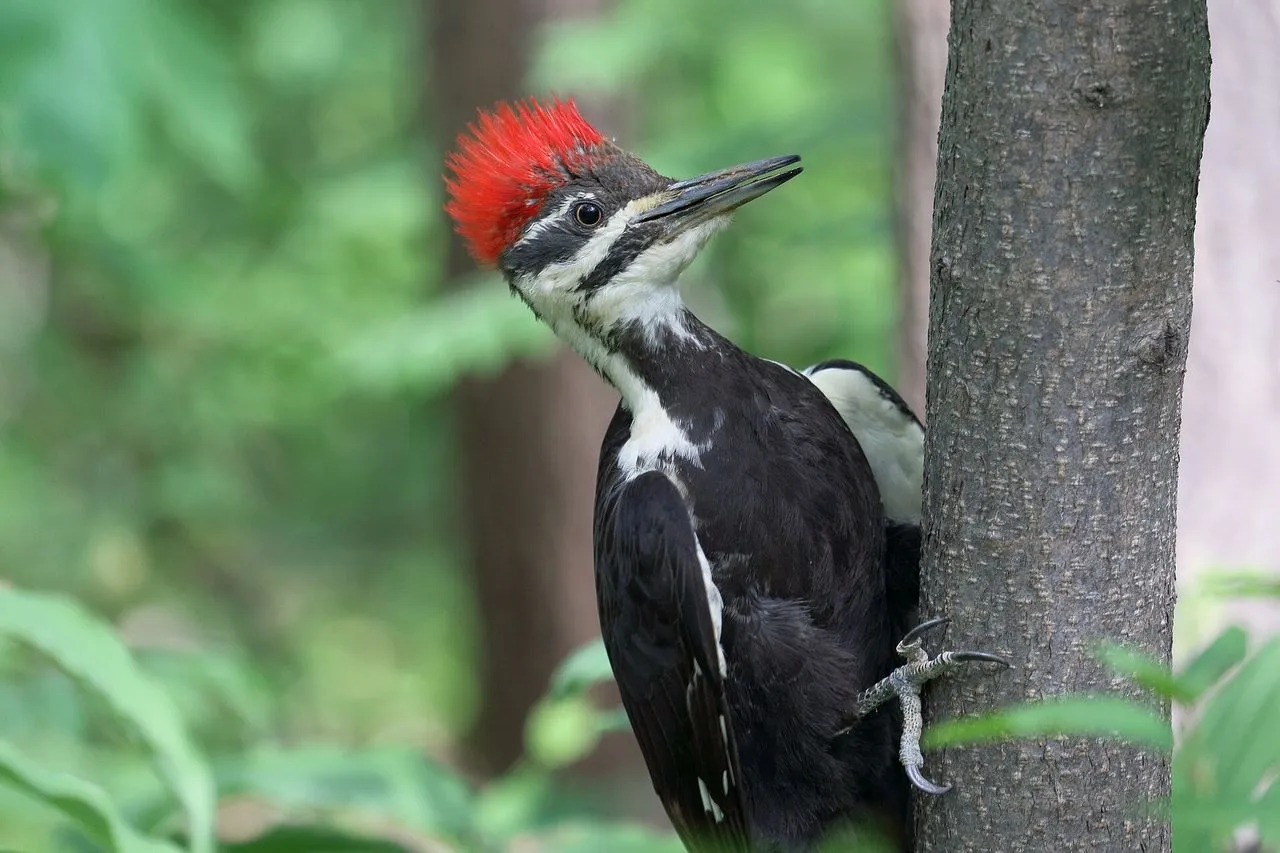
First step: Look for size first: pileated woodpeckers are much larger than downy, hairy, or red-bellied woodpeckers.
Avoid: Do not rely on the red crest alone; several woodpeckers show red on the head.
Dryocopus pileatus, the Pileated Woodpecker, is the largest woodpecker currently extant in North America, a position it holds by default since credible records of the Ivory-billed Woodpecker (Campephilus principalis) ceased in the mid-twentieth century. At 40–49 cm and 250–350 g, it is roughly crow-sized, and in flight can produce exactly that confusion until the bold white underwing linings flash.
Part of the Complete Woodpeckers Guide.
Identification
The Pileated is predominantly black with a brilliant red triangular crest, the most conspicuous field mark carried by any North American woodpecker. The face shows a white supercilium stripe and a white moustachial stripe below it, producing a bold pattern visible at considerable distance. In males, the red extends from the base of the bill across the entire crown and crest, with a red malar stripe running below the cheek. In females, the forehead is black with red restricted to the rear half of the crest; the malar stripe is absent. In flight, broad white patches across the underwing coverts and inner flight feathers are diagnostic at any range where the bird is visible at all.
The only plausible field confusion in current North American birding, aside from the Ivory-billed, which is not a realistic concern in any practical context, is the American Crow, and the confusion resolves quickly.
| Character | Pileated (D. pileatus) | American Crow (Corvus brachyrhynchos) |
|---|---|---|
| Bill | Long, pale, chisel-shaped | Stout, black, curved |
| Crest | Prominent red triangular crest | Absent |
| Underwing | Bold white patches | Uniformly dark |
| Flight | Undulating, with deep wingbeats | Direct, steady |
| Call | Loud laughing wuk-wuk-wuk series | Cawing |
The call carries further than the bird is visible: a loud series of wuk or kuk notes with a rising-then-falling inflection and a laughing quality.
Rectangular Excavations
The Pileated's foraging sign is diagnostic and unmistakeable once seen. Large rectangular or oblong cavities are gouged into dead or dying wood, typically 15–30 cm long and 8–12 cm wide, though considerably larger on trees with extensive carpenter ant (Camponotus spp.) infestations. The shape is rectangular because the bird works the wood systematically in lateral strips rather than drilling circular holes as smaller species do. Fresh excavation chips, large, pale, clearly cut rather than rotted, accumulate in substantial quantities at the base of the tree.
Carpenter ants constitute an estimated 40–60% of the diet across most of the range. The bird locates ant galleries acoustically and by probing with the bill, then excavates directly to the chamber. Wood-boring beetle larvae (Cerambycidae, Buprestidae) and termites account for most of the remainder. The long, barbed tongue, extended via the same elongated hyoid apparatus described in the Complete Woodpeckers Guide: retrieves prey from galleries the bill cannot reach directly.
Once abandoned, Pileated cavities become available to secondary nesters including Wood Ducks (Aix sponsa) and Barred Owls (Strix varia), species that cannot excavate at this scale themselves. The Pileated functions as a keystone excavator in any mature woodland community.
Habitat Requirements
The Pileated is a species of mature and old-growth forest. Its minimum habitat requirements centre on trees of sufficient diameter for nest cavity excavation, typically exceeding 30 cm dbh, and a substantial supply of large-diameter dead wood for foraging. It was extirpated from much of its eastern range during peak deforestation in the eighteenth and nineteenth centuries.
The suburban recovery of the past 30–40 years reflects the maturation of second-growth forest that regenerated after agricultural land abandonment across the eastern United States. Woodland that was scrub in the 1970s now holds trees large enough to support a resident pair. The Pileated has shown a willingness to cross open ground between woodland patches, which has allowed it to colonise fragmented suburban landscapes that would have been entirely unsuitable a generation ago.
Drumming
The drum is slow, loud, and long. Rolls run at approximately 15 strikes per second for two to three seconds, with some decelerating slightly toward the end. The tempo is slow enough that an experienced ear can count the beats, a fast roll lasting more than two seconds that then slows is almost certainly Pileated. The resonance from a large dead trunk at close range is felt as much as heard; the acoustic presence of a drumming Pileated on a still morning is of a different order from any of the smaller garden woodpeckers.
For a full cadence comparison across species, see the drum pattern table in the Complete Woodpeckers Guide.
Breeding and Territory
The Pileated requires a large territory: 40–200 ha depending on forest quality and prey density. Pairs are monogamous and remain on territory year-round. A new nest cavity is excavated each breeding season, typically in a large snag or in the dead heartwood of a living tree. The entrance hole is characteristically oblong, approximately 9 cm wide by 10–12 cm tall, distinct from the circular entrance holes produced by smaller species. Clutch size is three to four eggs; incubation runs 15–18 days and is shared by both sexes, with the male again taking the night shift.
A resident pair leaves a legible record: rectangular cavities at various stages of weathering, fresh chips at the base of worked snags. Where this sign accumulates, the birds are almost certainly still present.
See Also
Quick answer: how to identify a pileated woodpecker
Start with size and shape. A pileated woodpecker looks almost crow-sized, with a long neck, heavy bill, red crest, and black body. In flight, the white underwing patches flash clearly. On trees, look for deep rectangular excavations rather than neat small round holes.
A better field mark than the red crest
The red crest gets attention, but size separates this bird faster. If you watch woodpeckers often, steady 8x42 binoculars such as Celestron Nature DX 8x42 Binoculars make it easier to see the white face stripe, bill size, and wing flashes without crowding the bird. As an Amazon Associate, we earn from qualifying purchases, at no extra cost to you.
What do pileated woodpecker holes look like?
Their feeding holes are often tall, rough rectangles chopped into dead or dying wood. A single tree can look heavily worked over. Smaller woodpeckers usually leave shallower marks or smaller round holes, so a big rectangular cavity is one of the best clues.
Frequently Asked Questions
How do I identify a Pileated Woodpecker?
Look for the brilliant red triangular crest (males have red across entire crown; females only on rear), bold white supercilium and moustachial stripes, and large size (crow-sized at 40-49 cm). In flight, white underwing patches are diagnostic.
What makes Pileated Woodpecker excavations distinctive?
Pileated Woodpeckers create large rectangular or oblong cavities (15-30 cm long) in dead or dying wood while foraging for carpenter ants. The chips at the base are large, pale, and cleanly cut, quite different from the smaller, more circular holes of other woodpeckers.
Can Pileated Woodpeckers be found in suburban areas?
Yes, increasingly so. Suburban recovery has occurred over the past 30-40 years as second-growth forest matured. They will cross open ground between woodland patches, allowing colonization of fragmented suburban landscapes with sufficient mature trees.
What does the Pileated Woodpecker eat?
Carpenter ants comprise 40-60% of the diet. They also eat wood-boring beetle larvae, termites, and other insects. They locate ant galleries by probing and listening, then excavate directly to the chamber.
Are pileated woodpeckers rare?
They are not rare across much of their range, but they need mature trees, dead wood, or large wooded yards. They can feel uncommon in neighborhoods that lack older trees and snags.
Sources & References
- Ehrlich, P.R., Dobkin, D.S. & Wheye, D. (1988). The Birders Handbook. Simon & Schuster.
- Cornell Lab of Ornithology. (2024). All About Birds: Pileated Woodpecker. birds.cornell.edu
- Sibley, D.A. (2014). The Sibley Guide to Birds (2nd ed.). Knopf.
- Winkler, H., Christie, D.A. & Nurney, D. (1995). Woodpeckers: A Guide to the Woodpeckers of the World. Houghton Mifflin.