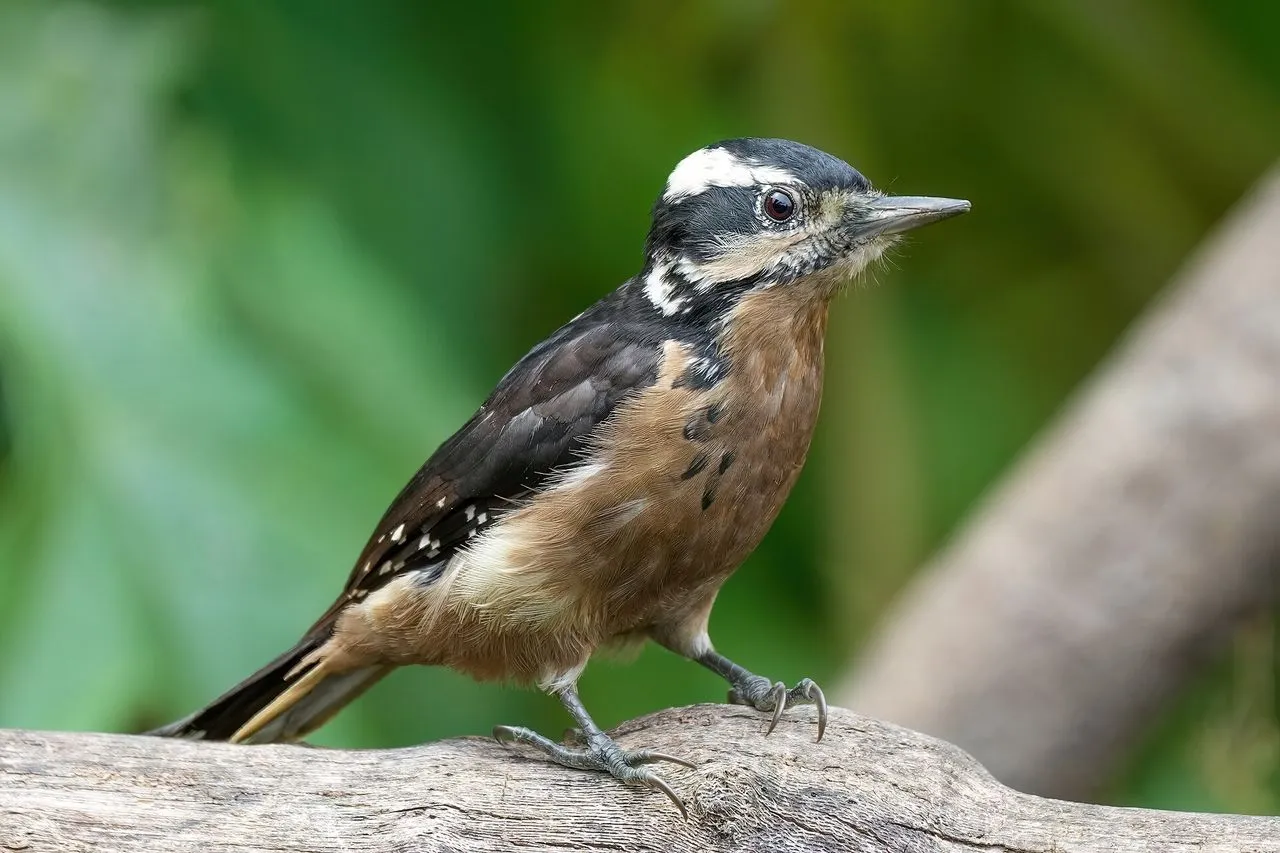
Leuconotopicus villosus (Linnaeus, 1766), the Hairy Woodpecker, is the larger black-and-white picid that causes persistent confusion with the Downy Woodpecker. Its drum is a hard, resonant roll of roughly 25 strikes per second, usually completed in about one second; the rate is fast enough that the ear perceives a single burst, but the heavier bill and body give the sound a sharper wooden crack than a Downy can usually produce.
Part of the Complete Woodpeckers Guide.
Identification at a glance
| Character | Hairy (L. villosus) | Downy (D. pubescens) |
|---|---|---|
| Body length | 19–26 cm (7.5–10.2 in) | 14–17 cm (5.5–6.7 in) |
| Body mass | 40–95 g (1.4–3.4 oz) | 20–33 g (0.7–1.2 oz) |
| Bill length | Approaches head depth | Noticeably shorter than head depth |
| Outer tail feathers | Plain white | Small black spots present |
| Drum | Hard, resonant, about 25 Hz | Softer, about 17 Hz |
Identification
Visual
The Hairy Woodpecker is 19–26 cm long and typically 40–95 g, with a straight chisel bill approaching the depth of the head. That proportional bill length is the most reliable field mark. A Downy's bill looks short, almost dainty, and usually measures distinctly less than the head depth; a Hairy's bill projects as a full tool. The two species share white underparts, black wings marked with white spotting, a broad white central back stripe, and a black-and-white striped face. Adult males show a red patch on the rear crown; females lack red.
The outer rectrices help when the bird is perched with the tail spread against bark. Hairy Woodpeckers normally show clean white outer tail feathers without the black spotting typical of Downy. This mark is useful but not always visible, and worn feathers or poor angle can make it less decisive than bill proportion. The Hairy also has a larger-headed, more rigid posture, with a heavier shoulder and less delicate movement on trunks. It is not simply a scaled-up Downy; the bill, neck, and foraging blows are proportionally stronger.
Drumming is rapid and even, about 25 Hz, with a one-second roll and abrupt stop. The sound is louder, drier, and more penetrating than Downy, especially from a dead limb or hollow trunk. A resonant substrate can mislead, so visual confirmation remains necessary.
Audio
The common call is a sharp peek, higher and more forceful than the Downy's flatter pik. The rattle or whinny series tends to remain on a more even pitch rather than descending clearly through the sequence. In mixed woods in March, a Hairy may give repeated sharp notes before moving to a drumming post, then drum several rolls at intervals of 10–30 seconds.
Distribution
The species is resident through most forested parts of North America, from boreal coniferous forest south through montane Mexico and Central America, with local forms in the Caribbean and highland forests farther south. In the United States and Canada it is present year-round across most regions where mature trees occur, though it is sparse in treeless prairie, open desert, and heavily urbanised districts without older canopy. It is less abundant than Downy almost everywhere, which is why many feeder records initially suspected as Hairy resolve into Downy under close inspection.
Habitat
Hairy Woodpeckers favour mature deciduous, mixed, and coniferous woodland with standing dead timber. They use parks and wooded suburbs when large trees and snags remain, but they are less tolerant of small ornamental trees and narrow hedgerows than Downy. In western mountains they occur in pine, fir, spruce, aspen, and riparian cottonwood. In eastern North America they use mature maple, oak, beech, hemlock, and mixed second-growth forest. The important structural requirement is not tree species alone but bark surface, dead branches, and decaying wood capable of holding beetle larvae.
Diet and Foraging
The diet is dominated by wood-boring beetle larvae, bark beetles, ants, caterpillars, and other arthropods extracted from bark and sapwood. Hairy Woodpeckers strike harder than Downies and spend more time on trunks and larger limbs, scaling bark and opening larval galleries. Their foraging is acoustically irregular: several exploratory taps, a pause, then a more forceful excavation if the substrate indicates prey beneath. They also take mast, berries, and suet, but feeder use is secondary to bark foraging in good habitat.
The species benefits from insect outbreaks. In forests with bark beetle activity, Hairy Woodpeckers may concentrate heavily on infested trees and remove substantial numbers of larvae before emergence. The relationship is functional rather than sentimental: retain dying timber and the bird has a reason to stay.
Breeding Biology
Pairs excavate a new cavity each breeding season, usually in a dead trunk, dead limb, or softened section of a living tree. Excavation generally takes one to three weeks depending on wood condition. Entrance diameter is commonly 4–5 cm, with cavity depth around 20–35 cm. The clutch is usually three to six white eggs. Incubation lasts about 11–12 days and is shared by both sexes, with the male commonly brooding at night. Young fledge after roughly 28–30 days. One brood is typical.
Old Hairy cavities are used by secondary nesters too small for Pileated holes and too large for many natural cracks: chickadees, nuthatches, titmice, flying squirrels, and small owls in appropriate regions. This makes the species an intermediate-scale cavity supplier in mature woodland.
Notes
The Downy problem is not solved by size alone. A lone Hairy at 20 m can look merely like a large Downy, and a cold, fluffed Downy on a feeder can look deceptively substantial. Use a sequence of marks: bill length approaching head depth, plain white outer tail feathers, hard 25 Hz drum, sharper peek, and preference for larger trunks. If only one mark is available, bill proportion carries the most weight.
See Also
- Downy Woodpecker
- Pileated Woodpecker
- Northern Flicker
- Red-bellied Woodpecker
- The Complete Woodpeckers Guide
- Why Are Woodpeckers Drumming on My Gutter?: the short fast roll on flashing is one of the Hairy's territorial signals.
- Downy vs Hairy Woodpecker: the two reliable marks (bill length vs head depth, outer tail feather pattern) explained side by side.
Frequently Asked Questions
What's the best way to tell a Hairy Woodpecker from a Downy?
Bill length is the most reliable field mark: a Hairy's bill approaches head depth while a Downy's appears noticeably shorter. Also check outer tail feathers, Hairy has plain white, Downy has small black spots. Size (Hairy 19-26 cm vs Downy 14-17 cm) is helpful when both species are present.
Do Hairy Woodpeckers use bird feeders?
Yes, but less frequently than Downy Woodpeckers. They will visit suet feeders and occasionally take sunflower seeds or peanuts. They are more tied to forest habitat and prefer natural foraging on trunks and large limbs.
What is the Hairy Woodpecker's drumming pattern?
Hairy Woodpeckers drum at approximately 25 strikes per second with a one-second roll that ends abruptly. The sound is louder, sharper, and more resonant than the Downy's softer drum due to the bird's larger body mass.
What do Hairy Woodpeckers eat?
Their diet consists primarily of wood-boring beetle larvae, bark beetles, ants, and caterpillars extracted from bark and sapwood. They also eat berries, nuts, and will visit suet feeders, especially in winter.
Sources & References
- Ehrlich, P.R., Dobkin, D.S. & Wheye, D. (1988). The Birders Handbook. Simon & Schuster.
- Cornell Lab of Ornithology. (2024). All About Birds: Hairy Woodpecker. birds.cornell.edu
- Sibley, D.A. (2014). The Sibley Guide to Birds (2nd ed.). Knopf.
- Winkler, H., Christie, D.A. & Nurney, D. (1995). Woodpeckers: A Guide to the Woodpeckers of the World. Houghton Mifflin.