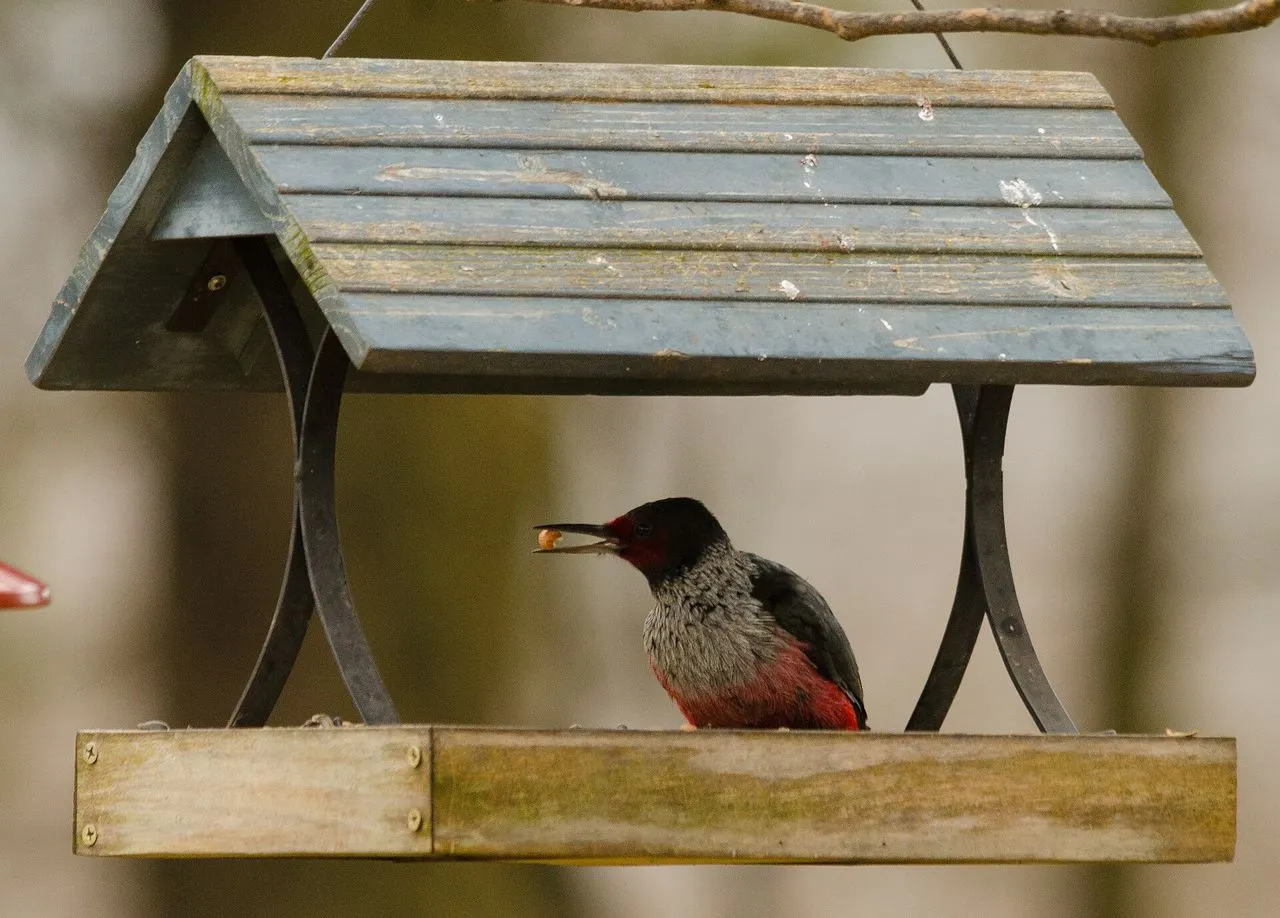
Melanerpes lewis (Gray, 1849), Lewis's Woodpecker, is the western picid that behaves at times more like a large flycatcher than a bark-drilling woodpecker. Its drum is weak and infrequent compared with most woodpeckers, while its long sallies after aerial insects, slow crow-like wingbeats, and habit of caching mast define its field character.
Part of the Complete Woodpeckers Guide.
Identification at a glance
| Character | Lewis's Woodpecker (M. lewis) | Field use |
|---|---|---|
| Body length | 26–28 cm (10.2–11 in) | Large, long-winged woodpecker |
| Body mass | 90–140 g (3.2–4.9 oz) | Heavier than Red-headed, lighter than Pileated |
| Plumage | Greenish-black back, grey collar, pink belly, red face | Unique muted four-colour pattern |
| Flight | Broad wings, slow crow-like beats | Separates it from bounding trunk specialists |
| Feeding mode | Aerial flycatching from exposed perches | Behaviour often gives the first clue |
Identification
Visual
Lewis's Woodpecker is 26–28 cm long and about 90–140 g, with a dark greenish-black back, grey collar and breast, pinkish-red belly, and deep red face. The colour pattern is muted but distinctive, lacking the barred backs, spotted wings, and white facial stripes common in many North American picids. In flight the wings look broad and the wingbeats slow. The silhouette can suggest a crow or jay until the colour and woodpecker posture become visible.
Perched birds often sit upright on exposed snags, fence posts, utility poles, or burned tree stems, scanning the air rather than hitching continuously up bark. The bill is long and straight, but the bird does not usually hammer with the frequency of Hairy or Downy. Drumming occurs, but it is not a field mark to lean on.
Audio
Calls are relatively quiet and include harsh churr and kik notes. The species is less vocally insistent than Acorn Woodpecker and less percussive than most trunk specialists. Detection often comes from movement: a dark bird launching from an exposed perch, capturing an insect in open air, and returning to the same or adjacent perch.
Distribution
Lewis's Woodpecker breeds in western North America, from British Columbia and the northwestern United States through the interior West into parts of California, the Great Basin, and the Rocky Mountain region. Winter distribution shifts toward areas with reliable mast and milder conditions, including oak woodlands, riparian corridors, and orchards. Movements are irregular because food supply, especially acorn and pine seed production, varies strongly among years.
Habitat
The species favours open ponderosa pine woodland, burned forest with standing snags, cottonwood riparian corridors, oak savanna, orchards, and open agricultural edges with large trees. It avoids dense closed forest. Recently burned landscapes can be highly suitable when they provide standing dead trees for nesting and open airspace for insect capture. Old cottonwoods along rivers are particularly important in parts of the interior West.
Diet and Foraging
Lewis's Woodpecker takes flying insects by sallying from perches, especially beetles, ants, wasps, grasshoppers, and flies. It also gleans from bark and foliage, but aerial hawking is unusually prominent for a woodpecker. In autumn and winter, acorns, walnuts, almonds, corn, berries, and other plant foods become important. The bird caches food in bark crevices, cracks in posts, and cavities, defending storage sites against competitors.
Its foraging posture is a useful field cue. A Hairy Woodpecker moves along bark and strikes. A Lewis's watches, launches, turns in open air, and returns. The difference is behavioural as much as anatomical.
Breeding Biology
Nest cavities are usually placed in dead or decaying trees, burned snags, large cottonwoods, or old woodpecker holes. Lewis's Woodpecker often reuses existing cavities rather than excavating entirely new ones, though it can modify soft wood. Entrance diameter is commonly about 5–6 cm; cavity depth varies widely, often 20–45 cm. Clutch size is usually five to seven eggs. Incubation lasts about 13–14 days, and young fledge after roughly four to five weeks. One brood is typical.
Because the species depends heavily on standing dead trees and open structure, post-fire salvage logging can remove breeding substrate quickly. A burn that looks untidy to forestry eyes may be prime habitat if snags remain standing.
Notes
The name commemorates Meriwether Lewis, whose expedition collected the species for science, but the bird's ecology is more interesting than the eponym. It sits near the behavioural edge of what many observers expect from a woodpecker: little routine drumming, much aerial feeding, extensive caching, and a preference for open, sometimes burned landscapes. Those traits are not exceptions. They are the species' operating system.
Seasonal detectability changes sharply. In spring and early summer, breeding birds may be tied to nest sites in burned pine or cottonwood groves and make repeated flycatching circuits from fixed perches. In autumn, birds may gather where acorns, walnuts, or orchard crops are abundant, then defend caches with a persistence more reminiscent of Acorn Woodpecker than of Hairy Woodpecker. Wintering individuals often use the same storage area repeatedly, and apparent abundance can rise or fall with mast crops rather than with local breeding numbers.
The species is vulnerable to the combination of snag removal and loss of large old trees along waterways. Retaining dead stems after fire and allowing cottonwoods to mature are not optional refinements; they are the conditions that produce nest sites.
Identification in flight should emphasise shape as well as colour. Lewis's Woodpecker has a steadier, more buoyant flight than the bounding pattern of many woodpeckers, with broad wings and relatively slow beats. The pink belly and grey collar may disappear in glare, but the dark body, long-winged profile, and repeated return to an exposed perch remain visible. A bird flycatching repeatedly over a burned slope or cottonwood opening deserves careful checking.
See Also
Frequently Asked Questions
How do I identify Lewis's Woodpecker?
Look for dark greenish-black upperparts, grey collar and breast, pinkish-red belly, and deep red face. The silhouette is crow-like with broad wings and slow wingbeats. They often sit upright on exposed snags or poles, scanning for insects rather than hitching along bark.
Why is Lewis's Woodpecker unusual among woodpeckers?
It behaves more like a large flycatcher than a typical woodpecker. It catches flying insects by sallying from perches, has relatively weak and infrequent drumming, and does more aerial hawking than bark drilling. This behaviour is distinctive among North American picids.
What habitat does Lewis's Woodpecker prefer?
It favours open ponderosa pine woodland, recently burned forest with standing snags, cottonwood riparian corridors, oak savanna, orchards, and open agricultural edges. It avoids dense closed forest. Recently burned areas can be highly suitable.
Do Lewis's Woodpeckers migrate?
They breed in western North America and move seasonally toward areas with reliable mast and milder conditions in winter. Movements are irregular because food supply (especially acorn and pine seed production) varies strongly among years.
Sources & References
- Ehrlich, P.R., Dobkin, D.S. & Wheye, D. (1988). The Birders Handbook. Simon & Schuster.
- Cornell Lab of Ornithology. (2024). All About Birds: Lewis's Woodpecker. birds.cornell.edu
- Sibley, D.A. (2014). The Sibley Guide to Birds (2nd ed.). Knopf.
- Winkler, H., Christie, D.A. & Nurney, D. (1995). Woodpeckers: A Guide to the Woodpeckers of the World. Houghton Mifflin.