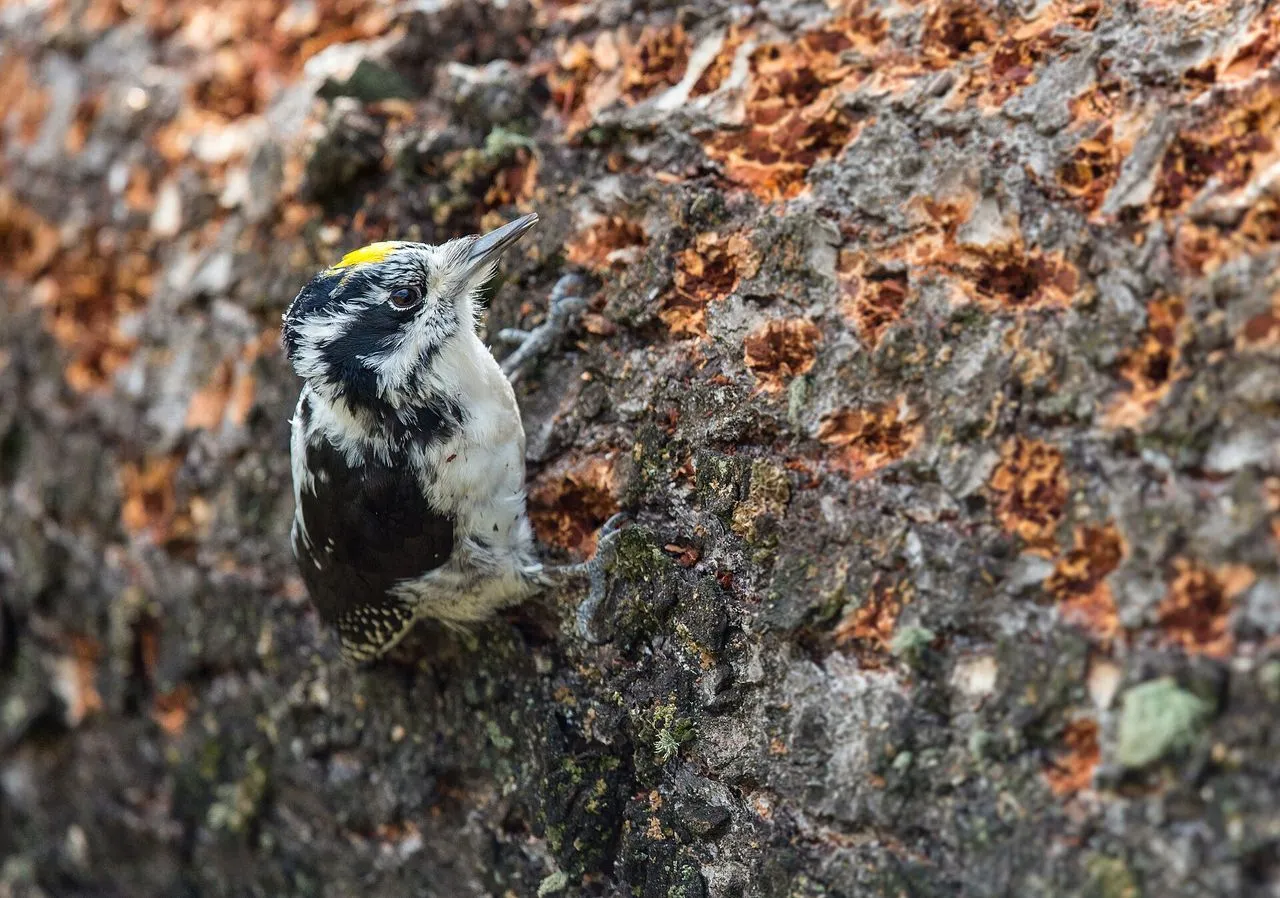
Quick answer: A woodpecker drumming on your gutter is advertising territory and attracting a mate, not searching for food. The rapid percussion, 15 to 25 strikes per second, is a mechanical communication signal, and metal gutters are chosen because they are louder than any dead branch in the neighbourhood. The bird is not drilling into the metal, and the gutter is not being damaged.
Best first step: Check the calendar. Gutter drumming is almost entirely a late-February through May problem. If it is mid-spring, the drumming will subside on its own within four to eight weeks once the bird forms a pair bond. In most cases no intervention is required.
Avoid: Attempting to remove or relocate the bird. All native woodpeckers are protected under the Migratory Bird Treaty Act. Removing one territorial individual does not solve the problem: the vacant territory is claimed by another bird within days.
A woodpecker hammering on your gutter at six in the morning is not a maintenance problem. It is a communication problem, and understanding the distinction is the first step toward a useful response.
Quick answer: The drumming is territorial advertisement, not foraging. Your gutter has been selected because it is the loudest resonating surface in the bird's territory, and that is exactly the point. The gutter is not being damaged.
Best first step: Check the calendar. If it is late February through May, the drumming will stop on its own within four to eight weeks once the bird establishes a pair bond. No intervention is required in most cases.
Avoid: Attempting to remove or relocate the bird. All native woodpeckers are protected under the Migratory Bird Treaty Act. Removing one territorial individual does not resolve the problem: another bird will claim the same territory, and the same gutter, within days.
Why Woodpeckers Drum
Drumming in the woodpecker family (Picidae) is a mechanical communication signal, the percussive equivalent of birdsong. The bird strikes a resonant surface rapidly and repeatedly to produce a loud roll that carries across the neighbourhood, advertising occupancy of a territory and signalling readiness to mate. The sound is produced by bill contact alone; the syrinx, the avian vocal apparatus, is not involved.
This is categorically different from the irregular, purposeful knocking of a bird that is excavating a nest cavity or foraging for wood-boring beetle larvae beneath bark. A drumming woodpecker produces a metronomic roll with a defined start and stop, returns to the same surface, and repeats it at intervals of seconds to minutes. A foraging woodpecker pauses, repositions, and works systematically across a surface in a searching pattern. The distinction is audible once you know what to listen for: drumming sounds like a snare roll; excavation sounds like deliberate knocking with variable pauses.
Both sexes drum, though males drum more frequently during the establishment phase. The Complete Woodpeckers Guide covers the full mechanics of drumming behaviour and the structural anatomy, particularly the hyoid apparatus, that allows woodpeckers to strike at up to 25 times per second without neurological damage.
Why Your Gutter?
A woodpecker does not choose a metal gutter because it smells of food or resembles suitable nesting material. It chooses it because metal is louder than any dead branch in the neighbourhood.
The function of the drum roll is to be heard, and to be heard as far away as possible. A signal that carries 300 metres through suburban vegetation is more effective than one that carries 100 metres from a hollow branch. Metal gutters, downspouts, chimney caps, satellite dishes, and aluminium flashing all amplify the percussion signal far beyond what a dead branch can produce. From the bird's perspective, this is not a problem to be managed. It is an advantage to be exploited.
The Northern Flicker has a particularly well-documented relationship with metal architectural elements. Its own species page notes directly: "Metal chimney caps, roof vents, and siding can amplify the territorial signal far beyond a dead branch. The bird is not searching for food in metal. It is exploiting resonance." The same principle applies to every woodpecker species that selects a gutter as a drumming post.
A bird that has found an excellent drumming substrate will return to it day after day, and may return to the same spot in subsequent breeding seasons.
Is the Gutter Being Damaged?
This is the question that most concerns homeowners, and the reassuring answer is: almost certainly not.
Drumming is bill contact against a hard surface. The bird is not attempting to penetrate the metal, and it has no mechanism for doing so against aluminium or galvanised steel. Connecticut DEEP's wildlife guidance states that drumming on metal surfaces "rarely results in any significant damage." University of Wisconsin Wildlife Damage Management confirms that aluminium gutters and siding are "seldom damaged" by woodpecker drumming activity. You may see minor surface marks or scuffs at a heavily used spot after a full season of daily contact, but the structural integrity of standard gutters is unaffected.
This is entirely different from the excavation behaviour that damages wooden siding, fascia boards, and eaves. When a woodpecker excavates wood, it is either creating a cavity roost or foraging for insect larvae beneath the surface. That is a slow, targeted process aimed specifically at soft or compromised wood with prey activity beneath it. Drumming on metal has no such goal. The bird wants acoustic output, not access.
If your concern is woodpeckers causing excavation damage to wooden elements of the building, that is a different problem with different causes and a different set of solutions. The two behaviours should not be conflated.
When Does It Happen?
Gutter drumming follows the breeding calendar closely. In temperate North America, drumming activity begins in late February as day length increases and males begin establishing territories. It peaks in March and April, and drops sharply once pair bonds are established and incubation begins, typically by late April to mid-May. Most homeowners find the problem resolves within four to eight weeks of its onset, without any intervention.
Dawn is by far the most active time. Woodpeckers, like most songbirds, are most percussively active in the first hour after sunrise. Highly motivated males may return to a preferred drumming substrate multiple times across the morning during peak season, and some individuals drum throughout the day in the earliest weeks of territory establishment.
If drumming continues past mid-May without signs of decreasing, it is worth considering whether a second territorial bird has moved in after the original one paired, or whether you have a late breeding attempt. In most cases, however, the calendar resolves the problem on its own timeline.
Which Species Is Drumming?
The drum roll is one of the most reliable ways to identify the species without seeing the bird. Cadence, duration, and the character of the roll differ meaningfully between species. Stark et al. (1998), publishing in The Condor, confirmed through quantitative analysis that cadence is the primary variable distinguishing woodpecker species in the field.
| Species | Roll duration | Strikes / sec | Cadence | Season peak |
|---|---|---|---|---|
| Northern Flicker | 1.0-1.5 sec | ~25 | Even, sustained roll | March-April |
| Hairy Woodpecker | ~1.0 sec | ~26 | Fast, abrupt stop | Feb-April |
| Downy Woodpecker | ~0.8 sec | ~17 | Softer, shorter | Feb-April |
| Red-bellied Woodpecker | ~1.0 sec | ~19 | Irregular bursts | March-May |
| Pileated Woodpecker | 2.0-3.0 sec | ~15 | Slow, deep, may decelerate | Feb-April |
Northern Flicker is the species most likely responsible for gutter drumming in most of North America. It drums at approximately 25 strikes per second with an even, sustained roll lasting one to one and a half seconds. The Flicker's habit of selecting metal architectural surfaces is well established in the ornithological literature and in homeowner reports across the continent. Look for a large brown woodpecker with a white rump patch visible in flight and a distinctive black crescent across the upper breast.
Hairy Woodpecker is the second most common candidate. Its drum cadence is virtually identical to the Flicker at approximately 26 strikes per second, but the roll ends more abruptly and the overall sound is harder and more penetrating. The Hairy Woodpecker is a black-and-white species whose bill approaches the full depth of its own head, the key field mark separating it from the smaller Downy.
Downy Woodpecker drums more softly and at a slower rate, around 17 strikes per second, with a shorter roll. It is capable of using metal substrates but is less likely to persist on a gutter than either Flicker or Hairy. If the drumming is noticeably quieter and ends quickly, Downy is worth considering.
Pileated Woodpecker produces an unmistakable slow, deep roll, more tympani than snare, lasting two to three seconds with an even cadence that may decelerate slightly toward its end. If the sound is less like a machine-gun burst and more like a rolling crack from a large hollow trunk, a Pileated Woodpecker is a possibility, particularly in wooded suburban areas with mature trees and significant dead wood.
Red-bellied Woodpecker tends toward irregular, stuttering bursts rather than a clean sustained roll. More common in the eastern half of North America, it may use metal surfaces opportunistically.
Legal Protection
All native North American woodpeckers are protected under the Migratory Bird Treaty Act of 1918 (MBTA). It is a federal offence to kill, capture, harm, or disturb a woodpecker, or to destroy an active nest, without a depredation permit issued by the US Fish and Wildlife Service. Visual deterrents, exclusion measures, and physical modification of the drumming substrate are all legal without a permit.
More practically: lethal control of a territorial drumming woodpecker does not solve the underlying problem. The territory remains after the bird is gone, and so does the resonant gutter. Research on woodpecker territorial dynamics confirms that high-quality territories, those with good food resources and drumming substrates, are reoccupied quickly when vacancies arise. Removing the individual bird does not remove the territory, the substrate, or the sequence of drumming activity that will continue with the next occupant.
Effort spent on deterrents and substrate modification addresses the actual mechanism. Effort spent trying to remove the bird does not.
What You Can Do
Wait it out
The simplest and most effective response to seasonal drumming is patience. If it is March or April, the behaviour will stop. Four to eight weeks is the typical duration from onset to natural cessation. Before investing in deterrents that require weekly maintenance, consider whether the calendar will solve the problem first.
Dampen the substrate
The bird chose your gutter because it is loud. Reduce its resonance and the bird may shift to a more productive surface elsewhere.
- Foam pipe insulation, the split-tube type, wrapped around the gutter section where the bird drums. Available at any hardware store, inexpensive, reversible, and effective for the season.
- Vibration-dampening tape applied to the gutter face.
- A cloth or folded towel secured over the contact point temporarily.
All of these are non-harmful. Remove them after mid-May when the breeding season ends.
Offer an alternative drumming post
Some individuals will shift their drumming to a purpose-built substitute. A hollow log mounted on a pole in the garden, positioned where the bird has a clear sightline across its territory, can attract a Flicker or Hairy away from the gutter. Success varies by individual, but the cost is low and a hollow log also adds cavity habitat value for the wider garden. For more on creating woodpecker-friendly garden habitat, see the Complete Attracting Guide.
Visual deterrents
Reflective Mylar streamers, holographic tape, or hawk silhouettes that move in wind can discourage a bird from approaching a preferred surface. The honest assessment is modest success: some individuals are deterred, others habituate within a few days. Rotating the position of deterrents weekly maintains novelty and improves effectiveness. These work best as a short-term measure during the peak four to six weeks of activity, not as a permanent solution.
Do not use sticky repellent gels on any surface the bird contacts. They cause feather damage and can immobilise small birds, which constitutes harm under the MBTA.
A Note on Perspective
A woodpecker choosing your gutter as a drumming post is, in one sense, evidence of a healthy local bird population. The bird has a territory, has located the most resonant surface available, and is proceeding through the normal rituals of its breeding season. The noise is temporary. The structural damage is essentially zero. The behaviour, once understood, is considerably more interesting than it is threatening.
The gutter drumming will stop. In most cases it stops without intervention. In the meantime, foam pipe insulation and a clear calendar are the most cost-effective tools available.
See Also
- The Complete Woodpeckers Guide: full reference on drumming mechanics, drum cadence by species, suet feeder selection, and woodpecker biology.
- Northern Flicker: identification, ecology, and habits of the species most often responsible for gutter drumming.
- Hairy Woodpecker: field identification and drumming pattern for the second most common gutter drummer.
- Downy Woodpecker: the smallest and softest drummer; how to distinguish it from the Hairy Woodpecker.
- Pileated Woodpecker: identification and habits of the slow, deep roller; what to do if one is active near the house.
- The Complete Attracting Guide: garden habitat management including snag retention, native planting, and water sources that benefit cavity-nesting species year-round.
Frequently Asked Questions
Is the woodpecker actually damaging my gutter?
Almost certainly not. Drumming is bill contact against a resonant surface, not excavation. The bird is not attempting to break through the metal. Connecticut DEEP wildlife guidance confirms that drumming on metal surfaces rarely results in any significant damage. University of Wisconsin Wildlife Damage Management notes that aluminium siding and gutters are seldom damaged by drumming. You may see minor surface marks at a well-used spot after a full season, but the structural integrity of standard aluminium or galvanised gutters is unaffected.
What species is most likely drumming on my gutter?
The Northern Flicker (Colaptes auratus) is the most commonly reported species at metal architectural substrates. It drums at approximately 25 strikes per second with an even, sustained roll of one to one and a half seconds. Hairy Woodpeckers are also frequent at metal surfaces, with a drum cadence of approximately 26 strikes per second. Downy Woodpeckers are possible but less persistent on gutters. If the sound is a slow, deep roll lasting two to three seconds, a Pileated Woodpecker may be the culprit.
Will the drumming stop on its own?
Yes. Drumming is a seasonal behaviour tied directly to the breeding cycle. Activity peaks in late February through April across most of temperate North America and drops sharply once a pair bond is established and incubation begins. Most homeowners find that persistent gutter drumming resolves within four to eight weeks without any intervention.
Can I legally remove the woodpecker?
Not without a federal depredation permit issued by the US Fish and Wildlife Service under the Migratory Bird Treaty Act. All native North American woodpeckers are protected. Harassment, visual deterrents, and exclusion measures are legal without a permit. Lethal control is not, and is in any case counterproductive: a vacant territory is occupied by another bird quickly.
What is the difference between drumming and the pecking that damages wood siding?
Drumming is rapid and metronomic, with 15 to 25 strikes per second and a defined start and stop. The bird returns to the same resonant spot and repeats the roll at intervals of seconds to minutes. Damage-causing pecking is slower and exploratory: the bird is excavating a cavity or foraging for larvae in wood. Drumming sounds like a snare roll; excavation sounds like deliberate knocking with pauses between strikes.
Sources & References
- Stark, R.D., Dodenhoff, D.J., & Johnson, E.V. (1998). "A quantitative analysis of woodpecker drumming." The Condor, 100(2), 350-356
- Cornell Lab of Ornithology, All About Birds: Northern Flicker
- Connecticut Department of Energy and Environmental Protection: Problems with Woodpeckers
- University of Wisconsin, Wildlife Damage Management: Woodpeckers
- US Fish and Wildlife Service, Migratory Bird Depredation Permit (Form 3-200-13)