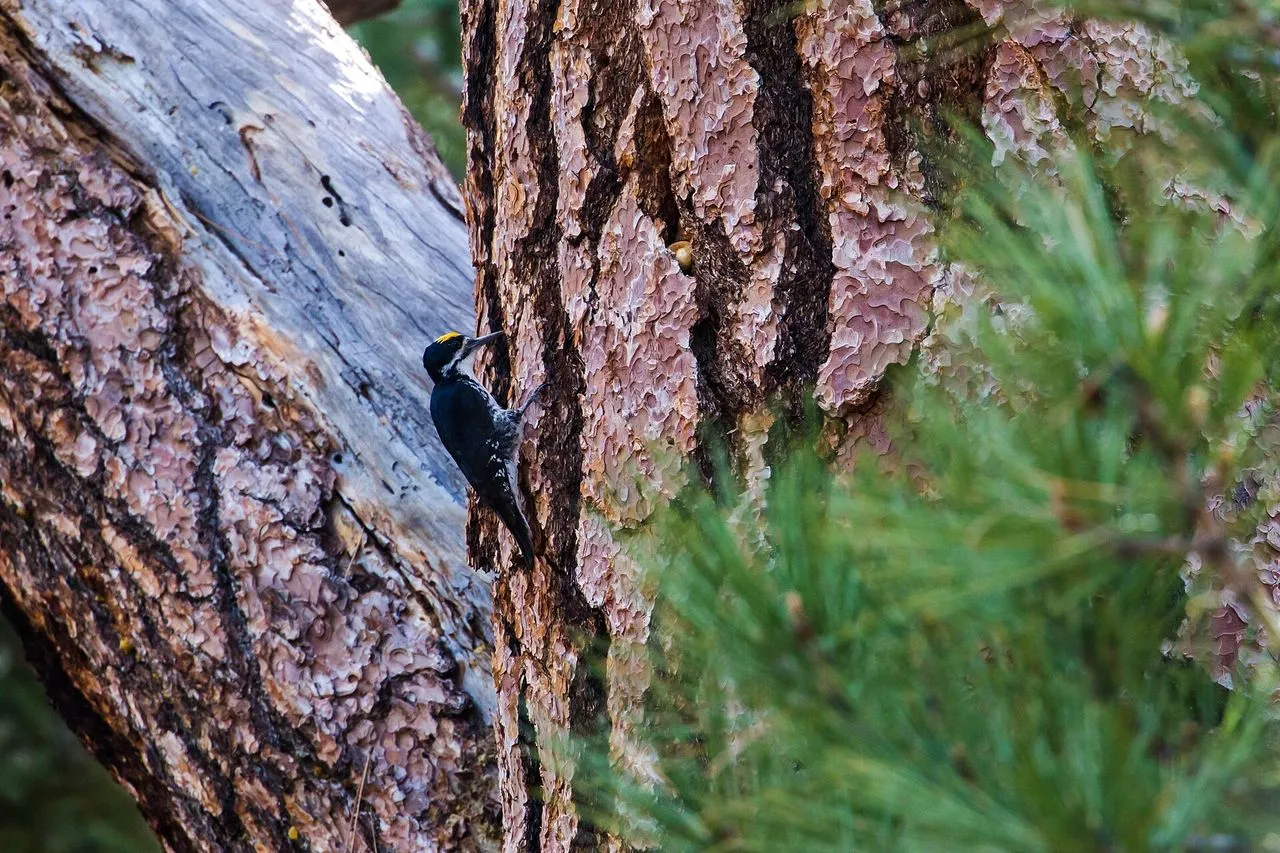
Picoides arcticus (Swainson, 1832), the Black-backed Woodpecker, is the North American burned-forest specialist most closely tied to post-fire beetle outbreaks. Its drum is a short, even roll, often around 15–20 strikes per second, but its strongest field association is ecological: recently burned conifer forest with standing dead trees and abundant wood-boring beetle larvae.
Part of the Complete Woodpeckers Guide.
Identification at a glance
| Character | Black-backed (P. arcticus) | American Three-toed (P. dorsalis) |
|---|---|---|
| Body length | About 23 cm (9.1 in) | 21–23 cm (8.3–9.1 in) |
| Body mass | 60–90 g (2.1–3.2 oz) | 45–70 g (1.6–2.5 oz) |
| Back pattern | Solid black | Barred or laddered black and white |
| Male crown | Yellow patch | Yellow patch |
| Strongest habitat cue | Recently burned conifer forest | Boreal or montane spruce-fir forest |
Identification
Visual
Black-backed Woodpeckers are medium-sized, about 23 cm long and 60–90 g, with a solid black back, barred flanks, white underparts, and a mostly dark head marked by a pale line behind the eye. Adult males show a yellow crown patch; females lack it. The back is the decisive mark. American Three-toed Woodpecker has a barred black-and-white back, while Black-backed is nearly unmarked above, an adaptation that makes it difficult to see against charred trunks.
The species has three toes rather than the four-toed zygodactyl arrangement typical of many woodpeckers: two forward and one back, with the first digit absent. This does not usually help at field distance, but it matters mechanically. Three-toed woodpeckers deliver strong blows and spend long periods flaking bark from dead conifers.
Drumming is quieter than Pileated and less rapid than Hairy, usually a compact roll from a dead stem. The bird is often detected by bark scaling sounds: deliberate flakes pried from fire-killed trees.
Audio
Calls include sharp pik or kyik notes, generally less conspicuous than the calls of Hairy or Red-bellied Woodpeckers. In good burned habitat, silence does not imply absence. A bird may work one side of a blackened trunk for several minutes with only soft tapping and bark-flaking noise.
Distribution
The Black-backed Woodpecker occurs across boreal North America from Alaska and Canada into the northern United States, with additional populations in western mountain conifer forests. It is resident but locally nomadic, shifting in response to fire, beetle outbreaks, and dead-wood availability. After severe burns, numbers may increase rapidly within one to three years, then decline as beetle larvae are depleted and snags decay or fall.
Habitat
Prime habitat is recently burned conifer forest, especially within about eight years after fire, though local suitability depends on burn severity, tree species, and beetle colonisation. The species also uses unburned spruce, fir, pine, and tamarack forests affected by bark beetles, windthrow, disease, or flooding. What matters is standing dead conifer wood with larvae beneath loosening bark.
Salvage logging is a direct habitat issue. Removing fire-killed trees may remove the exact substrate that produces the post-fire woodpecker pulse. A blackened forest can be biologically active even when it looks destroyed.
Diet and Foraging
Wood-boring beetle larvae, especially longhorn beetles and bark beetles, dominate the diet in burned stands. The bird flakes bark with sideways blows, exposing larval galleries, then extracts larvae with the tongue. Foraging sign appears as large patches of bark removed from dead conifers, often with pale exposed wood beneath. It also takes ants, spiders, and other arthropods.
Black-backed Woodpeckers spend much of the day on trunks rather than small branches. Their movements are quiet and methodical. The cryptic black back against charred bark makes them easy to miss until the head turns or the barred flanks show.
Breeding Biology
Nest cavities are excavated in dead conifers, burned snags, or softened live trees with decay, often 1–6 m above ground but sometimes higher. Excavation usually takes one to three weeks. Entrance diameter is roughly 4–5 cm, with cavity depth around 20–30 cm. Clutches commonly contain three to four eggs. Incubation lasts about 12–14 days, shared by both adults, and young fledge after roughly 24–27 days. One brood is typical.
Pairs may settle quickly in burned areas when prey is abundant. Territories can be smaller in high-quality burns because food density is high. As the post-fire pulse fades, birds disperse to newer disturbances.
Notes
The Black-backed Woodpecker is a useful test of how one reads a forest. If burned timber is treated only as loss, the bird becomes an inconvenience. If fire is recognised as a recurrent ecological process, the species is exactly where it should be: on black trunks, harvesting beetle larvae from trees that are dead but not biologically finished.
Field surveys should account for the narrow post-disturbance window. A stand may be poor in the first weeks after fire, excellent once beetles colonise and larvae develop, then gradually decline as bark loosens, prey emergence passes, and snags fall. Occupancy therefore says as much about time since disturbance as about geography. Burn severity also matters: patches with many standing killed conifers are more useful than low-severity burns that leave little dead wood or salvage-treated areas where the stems have been removed.
Because the black dorsal plumage works so well against charred bark, observers should scan for movement across pale exposed wood, listen for bark flakes falling, and check the lower to middle trunk rather than only treetops.
Nest placement often reflects the same post-fire logic. A pair may choose a moderately softened burned snag rather than the hardest fresh kill, because excavation must be possible within the breeding schedule. The surrounding stand still needs enough recently dead trees to supply larvae. A single remaining snag in a cleared burn is therefore poor compensation for an intact burned patch. The bird uses a stand-level resource, not an isolated perch.
See Also
Frequently Asked Questions
How do I identify a Black-backed Woodpecker?
The solid black back is the decisive mark - American Three-toed has a barred back. Also look for barred flanks, white underparts, pale line behind the eye, and yellow crown in adult males. The black plumage makes them nearly invisible against charred tree trunks.
Why is the Black-backed Woodpecker associated with fires?
They are specialists in recently burned conifer forest where wood-boring beetle larvae pulse after fire. They arrive within 1-3 years after fire when beetle populations peak, then decline as prey diminishes and snags decay. This makes them a classic post-disturbance species.
Do Black-backed Woodpeckers migrate?
They are resident but locally nomadic, shifting in response to fire, beetle outbreaks, and dead-wood availability. After severe burns, numbers may increase rapidly, then decline as the post-fire food pulse fades.
What threats affect Black-backed Woodpeckers?
Salvage logging is the main threat - removing fire-killed trees eliminates the exact substrate (standing dead conifers with beetle larvae) they need. They require standing dead trees for 5-8 years post-fire to complete their ecological cycle.
Sources & References
- Ehrlich, P.R., Dobkin, D.S. & Wheye, D. (1988). The Birders Handbook. Simon & Schuster.
- Cornell Lab of Ornithology. (2024). All About Birds: Black-backed Woodpecker. birds.cornell.edu
- Sibley, D.A. (2014). The Sibley Guide to Birds (2nd ed.). Knopf.
- Winkler, H., Christie, D.A. & Nurney, D. (1995). Woodpeckers: A Guide to the Woodpeckers of the World. Houghton Mifflin.