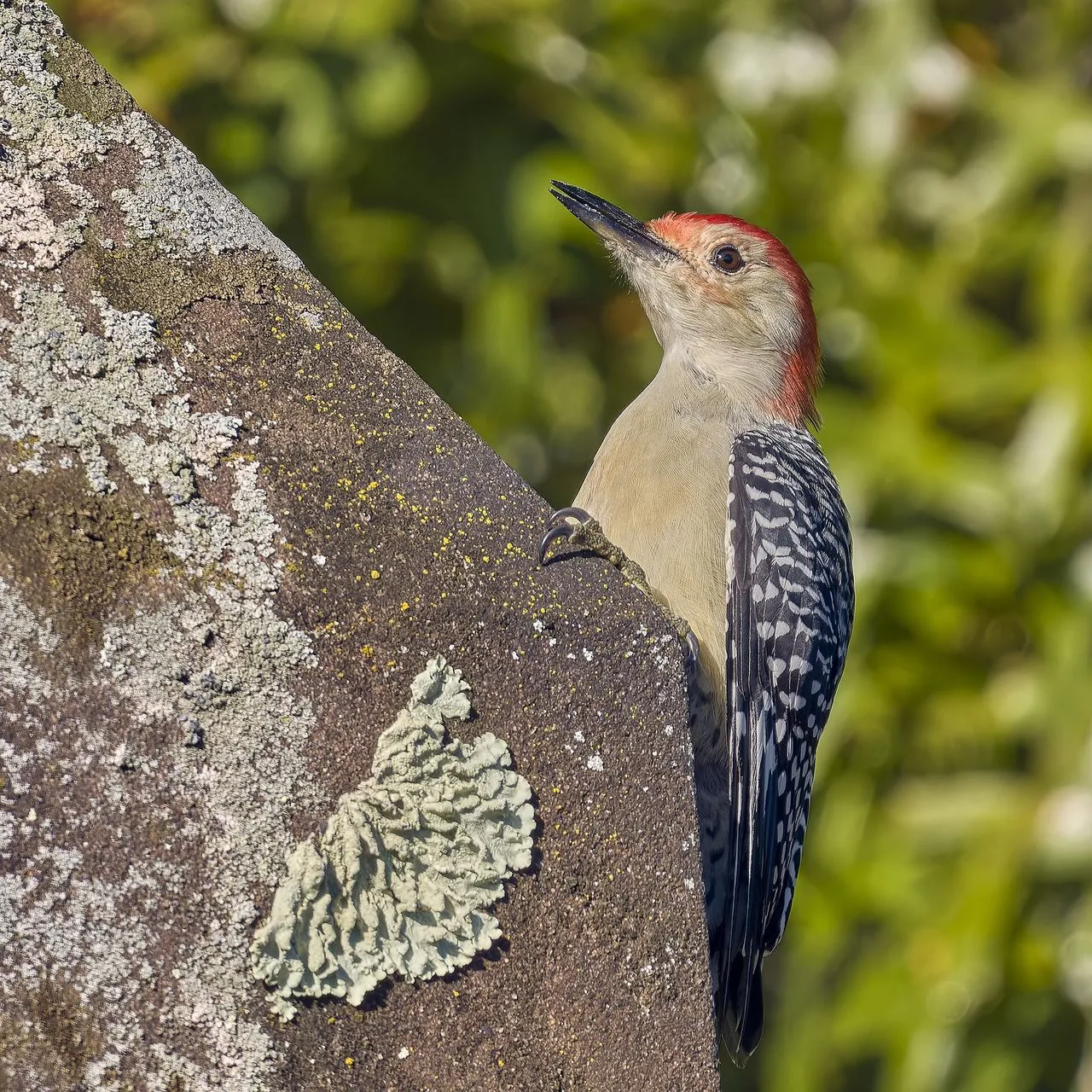
Melanerpes carolinus (Linnaeus, 1758), the Red-bellied Woodpecker, is badly named from a field perspective: the red wash on the belly is faint, often invisible, while the barred back and red crown or nape are conspicuous. It drums at about 19 strikes per second in a compact roll near one second long, but many birds are detected first by the loud rolling churr that carries through eastern deciduous woodland.
Part of the Complete Woodpeckers Guide.
Identification at a glance
| Character | Red-bellied (M. carolinus) | Red-headed (M. erythrocephalus) |
|---|---|---|
| Body length | 23–27 cm (9.1–10.6 in) | 21–25 cm (8.3–9.8 in) |
| Body mass | 55–90 g (1.9–3.2 oz) | Not the primary field cue |
| Head pattern | Pale face, red crown or nape | Entire head and throat red in adults |
| Back pattern | Tight black-and-white barring | Black back with large white wing panels |
| Call | Rolling churr or kwirr | Harsher tchur or queer |
Identification
Visual
This is a medium-sized woodpecker, 23–27 cm long and roughly 55–90 g, with a pale face, pale underparts, and a back barred tightly in black and white. The bill is long, greyish, and slightly down-curved compared with the straighter chisel shape of Hairy Woodpecker. Adult males show red from the bill base across the crown to the nape. Adult females show red on the nape and sometimes above the bill, but the crown centre remains grey. Juveniles are duller, with reduced or absent red and a browner cast to the head.
The belly mark is a pale peach to reddish wash low on the abdomen. It is real, but usually hidden by posture, shade, or feathers. Field identification should not depend on seeing it. A perched Red-bellied shows a strong black-and-white zebra back, pale grey face, and red head pattern quite unlike the clean crimson full head of a Red-headed Woodpecker. In flight, white patches in the wings and rump flash, though the pattern is less blocky than Red-headed.
Drumming is regular, moderately fast, and less explosive than Hairy. It has enough weight to be heard across a garden but lacks the prolonged, heavy resonance of Pileated.
Audio
The voice is often the best clue. The common kwirr or churr is a rolling, nasal call, descending slightly and repeated frequently from tree crowns. Short chuck notes are also common. During territorial disputes, paired birds may call persistently from opposite sides of a trunk or from adjacent trees, and the sound can make one bird seem like several.
Distribution
The Red-bellied Woodpecker is resident across the eastern and central United States, from the Great Plains eastward and from the Gulf Coast north into the Great Lakes, southern Ontario, and parts of New England. Its northern range has expanded markedly during the twentieth and twenty-first centuries, aided by maturing woodland, winter feeding, and a warming climate. Vagrants occur west of the usual range, but the species remains fundamentally an eastern deciduous-forest bird.
Habitat
It uses mature deciduous woodland, wooded suburbs, riparian corridors, orchards, parks, and swamp forest. Large oaks, hickories, maples, sycamores, cottonwoods, and dead limbs provide feeding and nesting substrates. Compared with Hairy Woodpecker, it is more comfortable in open residential landscapes if large trees are present. Compared with Downy, it demands more vertical structure and larger trees, but it is now a standard backyard species in much of the eastern United States.
Diet and Foraging
The diet is broad: beetles, ants, caterpillars, grasshoppers, spiders, acorns, beechnuts, fruits, berries, corn, sunflower seed, peanuts, and suet. Red-bellied Woodpeckers store food by wedging nuts or insects into bark cracks. They forage on trunks and limbs, but also glean from branches, probe bark, fly out for insects, and visit feeders with confidence. At suet cages they often dominate Downy Woodpeckers and nuthatches by size rather than aggression alone.
They are useful birds to watch because the genus Melanerpes is behaviourally flexible. A Red-bellied may hang under a limb like a typical picid, sidle along a branch like a nuthatch, or launch a short flycatching sally from an exposed perch. This versatility helps explain its success in fragmented eastern landscapes.
Breeding Biology
Nest cavities are excavated in dead trunks, dead limbs, or softened wood in living trees, often 2–18 m above ground. Excavation takes roughly one to three weeks. Entrance diameter is about 5 cm, and cavity depth commonly 20–40 cm. The clutch is usually three to five eggs. Incubation lasts about 12 days, shared by both sexes, and the young fledge after 24–27 days. One brood is typical in the north; second broods occur more regularly in the south.
The male often begins several cavities or roost holes, with the pair completing one. Both sexes roost in cavities outside the breeding season, an important winter behaviour in cold regions. Old cavities are used by chickadees, titmice, nuthatches, wrens, and small mammals.
Notes
The common misidentification is with Red-headed Woodpecker. A Red-headed adult has an entirely crimson head, a clean white belly, a black back, and large white wing panels. A Red-bellied has a pale face, barred back, and red limited to crown and nape. Juvenile Red-bellieds are the trap: dull-headed birds with partial red can seem anomalous, but the barred back remains decisive.
At feeders, this species often announces itself before arrival. A loud churr from the canopy, a pause, a bounding flight to a trunk, and then a sidle down toward suet is typical behaviour. The bird is misnamed, not obscure.
One practical point for garden records is seasonality. In late winter the species becomes noisier and more visible as pairs reinforce territories, and males may drum from dead limbs, gutters, or utility poles before visiting feeders. In midsummer, adults often bring juveniles to suet or peanut feeders; young birds show dull heads and can look oddly unfinished, but their barred backs and pale faces identify them. A record should note age and sex when visible, because apparent local increases in autumn are often family groups rather than new migrants.
See Also
Frequently Asked Questions
How do I identify a Red-bellied Woodpecker?
Look for the barred black-and-white zebra back, pale grey face, and red on the crown/nape (males have red across crown; females only on nape). The faint red belly wash is rarely visible. Compare with Red-headed Woodpecker which has an entirely red head and black back.
Why is it called Red-bellied if the belly is hard to see?
The species name comes from a pale peach to reddish wash on the lower belly, which is real but usually hidden by the bird's posture, feathers, or shading. The name is anatomically accurate but field invisible.
Are Red-bellied Woodpeckers expanding their range?
Yes, their northern range has expanded markedly during the 20th and 21st centuries, aided by maturing woodland, winter feeding stations, and a warming climate. They are now common backyard birds across much of the eastern United States.
What do Red-bellied Woodpeckers eat at feeders?
They are regular feeder visitors, taking suet, peanuts, sunflower seeds, and fruits. They often dominate smaller woodpeckers and nuthatches by size. They also forage on trunks and branches for beetles, ants, caterpillars, and other insects.
Sources & References
- Ehrlich, P.R., Dobkin, D.S. & Wheye, D. (1988). The Birders Handbook. Simon & Schuster.
- Cornell Lab of Ornithology. (2024). All About Birds: Red-bellied Woodpecker. birds.cornell.edu
- Sibley, D.A. (2014). The Sibley Guide to Birds (2nd ed.). Knopf.
- Winkler, H., Christie, D.A. & Nurney, D. (1995). Woodpeckers: A Guide to the Woodpeckers of the World. Houghton Mifflin.